Feature Review
Optimization of Perennial Cultivation Models and Continuous Production Management Strategies for Paeonia lactiflora 

 Author Correspondence author
Medicinal Plant Research, 2026, Vol. 16, No. 5 doi: 10.5376/mpr.2026.16.0025
Received: 18 Aug., 2026 Accepted: 29 Sep., 2026 Published: 26 Oct., 2026
Liu C.C., 2026, Optimization of perennial cultivation models and continuous production management strategies for Paeonia lactiflora, Medicinal Plant Research, 16(5): 388-400 (doi: 10.5376/mpr.2026.16.0025)
Paeonia lactiflora Pall. is an important perennial medicinal and ornamental plant. However, its industrial development is constrained by a long propagation cycle, continuous cropping obstacles, limited ecological adaptability, and insufficient standardization of production management. This review systematically synthesizes the growth characteristics, cultivation models, and key management technologies of perennial P. lactiflora, and explores strategies for optimizing continuous production systems. The reviewed literature indicates that traditional open-field cultivation has advantages of strong adaptability and low production costs but is vulnerable to environmental fluctuations and soil-related problems. Large-scale standardized cultivation improves production stability through tissue culture, elite seedling propagation, and precision management, whereas ecological and green cultivation enhances quality improvement through soil health maintenance, rhizosphere microbiome regulation, and biological control. Future production should focus on establishing a collaborative optimization model integrating cultivar selection, environmental adaptation, and cultivation management, while developing continuous production systems covering seedling propagation, soil regulation, growth-stage management, and post-harvest processing. Furthermore, the integration of digital agricultural technologies will promote precision and intelligent management, providing technical support for the sustainable development of the P. lactiflora industry.
1 Introduction
Paeonia lactiflora Pall., a perennial herbaceous species in the family Paeoniaceae, has been used medicinally for over two millennia, with its processed root products-Paeoniae Radix Alba and Paeoniae Radix Rubra-occupying a central role in traditional Chinese medicine (Cai et al., 2026). The species is also globally renowned as an ornamental, cherished for its large, colorful, and fragrant flowers, and is widely cultivated as a landscape, potted, and cut-flower plant across European, North American, and Asian countries (Li et al., 2023). Over 200 bioactive compounds have been identified from P. lactiflora, including monoterpene glycosides, flavonoids, and polysaccharides, with paeoniflorin as the principal pharmacologically active constituent underpinning its anti-inflammatory, antioxidant, hepatoprotective, and neuroprotective effects. Given its dual medicinal and ornamental value, P. lactiflora serves as both an agricultural cash crop and a traditional famous flower, and market demand for high-quality seedlings and cut flowers has increased considerably in recent years.
In Japan alone, annual peony root consumption reached approximately 1,712 tons in fiscal year 2020, with roughly 98% of supply imported from China, underscoring strong international demand. China possesses rich germplasm resources across five main producing areas-Anhui, Zhejiang, Sichuan, Shandong, and Hunan-where 12 medicinal cultivars have been documented, including eight monopetalous red-flower types. Since 1900, over 2,200 new horticultural Paeonia cultivars have been created worldwide through the discovery and breeding of wild species, reflecting rapid industrialization (Yang et al., 2020).
However, the species is naturally distributed in temperate regions (hardiness Zones 3-7), and expanding cultivation into lower-latitude subtropical and tropical zones remains a significant horticultural objective constrained by hot-humid climates (Zhang et al., 2019a). Climate modeling projects a 25%-45% expansion of total suitable habitat under future warming scenarios, accompanied by a northeastward centroid shift, suggesting both opportunities in emerging northern regions and risks of degradation in traditional production areas. As a high-value crop with temperature-dependent growth, P. lactiflora requires worldwide production to satisfy year-round demand, motivating the development of perennial cultivation systems that can sustain productivity across diverse environments (Lewis et al., 2023).
Despite its economic importance, perennial cultivation of P. lactiflora faces multiple interconnected challenges. The species exhibits a characteristic double dormancy of both the hypocotyl and epicotyl, requiring a two-phase stratification-warm conditions for radicle elongation followed by cold conditions for shoot growth-that spans a prolonged winter period, resulting in an extended propagation cycle and low seedling emergence rates (Mu et al., 2026). Traditional seed reproduction entails a long cycle with a low reproduction coefficient, and plants grown from seed require four to five years before normal flowering, and their offspring may not retain the maternal cultivar’s traits. Division propagation, the predominant method, is similarly constrained by a long cultivation period and low propagation rate, requiring more than three years from rhizomes and more than six years from seeds, making it difficult to propagate large numbers of plants within a short period (Yamamoto et al., 2025). A particularly severe problem is the replanting disease that occurs when ramet seedlings are planted at the original site: growth and flowering rates decline, quality deteriorates, and pests and diseases aggravate, eventually resulting in plant mortality (Li et al., 2023). Long-term replanting reduces soil pH, nutrient contents, enzyme activities, and the diversity and richness of fungal and bacterial communities, while increasing the relative abundance of harmful microorganisms such as Gibberella and reducing beneficial genera such as Bacillus (Li et al., 2023). This soil microecological imbalance damages normal growth and restricts the sustainable development of the industry. Additionally, insufficient chilling accumulation in warm-winter climates, exacerbated by global warming, severely hinders bud dormancy release and flowering, limiting cultivation at low latitudes (Wang et al., 2020). High temperatures and humidity in subtropical regions impede the "Southward Planting of Herbaceous Peony," and the lack of an efficient and stable regeneration system further restricts rapid propagation and large-scale production. Production planning for perennial crops also presents logistical challenges, as large variations in yield and demand across multiple growth cycles can lead to costly shortages or excess in seed stock (Van Der Kruk et al., 2024).
Given these multifaceted challenges, optimizing perennial cultivation models and continuous production management strategies for P. lactiflora is essential for sustaining industry growth. Recent advances offer promising directions. Tissue culture systems have been developed for efficient regeneration, with optimized media achieving germination rates up to 91.11% and shoot induction rates of 96.67%, providing a foundation for rapid propagation and germplasm conservation. Bio-nursery systems using diurnal temperature treatments and elevated calcium concentrations during root induction have improved acclimation success, contributing to a more stable seedling supply. For season extension, high-tunnel production has advanced initial harvest by 21~34 days compared with natural field conditions, and staggered planting across high-tunnel and field environments extended harvest duration up to 38 days. Multi-criteria decision-making models incorporating adaptability, ornamental features, and growth habits have been established to screen elite cultivars for low-latitude cultivation, identifying 'Hang Baishao' and 'Meiju' as strongly adaptive germplasms. The Utah model has been validated as optimal for evaluating chilling requirements, enabling cultivar selection tailored to specific climatic conditions. Wild-like cultivation environments have demonstrated that paeoniflorin content and product traits increase year by year, offering an alternative production approach. Optimal harvest timing-late September of the fourth growing year-and shade drying have been identified as the most suitable post-harvest strategy for maximizing bioactive compound yield. Integrated production-inventory planning using model predictive control has been proposed for perennial crop seeds, balancing inventory levels and anticipating future deliveries to reduce both shortages and surpluses. This article synthesizes these advances to provide a comprehensive framework for optimizing perennial cultivation models and continuous production management, aiming to address the propagation bottlenecks, soil health deterioration, climatic constraints, and logistical challenges that currently limit the sustainable development of the P. lactiflora industry.
2 Growth Characteristics and Cultivation Basis of Perennial Paeonia lactiflora
2.1 Growth and development patterns and stage characteristics of perennial Paeonia lactiflora
Paeonia lactiflora is a perennial geophyte with a clear annual cycle built around overwintering bud dormancy, spring sprouting, vegetative and reproductive growth, summer senescence, and renewed underground persistence. Long-running observations in low-latitude introductions show that annual growth cycle traits, dormancy duration, and resistance performance differ substantially among cultivars, which makes stage-based cultivar evaluation essential for perennial production planning (Wang et al., 2022). In the low-chilling cultivar ‘Meiju’, sprouting can exceed 50% in March, leaves unfold 1~2 weeks later, and aboveground parts usually wither by early August, illustrating a compressed aboveground season followed by underground dormancy. Reproductively, mature clumps can support annual cut-flower harvest after establishment, and healthy plants may remain productive for about 10 years under suitable management (Li et al., 2023).
The earliest developmental bottleneck occurs at seed germination because P. lactiflora seeds exhibit double dormancy of the hypocotyl and epicotyl. Dormancy release requires warm stratification first to promote radicle growth, followed by cold stratification to trigger epicotyl elongation and seedling emergence, and this prolonged sequence lengthens the propagation cycle and lowers field emergence. Physiological evidence indicates that the warm phase mainly drives root growth, whereas the cold phase intensifies reserve degradation, hydrolytic enzyme activity, and hormonal rebalancing needed for shoot emergence; in transcriptome-metabolome profiling, the 28-day warm-stratification stage was the key transition period (Mu et al., 2026). Because conventional propagation from rhizomes or seeds is slow, in vitro embryo culture and rooted shoot systems now provide a practical basis for compressing early developmental stages and stabilizing seedling supply (Xin et al., 2025; Zhu et al., 2026).
2.2 Root development and formation characteristics of medicinal quality in Paeonia lactiflora
As a perennial root medicinal crop, the underground organ of P. lactiflora is both the main harvested product and the principal site of bioactive compound accumulation, so root development directly determines yield and medicinal quality (Guo et al., 2026). Reviews of its phytochemistry show that more than 200 compounds have been identified, including terpenoids, flavonoids, polyphenols, and organic acids, with paeoniflorin recognized as the major indicator compound and a major focus of quality evaluation. Root secondary metabolism is not autonomous: metabolomic and microbiome studies show that root metabolite accumulation is closely linked to rhizosphere microbial communities, and varietal comparisons further indicate that differences in paeoniflorin, total phenols, flavonoids, and antioxidant capacity track biological variation among germplasms (Wu et al., 2025). Environmental-response analysis similarly found that root secondary metabolites are jointly shaped by soil water content, mean annual precipitation, pH, and specific biotic factors such as Alternaria, indicating that medicinal quality is an outcome of genotype-environment-microbiome interaction rather than age alone (Sun et al., 2022).
Root medicinal quality also changes markedly with plant age, harvest season, and post-harvest processing (Guo et al., 2026). Across cultivation studies, active components tend to reach comparatively high levels in 4-year-old roots, while further extension to older ages yields limited chemical gain and greater structural or pathological risk; 5-year-old plants often show more disease, and 6-year-old roots can become hollow and lignified, which lowers medicinal quality. In the Tongliao study, comprehensive evaluation ranked late September of the fourth growing year as the optimal harvest period, and paeoniflorin content was positively correlated with root dry weight. Wild-like cultivation work further showed that root traits and paeoniflorin content increased year by year under simulated natural conditions, suggesting that ecological cultivation patterns can improve medicinal attributes when matched to developmental timing.
2.3 Ecological requirements and cultivation conditions for optimal growth of Paeonia lactiflora
The optimal growth of P. lactiflora depends on a temperate ecological niche characterized by cool winters, moderate thermal seasonality, adequate summer moisture, and sufficient light, which explains why the species is concentrated in temperate regions and is difficult to maintain in hot, humid low latitudes (Cai et al., 2026). Distribution modeling identified precipitation of the warmest quarter, mean temperature of the coldest quarter, temperature seasonality, and November solar radiation as the dominant environmental drivers, highlighting that active-season water supply and an appropriate winter cold period are both indispensable. Low-latitude cultivation is constrained because hot-humid spring weather can induce stem bending, bud abortion, and severe disease, extreme summer heat can hasten withering, and warm autumn-winter conditions can leave chilling requirements unmet (Wang et al., 2022). This pattern is consistent across observational, physiological, and modeling studies showing that winter warmth is a major barrier to southward expansion (Wang et al., 2020).
Cultivation practice therefore needs to align site selection, cultivar choice, chilling management, and soil regulation with the species’ perennial biology. Chilling studies show that lower temperatures and longer durations improve sprouting and flowering, with 0℃ for 6 weeks or 5℃ for 9 weeks sufficient to break dormancy in Korean cultivars, while low-CR cultivars such as ‘Hang Baishao’ and ‘Meiju’ are better suited to warm-winter regions (Rhie et al., 2012). Practical regulation can also be effective: chilling at 0-4℃ for four weeks plus humic-acid irrigation improved forcing performance in ‘Hang Baishao’, and high-tunnel cultivation advanced harvest by 21-34 days, although excessive heating and humidity reduced quality and increased pest and disease pressure (Zhang et al., 2019b). Belowground management is equally important because long-term replanting lowers pH, nutrients, enzyme activities, and microbial diversity while increasing harmful taxa, whereas rhizosphere studies indicate that cation exchange capacity, soil water, and cooperative microbial networks are closely tied to growth and metabolite accumulation (Sun et al., 2022).
3 Cultivation Models and Application Characteristics of Perennial Paeonia lactiflora
3.1 Traditional open-field perennial cultivation model and production characteristics
The traditional open-field perennial cultivation model remains the basic production form for medicinal and ornamental P. lactiflora because the crop is widely grown in temperate regions and performs as a cool-season, field-based perennial with strong dependence on local seasonal temperature patterns (Qi et al., 2020). In this model, establishment is slow: medicinal production generally requires more than three years from rhizomes and more than six years from seed, and conventional seed propagation also suffers from long cycles, season-dependent germination, and delayed flowering after 4~5 years (Yamamoto et al., 2025). Seed-based open-field expansion is further constrained by double dormancy, because radicle growth requires warm stratification and shoot emergence then requires cold stratification, which prolongs winter propagation and lowers emergence. Even so, open-field cultivation remains attractive because it is simple, broadly adaptable in temperate zones, and can support multiple product types including medicinal roots, cut flowers, and even seed oil production, although fertility traits vary markedly among genotypes (Sun et al., 2022).
Its production characteristics are defined by strong environmental exposure and by tradeoffs among yield, flower timing, and medicinal quality. In field production of ‘Coral Charm’, natural field systems yielded about 16.1-20.8 stems/m², and combining field with protected production extended harvest duration up to 38 days, showing the value of open-field plots for staggered supply. Open-field cultivation can also outperform forcing systems in yield: in ‘Taebaek’, greenhouse forcing shortened time from sprouting to flowering by about 26 days, but yield was lower than under open-field cultivation and early forcing increased susceptibility to powdery mildew and gray mold (Bae et al., 2008). For medicinal roots, open-field management strongly affects both biomass and chemistry: late September of the fourth year produced the best combined yield-quality score in Inner Mongolia, and root dry weight declined with later harvest dates (Guo et al., 2026). Field weed and tillage regimes also matter, because inter-tillage substantially reduced weed biomass, while grass management tended to increase paeoniflorin content and sometimes yield, indicating that conventional open-field systems involve a real balance between cleaner fields and stress-linked quality formation (Seki et al., 2021).
3.2 Large-scale standardized cultivation model and technical advantages
Large-scale standardized cultivation models are designed to overcome the main bottlenecks of perennial P. lactiflora production: slow multiplication, unstable seedling supply, and inconsistent field performance. The strongest technical basis for this model is tissue culture. Mature embryo systems achieved germination rates up to 91.11%, direct seedling formation up to 67.78%, multiple-shoot induction of 96.67%, shoot proliferation coefficients of 3.48, and rooting rates of 73.33%, showing that standardized in vitro protocols can sharply compress the early propagation phase (Xin et al., 2025). Complementary regeneration studies show that tissue culture is not only useful for multiplication but also for germplasm conservation, cultivar improvement, and later genetic engineering (Duan et al., 2022). Standardization also now extends to rooting and acclimation: embryo-derived shoots rooted best after 7 days of darkness followed by 28 days of light, and modified half-strength medium with double calcium, putrescine, indole-3-butyric acid, and coumarin produced 75% rooting with 8.3 roots per shoot.
The technical advantage of this model is that it converts a long, variable perennial crop into a more controllable production chain spanning propagation, nursery management, protected cultivation, and harvest standardization. In a bio-nursery system, a 15/5℃ day-night regime increased shoot proliferation relative to constant 15℃, 6 mmol/L calcium during root induction improved post-transplant vigor, and acclimation was suitable in a closed greenhouse at 20℃ after cold treatment, all of which support stable commercial seedling supply. Standardized protected production can also regulate market timing: high tunnels advanced initial harvest by 21~34 days while maintaining 15.7~19.4 stems/m², although extra soil heating under low tunnels reduced quality under excessive temperature and humidity. Standardization is also supported by harvest-year optimization, because both chemical profiling and bioactivity testing indicate that a 4-year growth period is sufficient for desired root quality, avoiding unnecessary extension of the production cycle (Jin et al., 2026).
3.3 Ecological and green cultivation model and development potential
Ecological and green cultivation models focus less on maximal input intensity and more on matching perennial biology with soil health, rhizosphere function, and environmentally safer disease control. This direction is well supported because P. lactiflora root secondary metabolism is closely linked to rhizosphere microorganisms, and current evidence shows that root metabolites respond jointly to abiotic conditions such as soil water, precipitation, and pH and to biotic factors such as Alternaria (Wu et al., 2025). Rhizosphere studies further show that the rhizosphere contains enriched carbohydrates and organic acids, more complex and stable microbial co-occurrence networks, and more cooperative microbial relationships than bulk soil, making it a practical target for ecological regulation. In ornamental cultivars, pH and alkaline phosphatase significantly affected rhizosphere bacterial communities, while some cultivars enriched more stress-tolerant growth-promoting bacteria, indicating that green cultivation can combine soil management with cultivar choice (Zu et al., 2022). More broadly, rhizosphere engineering research supports two complementary routes for sustainable agriculture: precise agronomic management of environment-dominated microbiomes and breeding for plant genetic-dominated microbiome assembly (Mahmud et al., 2021; Xun et al., 2024).
Its development potential is especially strong because ecological practices can improve both sustainability and product quality while reducing chemical dependence. In medicinal peony fields, grass management increased paeoniflorin content relative to inter-tillage, suggesting that moderated competition and less intensive soil disturbance can sometimes favor medicinal quality even when weed pressure rises (Seki et al., 2021). Disease management can also shift toward biological control: Bacillus subtilis SY8 suppressed four major fungal pathogens, reduced black spot incidence, increased defense-related enzyme activities, and restructured microbial communities toward greater bacterial diversity and fewer pathogenic fungi. Varietal evidence likewise suggests that long-domesticated local lines can maintain stable phenotypes for decades and differ in paeoniflorin, phenolics, flavonoids, and antioxidant capacity, which creates room for ecological model selection around both adaptation and quality (Wu et al., 2025). The ecological green model appears best suited for the next stage of perennial P. lactiflora development because it integrates quality formation, soil-microbiome management, and biological disease suppression into a lower-input cultivation framework while retaining clear commercial potential.
4 Key Management Technologies for Continuous Perennial Production of Paeonia lactiflora
4.1 Elite germplasm selection and standardized seedling propagation technology
Elite germplasm selection for continuous perennial production should prioritize regional adaptability, especially chilling requirement, heat-humidity tolerance, flowering stability, and division-propagation potential. In low-latitude evaluation systems, ‘Meiju’, ‘Hang Baishao’, ‘Hongpan Tuojin’, and ‘Bo Baishao’ consistently ranked as top-performing materials, with ‘Hang Baishao’ standing out as a local low-chilling germplasm with strong warm-winter adaptation and long cultivation history in subtropical China. Regional mismatch matters: cultivars can perform very differently across sites, so large-scale introduction should follow local multi-criteria evaluation rather than name-based transfer, and traits such as bud number, flowering earliness, upright stem habit, and cross-breeding value can all be used as practical screening indices for commercial deployment and breeding parent choice (Zhang et al., 2019a).
Standardized seedling propagation is needed because conventional breeding and division are slowed by double seed dormancy, long juvenile periods, and low multiplication efficiency (Mu et al., 2026). Mature-embryo and zygotic-embryo tissue culture now provide workable large-scale routes: optimized media achieved 91.11% embryo germination, 67.78% direct seedling formation, 96.67% multiple-shoot induction, 3.48 shoot proliferation, and 73.33% rooting, while an improved rooting system using 7 days dark plus 28 days light, doubled calcium, IBA, putrescine, coumarin, and porous perlite-vermiculite substrate raised rooting to 75% with 8.3 roots per shoot. For low-chilling ‘Hang Baishao’, embryo culture on half-strength MS with 6-BA, GA3, and PVP was effective, and transplant survival depended strongly on vascular bundle development; bio-nursery work further showed that 15/5℃ diurnal culture, 6 mmol/L calcium during rooting, and 20 ℃ acclimation after cold treatment improved post-transplant vigor and seedling supply stability (Figure 1) (Xin et al., 2025).
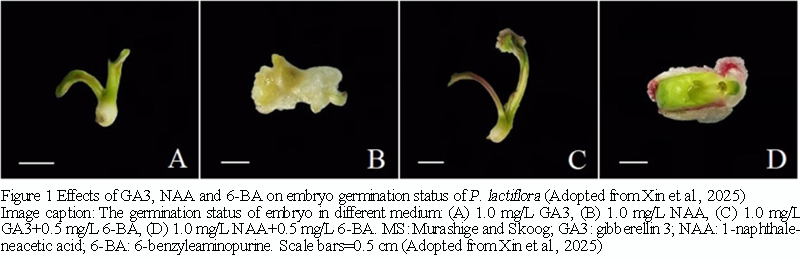 Figure 1 Effects of GA3, NAA and 6-BA on embryo germination status of P. lactiflora (Adopted from Xin et al., 2025) Image caption: The germination status of embryo in different medium: (A) 1.0 mg/L GA3, (B) 1.0 mg/L NAA, (C) 1.0 mg/L GA3+0.5 mg/L 6-BA, (D) 1.0 mg/L NAA+0.5 mg/L 6-BA. MS: Murashige and Skoog; GA3: gibberellin 3; NAA: 1-naphthaleneacetic acid; 6-BA: 6-benzyleaminopurine. Scale bars=0.5 cm (Adopted from Xin et al., 2025) |
4.2 Soil quality maintenance and control technologies for continuous cropping obstacles
Soil quality maintenance in continuous perennial P. lactiflora production should focus on preventing replanting obstacles rather than assuming all long-term cultivation is equally harmful. In peony, replanting at original sites reduced growth and flowering, worsened quality, increased pests and diseases, and eventually caused plant death, while sequencing studies showed that five years of replanting lowered pH, available nutrients, enzyme activities, and bacterial and fungal diversity, and increased harmful microorganisms such as Gibberella while reducing beneficial Bacillus (Li et al., 2023). Root-soil studies refine that picture: seven years of continuous planting did not produce obvious adverse soil factors, but four years of replanting shifted soil from a bacterial high-fertility state to a fungal low-fertility state, decreased pH, organic matter, nutrients, enzymes, and bacterial abundance, and increased benzoic acid, which is a plausible autotoxin contributor.
Control technologies therefore need to combine soil improvement, microbial regulation, and system-level cropping design. Broader medicinal-plant reviews agree that continuous-cropping obstacles are mainly driven by altered microbial communities, nutrient imbalance, and allelopathic effects, and that effective mitigation includes soil amendments, crop rotation, intercropping, and management aimed at rebuilding beneficial microbiota and soil fertility (Haq et al., 2023; Liao and Xia, 2024). This systems view also matters because not all continuous-cropping systems develop obstacles; some can enrich beneficial microorganisms and become disease-suppressive, so management should target microbial food-web structure and plant-soil-organism interactions instead of treating years of continuous cultivation alone as the decisive risk factor. For P. lactiflora, that implies practical use of organic matter enhancement, pH and nutrient correction, avoidance of repeated hole replanting, and introduction of beneficial microbes such as Bacillus, which are biologically aligned with the mechanisms identified in replant soils (Xie et al., 2023).
4.3 Growth-stage precision management and quality improvement technologies
Growth-stage precision management should match perennial peony’s temperature-dependent developmental stages, from dormancy release and sprouting to flowering, harvest, and post-harvest handling. Bud dormancy release is a major control point in warm-winter regions: high winter temperatures hinder flowering, while ‘Hang Baishao’ succeeds because of its lower chilling requirement, and chilling at 0~4 ℃ for four weeks plus 300 mg/L humic acid improved flowering advancement and quality under forcing conditions (Zhang et al., 2019b). Protected cultivation can then regulate harvest windows: high tunnels advanced first harvest by 21-34 days with yields of 15.7~19.4 stems/m², field plots yielded 16.1~20.8 stems/m², and combining both systems extended harvest duration to 38 days, although low tunnels with soil heating sometimes reduced quality because excessive temperature and humidity damaged buds and increased pest and disease pressure (Lewis et al., 2023).
Quality improvement also depends on stage-specific regulation of plant architecture, harvest age, and post-harvest processing. Paclobutrazol reduced plant height and crown width but increased stem diameter, leaf thickness, chlorophyll, water status, soluble sugar, and antioxidant enzyme activity, and improved flower diameter and fresh weight when applied at the flower-bud stage, although it also reduced anthocyanin content and total aroma compounds under some other application timings. For medicinal root production, the best combined yield-quality outcome was region-specific but clear in Tongliao: 4-year-old plants performed best, late September of the fourth year was the optimal harvest window, shade drying gave the highest quality, and paeoniflorin correlated positively with root dry weight. Wild-like cultivation adds a useful ecological option, because paeoniflorin content and product traits increased year by year under simulated natural conditions, while varietal metabolomics showed that root quality traits such as paeoniflorin, total phenols, flavonoids, and antioxidant capacity differ systematically among cultivars and are linked to rhizosphere microbial composition (Wu et al., 2025).
5 Optimization Strategies for Perennial Cultivation Models of Paeonia lactiflora
5.1 Establishment of a collaborative optimization model integrating cultivar selection, environmental adaptation, and cultivation management
A collaborative optimization model for perennial P. lactiflora should begin with cultivar stratification by adaptation traits, because low-latitude expansion is constrained by warming, humidity, and insufficient winter chilling. Multi-criteria screening identified ‘Meiju’, ‘Hang Baishao’, ‘Hongpan Tuojin’, and ‘Bo Baishao’ as Level I germplasm with strong adaptability and ornamental value under hot-humid conditions (Figure 2) (Wang et al., 2022). Chilling-requirement studies further showed that ‘Hang Baishao’ and ‘Qihua Lushuang’ are representative low-CR cultivars, and the Utah model was the most dependable framework for evaluating cultivar chilling demand across winters. This supports a coordinated introduction pathway in which germplasm is screened first for stress adaptation, then matched to target production zones and management schedules (Wang et al., 2020).
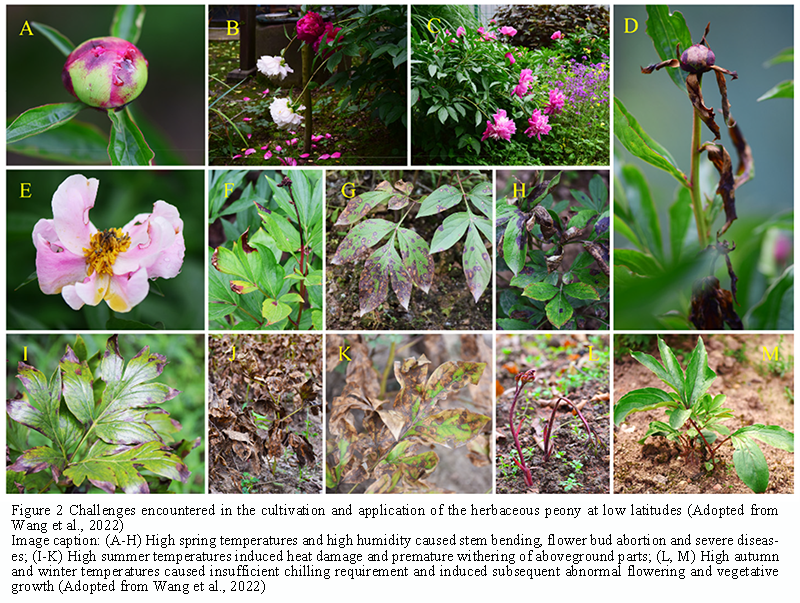 Figure 2 Challenges encountered in the cultivation and application of the herbaceous peony at low latitudes (Adopted from Wang et al., 2022) Image caption: (A-H) High spring temperatures and high humidity caused stem bending, flower bud abortion and severe diseases; (I-K) High summer temperatures induced heat damage and premature withering of aboveground parts; (L, M) High autumn and winter temperatures caused insufficient chilling requirement and induced subsequent abnormal flowering and vegetative growth (Adopted from Wang et al., 2022) |
The second layer of collaboration is linking adaptive cultivars with standardized propagation systems and downstream quality goals. China’s medicinal peony industry already contains rich cultivar resources across five main producing areas and 12 documented medicinal cultivars, which provides a broad germplasm base for differentiated deployment. Because conventional propagation is slow and breeding remains limited by fragmented germplasm knowledge and low efficiency, optimized embryo and tissue-culture systems are critical for rapidly multiplying selected materials (Xin et al., 2025). Mature-embryo culture reached 91.11% germination, 96.67% shoot induction, and 73.33% rooting, while low-chilling ‘Hang Baishao’ also now has a workable embryo-propagation and transplanting protocol. At the breeding end, large fertility differences among genotypes and the need for marker-assisted, trait-directed parent selection argue for using propagation, adaptation testing, and breeding as one continuous optimization chain rather than separate tasks (Qi et al., 2020).
5.2 Development of a green and efficient long-term continuous production system
A green and efficient long-term continuous production system should center on stable seedling supply, lower-input establishment, and rhizosphere-mediated quality regulation. Tissue culture and bio-nursery work directly address the chronic bottleneck of slow multiplication, which is especially important because medicinal peony production takes more than three years from rhizomes and more than six years from seed (Song et al., 2023). In the bio-nursery system, a 15/5℃ diurnal regime increased shoot proliferation, 6 mmol/L calcium improved post-transplant vigor, and 20℃ greenhouse acclimation after cold treatment improved plantlet establishment. Rooting can be further strengthened by 7 days dark plus 28 days light and by a modified half-strength medium with doubled calcium, IBA, putrescine, and coumarin, which produced 75% rooting and 8.3 roots per shoot (Zhu et al., 2026). These propagation advances make green long-cycle production more feasible by reducing loss rates at the nursery stage.
Long-term efficiency also depends on soil ecological stability, because replanting obstacles in P. lactiflora are strongly linked to declining pH, nutrients, enzyme activities, and beneficial microbes, alongside increases in harmful fungi and possible autotoxins such as benzoic acid (Xie et al., 2023). Rhizosphere studies show that root secondary metabolism is closely tied to microbial communities, and cultivar differences in paeoniflorin, phenolics, flavonoids, and antioxidant capacity track microbial differences as well (Wu et al., 2025). Green production should therefore combine organic matter and pH management with microbial optimization, especially because pH and alkaline phosphatase significantly shape rhizosphere communities and some cultivars enrich stress-tolerant growth-promoting bacteria (Zu et al., 2022). Quality-oriented green systems can also incorporate optimized harvest and processing: 4-year roots performed best overall, late September was the best harvest window in Tongliao, shade drying gave the highest quality, and low-temperature storage followed by washing, boiling, and 30℃ machine drying improved main active components in processed roots (Komatsu, 2024).
5.3 Promotion of precision cultivation management through digital agricultural technologies
Digital agricultural technologies can convert perennial peony management from calendar-based practice to data-driven precision cultivation. More broadly, digital agriculture integrates sensors, drones, satellites, and analytics to collect crop, soil, weather, and phytosanitary data and use them for more precise decisions on irrigation, fertilization, and pest control. Remote sensing and UAVs are particularly useful for non-destructive, near real-time monitoring of growth and field heterogeneity, while AI and big-data tools improve pattern detection and operational decision-making (Fuentes-Peñailillo et al., 2024). For perennial P. lactiflora, this framework is well matched to key control points that already show strong environmental sensitivity, including chilling fulfillment, dormancy release, stem emergence, flowering timing, soil moisture, and disease pressure (Wang et al., 2020).
In practice, precision management should prioritize cultivar-specific models that combine climatic suitability, stage regulation, and harvest optimization. Protected-cultivation experiments already show that high tunnels advance initial harvest by 21-34 days, low tunnels with soil heating can further advance harvest, and excessive heat-humidity lowers stem quality and increases disease pressure. Those results are directly translatable into digital control rules, where real-time sensing could regulate tunnel temperature and humidity against cultivar-specific thresholds rather than relying on fixed schedules. Precision systems should also integrate biochemical quality targets, because 4-year roots already match 5-year roots in major active constituents and antidepressant-related bioactivity, making prolonged cultivation unnecessary when monitored quality indices are achieved (Jin et al., 2026). The main limitation is implementation: scalable AI-IoT systems still need better dataset integration, user-friendly interfaces, and adaptation to diverse farm conditions, so digitalization in peony should advance in parallel with standardized field data collection and model validation.
6 Current Research Problems and Future Development Directions
6.1 Insufficient research on perennial cultivation cycles and optimal harvesting strategies
Research on perennial cultivation cycles and optimal harvesting strategies for P. lactiflora is still insufficient because most available studies identify useful local harvest windows but do not yet establish a broadly validated, multi-region production calendar. Recent work in Tongliao compared 3-, 4-, and 5-year-old plants on the same plot and found that 4-year-old plants gave the best combined yield-quality score, with late September outperforming earlier and later harvest dates, but the authors explicitly noted that these results are region-specific rather than universal. Independent chemical-bioactivity integration reached a similar conclusion that 4-year roots were comparable to 5-year roots in key active constituents and antidepressant-related effects, supporting a shorter production cycle, yet this line of evidence is still based on limited cultivation-year contrasts rather than long-term multilocation validation. At the same time, the long juvenile period and double seed dormancy of P. lactiflora continue to slow cycle optimization research itself, because warm-cold stratification, prolonged establishment, and difficult rooting make full-cycle experiments expensive and slow to repeat across environments (Mu et al., 2026).
Future work should therefore move from single-point harvest screening to a full life-cycle optimization framework integrating cultivar, site, developmental stage, and end-use quality. Existing studies already show that flowering, sprouting, and dormancy release are highly climate-sensitive, especially in low-latitude regions where winter warmth disrupts chilling fulfillment and spring-summer heat damages growth. Long-running observation and multi-criteria evaluation have proven useful for comparing cultivar performance across years, and low-chilling materials such as ‘Hang Baishao’, ‘Meiju’, and ‘Qihua Lushuang’ offer a practical basis for region-specific cycle design. Future studies should combine multilocation age-by-harvest experiments with metabolomics, bioactivity assessment, and controlled environment trials so that cultivation years, harvest dates, and post-harvest methods can be optimized for both medicinal roots and ornamental stems rather than inferred from isolated local trials (Sun et al., 2022).
6.2 Incomplete understanding of continuous cropping obstacle mechanisms and green control technologies
The mechanism of continuous-cropping obstacles in P. lactiflora remains incomplete because current evidence clearly identifies soil deterioration and microbial imbalance, but does not yet resolve how autotoxins, root exudates, nutrient shifts, enzyme changes, and pathogen enrichment interact over time in perennial peony systems. In replanted peony, growth and flowering decline progressively, while soil pH, nutrients, enzyme activities, and microbial diversity decrease and harmful genera rise as beneficial taxa such as Bacillus fall (Li et al., 2023). Broader medicinal-plant syntheses point to the same three main drivers-microbial community change, nutrient imbalance, and allelopathic effects-and emphasize that rhizosphere plant-soil-microbe interactions are the core system where obstacles develop (Liao and Xia, 2024). Yet a key complication is that not all continuous cropping systems inevitably deteriorate; some long-term systems can become more suppressive or self-repairing, which means years of continuous planting alone do not explain obstacle formation.
Future development should focus on green control technologies grounded in mechanism rather than blanket soil replacement or chemical intervention. Reviews across medicinal plants support soil amendments, crop rotation, and intercropping as effective directions because they can increase beneficial microorganisms and improve fertility and nutrient availability. In P. lactiflora, rhizosphere studies show that secondary metabolite accumulation is linked to microbial communities and is shaped by soil water, precipitation, pH, and biotic factors such as Alternaria, while microbial networks in the rhizosphere are more complex and cooperative than in bulk soil. This supports future strategies based on microbiome screening, synthetic beneficial communities, and soil ecological regulation, especially since recent long-term monoculture work in another crop showed that suppressive microbiomes can be rebuilt and even mimicked through designed inoculation. For peony, the next step is to connect replant years, root exudate chemistry, microbial food-web structure, and quality outcomes in long-term field experiments so that green prevention targets can be defined precisely rather than descriptively (Liao and Xia, 2024).
6.3 Need for establishment of intelligent production systems and standardized management models for Paeonia lactiflora
There is also a clear need to establish intelligent production systems and standardized management models for P. lactiflora, because current production still depends heavily on local experience, fragmented propagation methods, and inconsistent environmental control. Standardized regeneration systems have advanced rapidly: mature embryo culture achieved high germination, shoot induction, and rooting rates, and optimized rooting protocols improved root architecture and survival of embryo-derived shoots These advances solve part of the seedling bottleneck, but they do not yet constitute a farm-scale standardized management model that links germplasm screening, nursery propagation, field deployment, environmental monitoring, and harvest timing across production regions (Wang et al., 2022). The need is especially urgent because P. lactiflora is temperature-sensitive, and protected cultivation studies show that changes in soil and air temperature can shift harvest timing substantially while also affecting quality and disease pressure.
Future development should therefore promote a digital, standardized perennial management platform that combines cultivar-specific thresholds with real-time sensing and decision support. Precision-agriculture research shows that AI, IoT, remote sensing, and automated systems can collect real-time soil, crop, and environmental data, support irrigation and input decisions, and reduce labor and environmental costs (Rajappa et al., 2025). Integrated smart systems have already reached high predictive accuracy for crop selection and yield forecasting and can save substantial irrigation water through sensor-driven fuzzy control, which indicates that similar architectures are feasible for peony production zones (Saha et al., 2025). The main constraints are dataset integration, scale-up cost, connectivity, and farmer training, so future peony research should pair digital trials with unified phenological indicators, soil-health standards, and operational protocols to build a truly standardized intelligent production model.
7 Conclusions and Perspectives
Optimization of cultivation models is essential for improving the production efficiency of Paeonia lactiflora, as its growth is highly influenced by temperature, winter chilling requirements, and regional climatic conditions. Multi-criteria evaluation studies in low-latitude regions have identified ‘Qihua Lushuang’, ‘Hang Baishao’, ‘Meiju’, ‘Hongpan Tuojin’, and ‘Bo Baishao’ as highly adaptable germplasm resources, highlighting the importance of elite cultivar selection as the foundation for cultivation model optimization. Among them, ‘Hang Baishao’ exhibits strong heat-humidity tolerance and low chilling requirements, making it suitable for warm-winter regions. In addition, the integration of open-field and protected cultivation systems can effectively improve production efficiency by extending harvest periods and regulating flowering time, although precise environmental control remains necessary to maintain quality.
Continuous production management is critical for maintaining stable yield and medicinal quality in perennial P. lactiflora cultivation. Advances in embryo culture and tissue culture have significantly improved propagation efficiency, providing technical support for standardized seedling production. However, sustainable production still requires effective control of replanting obstacles, as long-term cultivation can disrupt soil microbial communities, reduce nutrient availability, and increase harmful microorganisms. Therefore, integrated management involving standardized propagation, soil health maintenance, optimized cultivation duration, and appropriate post-harvest processing is necessary. Regional studies suggest that four-year-old roots and late September harvesting can provide favorable yield-quality performance, while ecological cultivation approaches may further enhance paeoniflorin accumulation and medicinal quality.
Future development of the P. lactiflora industry should focus on green, standardized, and intelligent production systems integrating breeding, propagation, environmental regulation, and digital management. Standardized regeneration technologies, including optimized embryo culture and tissue culture systems, provide a foundation for rapid propagation and germplasm improvement. Meanwhile, the application of AI, IoT, remote sensing, and data-driven decision systems can enable real-time monitoring of environmental conditions, plant growth, irrigation, nutrition, and disease risks. Establishing standardized field datasets and intelligent management platforms will facilitate precision cultivation, improve resource utilization efficiency, and promote the sustainable development of the P. lactiflora industry.
Conflict of Interest Disclosure
The author affirms that this research was conducted without any commercial or financial relationships that could be construed as a potential conflict of interest.
Bae S.G., Kim J.H., Park S.J., and Kim J.C., 2008, Influence of Forcing Cultivation Time on Cut Flower, Root Quality, and Yield in Peony (Paeonia lactiflora Pall. cv. Taebaek), Korean Journal of Medicinal Crop Science, 16(6): 421-426.
Cai J., Wang S., Fan Z., Han R., and Tong X., 2026, Global potential distribution of Paeonia lactiflora and its climate-driven shifts: insights from an enhanced MaxEnt model integrating soil and solar radiation variables, Frontiers in Plant Science, 17: 1756429.
https://doi.org/10.3389/fpls.2026.1756429
Duan S.Y., Xin R.Y., Guan S., Li X., Fei R., Cheng W., Pan Q., and Sun X., 2022, Optimization of callus induction and proliferation of Paeonia lactiflora Pall. and Agrobacterium-mediated genetic transformation, Frontiers in Plant Science, 13: 996690.
https://doi.org/10.3389/fpls.2022.996690
Fuentes-Peñailillo F., Gutter K., Vega R., and Carrasco Silva G., 2024, Transformative Technologies in Digital Agriculture: Leveraging Internet of Things, Remote Sensing, and Artificial Intelligence for Smart Crop Management, Journal of Sensor and Actuator Networks, 13(4): 39.
https://doi.org/10.3390/jsan13040039
Guo D., Zhuang D., Jia J., Guo Y., Li Z., Sun D., and Yu X., 2026, Screening of optimal harvesting period and drying methods for Paeoniae Radix Rubra based on eight bioactive compounds and biomass, Frontiers in Nutrition, 13: 1774758.
https://doi.org/10.3389/fnut.2026.1774758
Haq M.Z.U., Yu J., Yao G., Yang H., Iqbal H.A., Tahir H., Cui H., Liu Y., and Wu Y.G., 2023, A Systematic Review on the Continuous Cropping Obstacles and Control Strategies in Medicinal Plants, International Journal of Molecular Sciences, 24(15): 12470.
https://doi.org/10.3390/ijms241512470
Jin Z., He H., Zhang L.P., Yu M., and Zou Z., 2026, Integrating Ultra-High-Performance Liquid Chromatography-Photodiode Array Detector Coupled to Quadrupole Time-of-Flight Mass Spectrometry, Network Pharmacology, and Antidepressant Effects to Determine the Optimal Cultivation Years for Paeonia lactiflora Roots, Journal of Separation Science, 49(4): e70408.
https://doi.org/10.1002/jssc.70408
Komatsu K., 2024, Comprehensive study on genetic and chemical diversity of Asian medicinal plants, aimed at sustainable use and standardization of traditional crude drugs, Journal of Natural Medicines, 78(2): 267-284.
https://doi.org/10.1007/s11418-023-01770-2
Lewis M., Stock M., Black B., Drost D., and Dai X., 2023, Field Production Methods for Season Extension of Peony ‘Coral Charm’, HortScience, 58(4): 389-394.
https://doi.org/10.21273/hortsci16942-22
Li Y., Liu Z., Yang L., Yang X., Shi Y., Li X., Dong L., Zheng C., Zhang D., and Sun X., 2023, Analysis of Changes in Herbaceous Peony Growth and Soil Microbial Diversity in Different Growing and Replanting Years Based on High-Throughput Sequencing, Horticulturae, 9(2): 220.
https://doi.org/10.3390/horticulturae9020220
Liao J. and Xia P., 2024, Continuous cropping obstacles of medicinal plants: Focus on the plant-soil-microbe interaction system in the rhizosphere. Scientia, Scientia Horticulturae, 328: 112927.
https://doi.org/10.1016/j.scienta.2024.112927
Mahmud K., Missaoui A., Lee K., Ghimire B., Presley H., and Makaju S., 2021, Rhizosphere microbiome manipulation for sustainable crop production, Current Plant Biology, 27: 100210.
https://doi.org/10.1016/j.cpb.2021.100210
Mu Y., Cao K., Lu J.Y., Wang J., Li X., and Zhang X., 2026, Molecular mechanisms of seed dormancy release in Paeonia lactiflora revealed through transcriptomic and metabolomic analysis, BMC Plant Biology, 26: 702.
https://doi.org/10.1186/s12870-025-07636-x
Qi Q., Li Y., Xing G., Guo J., and Guo X., 2020, Fertility variation among Paeonia lactiflora genotypes and fatty acid composition of seed oil, Industrial Crops and Products, 152: 112540.
https://doi.org/10.1016/j.indcrop.2020.112540
Rajappa S.R., Lakshmi R.P., and Pavithra S., 2025, AI and IoT-Driven Crop Management System for Precision Agriculture and Optimized Resource Utilization, 2025 International Conference on Data Science, Agents and Artificial Intelligence (ICDSAAI): 163-168.
https://doi.org/10.1109/icdsaai65575.2025.11011584
Rhie Y., Jung H., and Kim K.S., 2012, Chilling requirement for breaking dormancy and flowering in Paeonia lactiflora ‘Taebaek’ and ‘Mulsurae’, Horticulture, Environment, and Biotechnology, 53(4): 277-282.
https://doi.org/10.1007/s13580-012-0002-x
Saha G., Shahrin F., Khan F.H., Meshkat M.M., and Azad A.A.M., 2025, Smart IoT-driven precision agriculture: Land mapping, crop prediction, and irrigation system, PLOS ONE, 20(3): e0319268.
https://doi.org/10.1371/journal.pone.0319268
Seki H., Hasegawa M., and Komatsuzaki M., 2021, Effect of Intertillage in the Medical Peony Cultivation and Grass Managements on Paeoniflorin Content and Yield, Japanese Journal of Farm Work Research, 56(3): 189-196.
https://doi.org/10.4035/jsfwr.56.189
Song W., Song Y., Liu X., Zhang X., Xin R.-Y., Duan S.-Y., Guan S., and Sun X., 2023, Improvement of Culture Conditions and Plant Growth Regulators for In Vitro Callus Induction and Plant Regeneration in Paeonia lactiflora Pall, Plants, 12(23): 3968.
https://doi.org/10.3390/plants12233968
Sun X., Zhang X., Zhang G., Miao Y.-J., Zeng T., Zhang M., Zhang H., Zhang L., and Huang L., 2022, Environmental Response to Root Secondary Metabolite Accumulation in Paeonia lactiflora: Insights from Rhizosphere Metabolism and Root-Associated Microbial Communities, Microbiology Spectrum, 10(6): e02800-22.
https://doi.org/10.1128/spectrum.02800-22
Van Der Kruk R., Van De Molengraft R., Bruyninckx H., and Van Henten E.V., 2024, Control of Production-Inventory systems of perennial crop seeds, Journal of Process Control, 144: 103330.
https://doi.org/10.1016/j.jprocont.2024.103330
Wang X., Li D., Zhang D., Shi X., Wu Y., Qi Z., Ding H., Zhu K., Xia Y., and Zhang J., 2020, Improving crucial details and selecting the optimal model for evaluating the chilling requirement of Paeonia lactiflora Pall. at low latitudes during four winters. Scientia, Scientia Horticulturae, 265: 109175.
https://doi.org/10.1016/j.scienta.2020.109175
Wang X., Zhang R., Zhang K., Shao L., Xu T., Shi X., Li D., Zhang J., and Xia Y., 2022, Development of a Multi-Criteria Decision-Making Approach for Evaluating the Comprehensive Application of Herbaceous Peony at Low Latitudes, International Journal of Molecular Sciences, 23(22): 14342.
https://doi.org/10.3390/ijms232214342
Wu S., Tian B., Shan C., Wang X., Xie X., Xie H., Jia X., Zhang F., and Han J., 2025, Integrated physiological, microbial, and metabolomics analyses revealed the differences in different varieties of Paeonia lactiflora Pall, Frontiers in Plant Science, 16: 1577695.
https://doi.org/10.3389/fpls.2025.1577695
Wu Y., Liu J., Zhao D., and Tao J., 2022, Effect of Paclobutrazol Application on Plant Growth and Flower Quality in Herbaceous Peony, Phyton-International Journal of Experimental Botany, 91(9): 2017-2032.
https://doi.org/10.32604/phyton.2022.020643
Xie A., Sun L., Zhang D., Li Y., Liu Z., Li X., and Sun X., 2023, Changes in the root system of the herbaceous peony and soil properties under different years of continuous planting and replanting, Horticultural Plant Journal, 9(4): 801-810.
https://doi.org/10.1016/j.hpj.2021.12.006
Xin R.-Y., Song Y., Zhang X.-Z., Kang X., Zhou X., Song W., Guan S., and Sun X., 2025, Optimization strategy for establishing an efficient mature embryo reproduction system of Paeonia lactiflora Pall. Scientia, Scientia Horticulturae, 340: 113952.
https://doi.org/10.1016/j.scienta.2025.113952
Xun W., Liu Y., Ma A., Yan H., Miao Y., Shao J., Zhang N., Xu Z., Shen Q., and Zhang R., 2024, Dissection of rhizosphere microbiome and exploiting strategies for sustainable agriculture, New Phytologist, 242(6): 2401-2410.
https://doi.org/10.1111/nph.19697
Yamamoto K., Inui T., Kawano N., Tamura T., Sakurai M., Jinbou T., Komatsu K., and Yoshimatsu K., 2025, Improvement of culture and acclimation conditions in a bio-nursery system for Paeonia lactiflora, Plant Biotechnology, 42(2): 179-183.
https://doi.org/10.5511/plantbiotechnology.25.0120a
Zhang R., Wang X., Shao L., Shen K., Liu Z., Chen X., Xia Y., Zhang J., and Li D., 2024a, Feasible strategies for efficient propagation system of Paeonia lactiflora ‘Hang Baishao’: In vitro culture of embryos, Scientia Horticulturae, 326: 112726.
https://doi.org/10.1016/j.scienta.2023.112726
Zhang Z.Y., Chu S.S., and Peng H.-S., 2024b, Cultivation history and cultivars of medicinal Paeonia lactiflora in China [in Chinese], China Journal of Chinese Materia Medica, 49(22): 6241-6248.
https://doi.org/10.19540/j.cnki.cjcmm.20240813.103
Zhu G., Cui Y., Wang M., Guo C., Song H., Da Silva J.T.A., and Yu X., 2026, Establishment of an Efficient Rooting System for Paeonia lactiflora Shoots Derived from Tissue-Cultured Zygotic Embryos: Effects of Indole-3-Butyric Acid, Coumarin, and Light, New Zealand Journal of Crop and Horticultural Science, 54(2): e70178.
https://doi.org/10.1002/nzc2.70178
Zu M., Gebhardt B., Yuan Y., Zuo J., Sun L., and Tao J., 2022, Microbiota associated with the rhizosphere of Paeonia lactiflora Pall. (ornamental cultivar), Applied Soil Ecology, 169: 104214.
https://doi.org/10.1016/j.apsoil.2021.104214


. PDF(822KB)
. FPDF(win)
. FPDF(mac)
. HTML
. Online fPDF
Associated material
. Readers' comments
Other articles by authors
. Chuchu Liu

Related articles
. Paeonia lactiflora
. Perennial cultivation
. Continuous production management
. Continuous cropping obstacles
. Precision cultivation
Tools
. Email to a friend
. Post a comment