Research Insight
Optimization of Primary Processing and Commercial Grade Classification System for Polygonatum 

2 Zhejiang Agronomist College, Hangzhou 310021, Zhejiang, China
 Author Correspondence author
Medicinal Plant Research, 2026, Vol. 16, No. 5 doi: 10.5376/mpr.2026.16.0024
Received: 08 Aug., 2026 Accepted: 20 Sep., 2026 Published: 17 Oct., 2026
Ma J.K., 2026, Optimization of primary processing and commercial grade classification system for Polygonatum, Medicinal Plant Research, 16(5): 372-387 (doi: 10.5376/mpr.2026.16.0024)
Polygonatum is an important medicinal and edible resource, and its commercial quality is influenced by multiple factors, including botanical origin, production environment, cultivation years, harvest time, and primary processing methods. To improve the stability of primary processing quality and the scientific basis of commercial specification grading, this paper systematically analyzes the raw material basis of Polygonatum quality formation, as well as the effects of key processing steps, including cleaning and sorting, steaming or boiling, drying, shaping, and storage, on rhizome morphology, color, texture, and internal chemical composition. Existing studies indicate that different botanical sources and raw material specifications show marked morphological and chemical variation, while repeated steaming and drying can continuously alter polysaccharides, fructans, saponins, and other constituents; excessive processing may result in the loss of certain bioactive components. Traditional commercial grading mainly relies on external characteristics such as size, integrity, color, and origin, but it remains limited by insufficient quantification, inconsistent standards among production areas, and incomplete correspondence between appearance grade and internal quality. Accordingly, this paper proposes a multi-indicator commercial grading system based on botanical origin and raw material specifications, integrating external traits, processing quality, moisture content, internal quality indicators such as polysaccharides and saponins, and rapid detection technologies. The proposed system follows a hierarchical framework of “basic qualification–external specification–processing quality–internal quality” and can be further standardized through graded processing, control of key processing parameters, batch documentation, and quality traceability. This framework may provide a reference for standardizing the primary processing of Polygonatum, stabilizing commercial quality, promoting classified utilization, and improving market circulation standards.
1 Introduction
Polygonatum is an important medicinal-and-edible resource whose rhizomes have been used for more than two millennia in China and other parts of Asia, and the genus is broadly distributed across the temperate Northern Hemisphere (Shu et al., 2026). Current official medicinal materials are mainly derived from the dried rhizomes of Polygonatum cyrtonema, P. sibiricum, and P. kingianum, which are recognized in the Chinese Pharmacopoeia as major botanical sources of Polygonati Rhizoma (Liao et al., 2023). As a homologous food and medicine resource, Polygonatum is rich in polysaccharides, saponins, flavonoids, amino acids, fructans, and other nutritional or functional constituents, which support reported activities such as hypoglycemic, hypolipidemic, antioxidant, immunomodulatory, anti-fatigue, and anti-aging effects (Xiao et al., 2024). In addition to medicinal use, its rhizomes have historically served as a famine-relief food and are now developed into wines, teas, beverages, yogurt, powders, biscuits, snacks, and other functional products, reflecting a strong commodity production basis and expanding industrial value (Cheng et al., 2026). Recent agronomic and germplasm studies further show that Polygonatum resources exhibit substantial variation in yield, morphology, and chemical composition across species, provenances, cultivation environments, and growth years, which creates both opportunities for quality-oriented production and challenges for standardization.
From the perspective of commodity production, the resource endowment of Polygonatum is accompanied by rising market demand, but also by constraints related to wild resource depletion, mixed germplasm, unstable quality, and incomplete domestication. Wild Polygonatum resources are decreasing because of overharvesting and environmental pressure, while artificial cultivation has become an important route for securing raw materials for the medicinal, food, and health-product industries. Annual demand in China has been estimated at 3.5×10⁶~4.0×10⁶ kg, and cultivated production can generate considerable economic returns, indicating that Polygonatum has already become a characteristic understory economic crop with significant social and industrial benefits (Cheng et al., 2026). At the same time, origin, climate, species, variety, and growth year all influence metabolite accumulation and nutritional quality, and elite materials differ markedly in polysaccharide content, fiber, mineral composition, and broader metabolomic profiles. This heterogeneity means that establishing a stable commodity production basis for Polygonatum cannot rely only on botanical identification or yield, but must also integrate resource evaluation, raw-material selection, and quality-linked grading criteria (Liao et al., 2023).
Primary processing is a decisive link connecting fresh rhizome resources with commercial products, because raw Polygonatum contains irritating substances such as calcium oxalate raphides and therefore usually requires postharvest treatment to reduce throat irritation, improve edibility, facilitate storage, and enhance tonic efficacy (Guo et al., 2026). Traditional methods are diverse, including single steaming, repeated steaming, nine steaming and nine basking, wine-processing, and processing with auxiliary materials, but modern production still lacks precise control of processing parameters, leading to uneven product quality (Bi et al., 2025). Existing studies show that different processing methods and processing intensities significantly alter appearance, color, sweetness, viscosity, polysaccharides, saponins, low-molecular-weight fructans, volatiles, and antioxidant-related traits (Mei et al., 2025). Several studies even suggest that the traditional nine-cycle process may involve over-processing, because key saccharides or fructans tend to stabilize or decline substantially after four to six cycles, whereas some simplified methods or wine-assisted processing can yield better comprehensive quality (Zhu et al., 2022). Despite this progress, commercial grading research remains comparatively weak: current practice often depends on empirical judgment of shape, size, and color, while multidimensional, quantitative systems linking external traits with intrinsic metabolites are only beginning to emerge. Recent work indicates that appearance traits, chromatic values, and multi-index chemical markers can be combined through chemometrics to classify samples and evaluate quality objectively, providing a methodological basis for commercial grade classification.
Against this background, the purpose of this review is to synthesize evidence on primary processing optimization and propose a scientifically grounded commercial grade classification framework for Polygonati Rhizoma that coordinates sensory characteristics, processing degree, and intrinsic quality indicators. Such a study is necessary because current research has emphasized either compositional transformation during processing or germplasm-level quality differences, but has not sufficiently connected processing-induced changes, quality control, and commodity specification in a unified framework. By integrating external morphology, color or slice characteristics, and representative bioactive constituents such as polysaccharides, saponins, and related markers, it becomes possible to move from experience-based judgment toward standardized, reproducible, and industry-applicable evaluation of Polygonatum raw and processed products. The establishment of an optimized primary processing route and commercial grading system would help preserve effective components while avoiding unnecessary over-processing, improve batch consistency, support raw-material procurement and market circulation, and provide a technical basis for the standardized, high-value, and sustainable development of the Polygonatum industry. In this sense, optimizing primary processing and commercial classification is not only a quality-control issue, but also a key step for transforming Polygonatum’s rich biological resources into stable, high-quality, and competitive commodities.
2 Raw Material Basis for the Formation of Polygonatum Commodity Quality
2.1 Effects of botanical origin and production area conditions on raw material quality
The three official botanical sources of Polygonati Rhizoma, Polygonatum cyrtonema, P. sibiricum, and P. kingianum, differ significantly in agronomic traits, yield, and chemical composition, establishing species identity as a primary determinant of raw material quality (Cheng et al., 2026). A common garden experiment across five species confirmed that saponin and polysaccharide contents, stem diameter, and inflorescence length vary substantially by species, with P. cyrtonema demonstrating high-yield potential up to 7.5 tons per hectare in Zhejiang (Liao et al., 2023). Within P. cyrtonema and P. sibiricum, five distinct rhizome types-“Jitou-type,” atypical “Jitou-type,” “Jiang-type,” “Cylinder-type,” and “Baiji-type”, exhibit different mucilage cell densities and comprehensive nutritional and medicinal values, with Baiji-type and Jitou-type showing superior quality (Hu et al., 2022). For P. kingianum, the improved variety ‘Linyun 1’ accumulates higher levels of amino acids, alkaloids, and phenolic acids than traditional germplasm, demonstrating the additional influence of intraspecific genetic variation on metabolite profiles (Xiao et al., 2024).
Beyond species and variety, geographical origin and local environmental conditions exert significant but sometimes inconsistent effects on quality. Provenance trials of 11 P. cyrtonema accessions across three heterogeneous garden sites revealed highly significant differences in growth and medicinal components, with saponin content increasing with altitude and temperature while flavonoid accumulation was promoted in drier conditions (Cheng et al., 2026). A multi-origin comparison of 40 germplasm resources from ten provinces found that P. cyrtonema from Huaihua, Lu’an, Hezhou, and Lishui, along with P. kingianum from Baoshan, exhibited the highest overall nutritional quality, with polysaccharide content exceeding 20% (Li et al., 2025). However, HPLC fingerprinting of 25 P. cyrtonema batches from six provinces showed that chemical composition specificity lacked obvious regularity with longitude, latitude, or altitude, suggesting that local environmental variation may override broad geographic patterns (Zhou et al., 2021). For P. kingianum, rhizosphere microbial communities and soil variables such as hydrolysable nitrogen and available potassium further influence active ingredient content, indicating that soil ecology is an additional quality driver. Cultivation mode also matters: intercropping P. cyrtonema with Paris polyphylla increased polysaccharide content by 12.1% compared with monoculture.
2.2 Effects of cultivation years and harvest time on rhizome quality
Cultivation years significantly influence the accumulation of bioactive components in Polygonatum rhizomes, though the optimal harvest age varies by species and target constituent. In P. cyrtonema, functional components increased significantly during the one- to four-year growth period, with the most active accumulation occurring between years three and four, followed by a significant decline from years four to five (Pu et al., 2024). A separate temporal study of P. cyrtonema found that polysaccharide and alcohol-soluble extractive contents peaked at the two-year age section and then decreased with age, while provenance and harvesting season also affected quality significantly (Su et al., 2019). Transcriptomic and metabolomic profiling of biennial and triennial P. cyrtonema identified 1,721 differentially expressed genes and 150 differential metabolites, with the phenylpropanoid biosynthetic pathway being the most crucial enrichment pathway, confirming that growth years are a critical factor affecting active substance accumulation. For P. kingianum, metabolomic analysis showed that differential compounds were mainly enriched in traditional germplasm at year one, while the improved ‘Linyun 1’ variety showed greater variety and higher content of differential compounds at year three. Studies on P. kingianum polysaccharide content across different growth years identified the fourth year after planting as the best harvest time for polysaccharide accumulation (Xiao et al., 2024).
Seasonal and harvest timing effects are equally consequential, as rhizome quality fluctuates dramatically from spring to autumn. In P. cyrtonema, spring-harvested rhizomes contained more flavonoids, alkaloids, and phenolic acids, while autumn-harvested rhizomes comprised more steroids, yielding unequal quality depending on the target application. For P. odoratum, polysaccharide content peaked in spring at 13.3% before declining through summer and fall, driven by a “source-sink” conversion mechanism in which overwintering starch reserves are mobilized into polysaccharides via upregulated α-amylase and invertase (Zhu et al., 2026). However, another P. odoratum study found that autumn-harvested rhizomes were highest in polysaccharides and saponins and thus more suitable for medicinal use, while summer-harvested rhizomes were richer in soluble sugars and free amino acids with better taste for food applications (Yuan et al., 2023). A separate study recommended late August to early September as the optimum harvest window for P. odoratum in northeast China based on drying rate and polysaccharide content. For P. cyrtonema, phenological data indicated that rhizomes should be harvested when aboveground parts have just withered, as neither the traditional February/August collection nor strict spring/autumn harvesting yielded the highest polysaccharide and extractive contents (Su et al., 2019).
2.3 Differences in raw material characteristics and criteria for preliminary grading
The substantial variation in raw material characteristics across species, origins, growth years, and harvest seasons creates a clear need for systematic preliminary grading criteria. Agronomic and quality traits of five Polygonatum species showed coefficients of variation ranging from 14.57% for leaf width to 42.93% for total inflorescence diameter, with polysaccharide and saponin contents varying by 27.55% and 24.63%, respectively. Stem diameter has been proposed as a practical indicator for variety screening and harvest assessment, providing a morphological marker that correlates with yield and quality (Liao et al., 2023). Among 40 cultivated germplasm resources, multivariate analyses including PCA, membership function scoring, and hierarchical clustering were applied to comprehensively rank nutritional quality, demonstrating that statistical methods can effectively differentiate accessions for grading purposes (Li et al., 2025). The five rhizome types of P. cyrtonema and P. sibiricum also differ in mucilage cell area ratio, with Baiji-type reaching 6.14% and Cylinder-type as low as 1.17%, providing a microscopic basis for quality differentiation.
Recent studies have begun integrating external appearance traits with multi-index metabolite quantification to establish objective grading frameworks. A quality evaluation of 16 batches of P. sibiricum slices from different regions quantified eight appearance traits and six functional metabolites, using PCA and OPLS-DA to cluster samples into three categories by origin and identify differential quality-affecting markers. A weighted TOPSIS-GRA fusion model combining appearance traits and metabolite contents confirmed significant quality differences among slices from different regions, providing a scientifically reliable method for quality control and standardization (Wang et al., 2025). Near-infrared spectroscopy combined with chemometrics has also been validated for rapid polysaccharide and saponin quantitation in P. cyrtonema, offering a non-destructive tool for preliminary grading (Liao et al., 2023). For the distinct medicinal commodity P. odoratum (Yuzhu), comparisons of round-leaf and long-leaf strains across two-and three-year growth periods found that long-leaf strains consistently outperformed round-leaf strains and that three-year rhizomes surpassed two-year rhizomes in drying rate, water extract, and polysaccharide content, suggesting that strain type and age can serve as preliminary grading criteria. Together, these findings indicate that a multidimensional grading system integrating botanical type, morphological traits, growth year, harvest season, and key chemical markers is both feasible and necessary for standardizing Polygonatum commodity quality.
3 Major Steps in Primary Processing of Polygonatum and Their Effects on Quality
3.1 Postharvest cleaning, sorting, and pretreatment
Fresh Polygonatum rhizomes contain 75–85% moisture and irritant components such as saponins that induce tongue numbness, making postharvest pretreatment essential for dehydration, enzyme inactivation, and component transformation (Wang, 2026). Raw rhizomes are irritating and can cause allergic reactions in their unprocessed form, necessitating thorough cleaning and sorting before further processing (Zhu et al., 2025). Initial preparation typically involves removing fibrous roots, washing with water to remove soil and impurities, and sorting rhizomes by size and quality to ensure uniform processing. Only fresh and undamaged rhizomes within a similar weight range and size are selected for optimal processing outcomes (Sabier et al., 2026).
Pretreatment practices also include preliminary grading based on morphological characteristics, which significantly influences final product quality. Among different lengths of Polygonatum cyrtonema, short-length rhizomes with younger tissues showed better performance after processing, indicating that raw material sorting by size and maturity serves as an effective pretreatment strategy. Fresh rhizomes may be stored at 4 °C for short periods prior to thermal processing, or sliced and quick-frozen in liquid nitrogen for laboratory sample preparation (not routine commercial primary processing) (Figure 1) (Shen et al., 2024). The selection of the appropriate raw material state-whether whole rhizomes or slices-further affects drying kinetics and component retention, with sliced samples requiring different processing parameters than whole rhizomes (Wang, 2026).
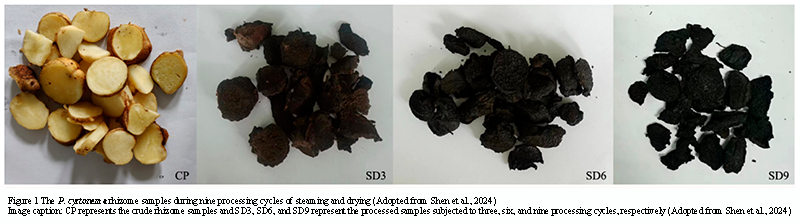 Figure 1 The P. cyrtonema rhizome samples during nine processing cycles of steaming and drying (Adopted from Shen et al., 2024) Image caption: CP represents the crude rhizome samples and SD3, SD6, and SD9 represent the processed samples subjected to three, six, and nine processing cycles, respectively (Adopted from Shen et al., 2024) |
3.2 Steaming, boiling, and other thermal processing treatments
Thermal processing is the most critical step in Polygonatum primary processing, with steaming being the predominant method that considerably influences rhizome quality. Traditional methods include atmospheric steaming and drying, simmering, and the well-known "nine-steam-nine-bask" process, while innovative approaches such as constant temperature and humidity steaming combined with vacuum-steam pulsed steaming have shown superior outcomes. The constant temperature and humidity combined with vacuum-steam pulsed steaming and drying method yielded the highest antioxidant capacity, better preservation of polysaccharides, and lower levels of 5-hydroxymethylfurfural compared to traditional atmospheric steaming. This innovative method also reduced production time by 66.7% while achieving a comparable color profile to conventional technology (Ren et al., 2025).
Processing methods and cycle numbers profoundly affect chemical composition, with strong consensus that excessive steaming leads to over-processing. Total polysaccharide content decreases progressively with increasing processing cycles, stabilizing at approximately 5.2 g/100 g after four cycles, a 45.81% reduction from raw rhizomes (Yao et al., 2022). In Polygonatum sibiricum, polysaccharide content decreased by 47.38% after nine cycles, with the most significant decline occurring in the first three cycles. Low molecular weight fructans underwent significant degradation within the first three processing cycles, with complete degradation by the seventh cycle, suggesting that the traditional nine-cycle method may be excessive (Mei et al., 2025). Total saccharides in P. cyrtonema increased from one to four cycles but decreased from four to nine cycles, indicating that four cycles of steam-heated air drying represents the ideal processing method for optimal saccharide, fructose, and phospholipid retention (Zhu et al., 2022).
Different thermal processing methods, steaming, wine-processing, and processing with auxiliary materials such as black beans, produce distinct chemical transformations. Wine-processed P. cyrtonema exhibited the best comprehensive quality, with surface colors gradually deepening, sweetness increasing, viscosity strengthening, and tongue-numbing sensation disappearing after processing. Steaming Polygonatum kingianum with black beans promoted a dual metabolic enhancement, incorporating isoflavones and triterpenoid saponins from black beans while most active components peaked after three steaming cycles. Multiple steaming and roasting methods increased sugars, nucleotides, esters, and flavonoids but reduced amino acid content significantly, with sugars predominantly being monosaccharides from polysaccharide depolymerization (Xu et al., 2023). Processing-induced chemical mechanisms include hydrolysis, oxidative decomposition, dehydration, Maillard reaction, and polymerization, with Maillard reactions between amino acids and reducing sugars being the primary driver of browning (Jiang et al., 2022).
3.3 Drying, shaping, and storage management
Drying methods significantly affect the final quality of processed Polygonatum, with different techniques offering distinct advantages and limitations. Among five drying methods-hot-air drying, infrared drying, microwave drying, freeze-drying, and vacuum drying, vacuum drying achieved an optimal balance between energy consumption and product quality, demonstrating significant advantages in maintaining antioxidant activity, active ingredients, and flavor. Microwave drying achieved the highest drying rate with a drying time only 1/83 that of freeze-drying, yet demonstrated a relatively low retention rate of total polysaccharides. Freeze-drying maintained antioxidant activity and active ingredients effectively but required extended duration of 1 080 minutes, leading to high energy consumption that restricts large-scale industrial application (Wang, 2026). Heated-air drying and infrared drying were not suitable replacements for traditional steam-sun drying, as hierarchical cluster analysis showed these methods produced samples far in distance from steamed ones (Zhu et al., 2022).
Drying parameters, including temperature, time, and steaming cycles, must be carefully controlled to optimize quality and minimize harmful byproduct formation. Response surface methodology and back-propagation neural network optimization of wine-processed P. sibiricum identified optimal conditions of 3.6 hours steaming time, 75 °C drying temperature, 11.4 hours drying time, and eight steaming cycles, which improved taste and bioactivity while reducing 5-hydroxymethylfurfural to 0.18 mg/g. Polysaccharides undergo hydrolysis under moist heat during drying, resulting in continuous accumulation of reducing sugars that promotes 5-HMF formation, making drying temperature and time critical control points (Li et al., 2026). For laboratory analysis, processed samples were ground and passed through a 40-mesh sieve and the resulting powder stored in a desiccator; these are analytical preparation procedures rather than general commercial storage specifications (Mei et al., 2025). The lack of precise control of processing parameters has led to uneven quality of processed Polygonatum, underscoring the need for standardized drying and storage protocols to ensure consistent product quality (Bi et al., 2025).
4 Effects of Primary Processing on the Formation of Commercial Specifications of Polygonatum
4.1 Changes in rhizome size, integrity, and external morphology
Thermal processing induces significant structural degradation in Polygonatum rhizomes, disrupting the microscopic pore wall structure and facilitating the release of intracellular components. Repeated steaming and drying cycles cause the rhizome surface to become wrinkled and shriveled as moisture is lost and cellular matrices collapse. Initial processing effectively disrupts cell wall structure, leading to a slight increase in extracted crude polysaccharide yields, though yields stabilize with further processing cycles as the enhancement effect reaches its limit (Mei et al., 2025). The disintegration of calcium oxalate raphides, which cause throat irritation, is a primary morphological goal of processing, with the change rate of needle crystals exceeding 90% by the fifth processing cycle (Cheng et al., 2022).
Raw material dimensions significantly influence post-processing morphology and final product integrity. Among different lengths of Polygonatum cyrtonema, short-length rhizomes with younger tissues demonstrated better performance after processing, indicating that preliminary sorting by size and maturity preserves structural integrity. Slice thickness dictates drying kinetics, as moisture diffuses from the interior to the exterior during hot-blast air drying, with steamed samples of less than 6 mm thickness exhibiting faster water loss and superior quality retention (Liu et al., 2022). The physical breakdown of rhizome tissue during steaming also enhances the solubility and dissolution rates of chemical components, which subsequently increases extract yields in the processed material.
4.2 Changes in color, texture, and processing yield
Color transformation is a primary visual indicator of processing adequacy and commercial quality in Polygonatum. The inner transverse section of processed rhizomes gradually turns moist black with a specular luster, matching the traditional identification standard of "brightness like oil and color like black lacquer". Quantitative colorimetric analysis using the CIE L*a*b* color space demonstrates that L* values significantly decrease while ΔE*ab values increase from crude to steamed to wine-processed products, reflecting the progressive darkening of the rhizome surface (Figure 2) (Cheng et al., 2022). In Polygonatum sibiricum, optimal quality corresponds to an L* value ranging from 21.0 to 22.0 and an a* value between 2.0 and 5.0, establishing specific chromatic thresholds for commercial grading. The browning mechanism is primarily driven by non-enzymatic Maillard reactions between amino acids and reducing sugars, alongside caramelization and the oxidative polymerization of phenolic substances (Ren et al., 2025).
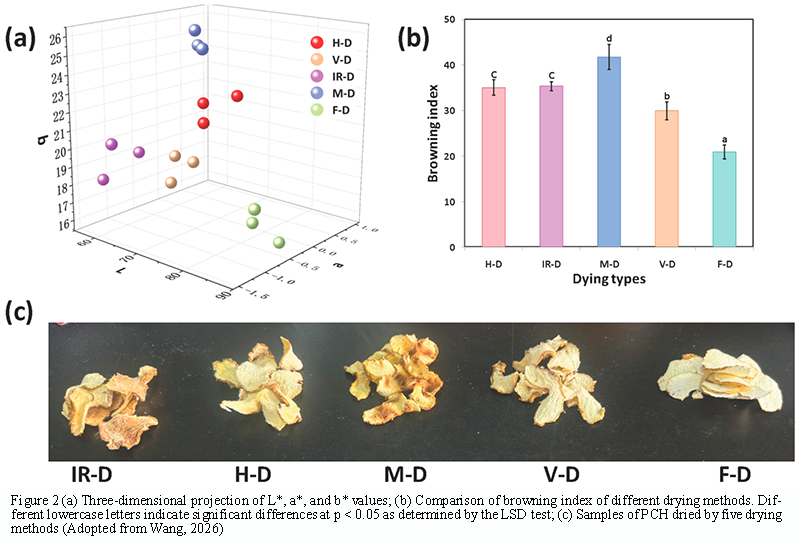 Figure 1 (a) Three-dimensional projection of L*, a*, and b* values; (b) Comparison of browning index of different drying methods. Different lowercase letters indicate significant differences at p < 0.05 as determined by the LSD test; (c) Samples of PCH dried by five drying methods (Adopted from Wang, 2026) |
Texture modifications accompany color changes, with processed rhizomes exhibiting increased sweetness, strengthened viscosity, and the complete disappearance of tongue-numbing sensations. Wine-processing accelerates these textural transformations, allowing the product to reach the endpoint of "color resembling black lacquer, sweetness akin to syrup" earlier than standard steaming methods. Processing yield and extractable matter content vary significantly by method; water extract and alcohol extract contents gradually increase from crude to steamed to wine-processed products due to enhanced solubility from thermal disruption. However, excessive steaming and drying cycles intensify bitter and sour flavors, causing overall quality to deteriorate and reducing the commercial value of the final product.
4.3 Effects of primary processing on internal quality and commercial grade
Primary processing fundamentally alters the internal chemical composition of Polygonatum, dictating its medicinal efficacy and commercial grade classification. Total polysaccharide content decreases progressively with increasing processing cycles, stabilizing at approximately 5.2 g/100 g after four cycles, representing a 45.81% reduction from raw rhizomes. In Polygonatum sibiricum, polysaccharide content decreased by 47.38% after nine cycles, with the most significant decline occurring within the first three cycles. Low molecular weight fructans undergo significant degradation within the first three processing cycles, with complete degradation by the seventh cycle, suggesting that the traditional nine-cycle method causes excessive glycan depletion (Mei et al., 2025). Conversely, total saponins, phenols, and flavonoids exhibit an increasing trend during processing, with antioxidant activity peaking after three to four cycles before stabilizing (Yao et al., 2022). Processing with black bean juice significantly increases saccharide and saponin content while enhancing DPPH and ABTS radical scavenging capacities compared to raw samples.
The correlation between external chromatic values and internal chemical composition provides a scientific basis for commercial grade classification. L. values are significantly correlated with Polygonatum cyrtonema polysaccharide (PCP) content, suggesting that L can objectively characterize the extent of processing and serve as a rapid grading parameter. Multivariate statistical analyses, including PCA and OPLS-DA, successfully cluster processed samples into distinct quality categories based on secondary metabolite and carbohydrate profiles, confirming that chemical composition shifts predictably across processing stages (Shen et al., 2024). The first six processing cycles induce drastic changes in functional component accumulation, while subsequent cycles yield diminishing returns, suggesting that four to six cycles may provide a favorable balance under the processing conditions investigated between enhanced medicinal effects and preserved bioactive components. Establishing a commercial grade classification system that integrates these processing-induced chemical variations with morphological and chromatic criteria is essential for standardizing Polygonatum commodity quality and ensuring consistent industrial efficacy (Bi et al., 2025).
5 Analysis of Existing Commercial Specifications and Grading Criteria for Polygonatum
5.1 Traditional methods for commercial specification classification
Traditional commercial classification relies primarily on morphological characteristics and geographical origin. As a related methodological example, Polygonatum odoratum (PO; Yuzhu), which is a distinct medicinal commodity rather than one of the three official botanical sources of Polygonati Rhizoma (Huangjing), is divided into two main commercial specifications: Xiangyuzhu (XPO) and Guanyuzhu (GPO), which are distinguished by their appearance, origin, and price. According to the "Standard compilation of authentic medicinal materials," XPO is characterized by a thick, long, translucent, and light yellow appearance, with products from Hunan considered authentic and occupying the majority of the Chinese market. GPO, in contrast, is a wild product from Northeast China, Inner Mongolia, and Hebei, and its cost is lower than that of XPO. These traditional specifications also dictate end-use applications; XPO is more frequently used as the raw material for dietary supplements, while GPO is more inclined toward medicinal use (Nan et al., 2023).
Beyond the P. odoratum market, Polygonatum species used for Huangjing (P. sibiricum, P. kingianum, and P. cyrtonema) exhibit extensive morphological diversity that historically guided classification. However, these morphological characteristics are seasonal, rendering it difficult for taxonomists to identify plants in the wild and complicating consistent commercial sorting. To evaluate germplasm resources systematically, agronomic traits such as stem length, stem diameter, leaf dimensions, and inflorescence characteristics are measured as direct representations of plant growth and quality. Among these traits, stem diameter has been identified as a practical indicator for variety screening and harvest assessment, providing a morphological marker that correlates with yield (Liao et al., 2023).
5.2 Differences in grading standards among production areas and markets
Grading standards and quality traits differ significantly among Polygonatum production areas, reflecting both genetic and environmental influences. A common garden experiment cultivating five Polygonatum species revealed that the plants mainly differed in yield, saponin and polysaccharide contents, stem diameter, leaf width, and inflorescence length. P. cyrtonema (PC) demonstrated high-quality yield when planted in Zhejiang, with output reaching 7.5 tons per hectare, making it particularly suitable for cultivation in Zhejiang and similar surrounding areas. Further analysis of 43 PC provenances from six geographical provinces showed that the specific relationship pattern between PC quality and its provenance was unclear, with most components not significantly correlating with longitude, latitude, or altitude. This suggests that short-term changes in the growth environment do not override long-term genetic variations acquired from original adaptive environments (Liao et al., 2023).
Market grading also reflects chemical composition differences that vary by species and region. In the P. odoratum market, current quality control focuses solely on polysaccharide content, yet studies indicate that the polysaccharide content of GPO is actually higher than that of XPO. A comprehensive qualitative analysis identified 62 compounds in PO, from which 13 robust chemical markers-including 6 flavonoids and 7 steroidal saponins-were screened to differentiate the two commercial specifications (Nan et al., 2023). The ratio of timosaponin H1 to polygodoraside G was proposed as a promising indicator to distinguish the specifications, with samples having a ratio <2 considered XPO and >5 considered GPO (Nan et al., 2023). For Huangjing species, saponin content varied significantly, with P. kingianum reaching 10.54%, significantly higher than PC, PS, and PF, while polysaccharide content ranged from 25.30% to 6.24% across species (Liao et al., 2023).
5.3 Problems in the existing commercial grading system
The existing commercial grading system for Polygonatum faces significant challenges due to germplasm confusion, lack of good varieties, and the indiscriminate introduction of seedlings across regions (Liao et al., 2023). These issues impede the development of the industry and lead to inconsistent product quality in the market . A major limitation is that traditional classification methods based on appearance and origin lack systematic chemical validation. For instance, no comparison had been made between the small molecule chemicals of the two main PO commercial specifications prior to recent instrumental analysis, making it difficult to objectively distinguish XPO and GPO based solely on traditional criteria. Furthermore, the quality of different batches within the same specification varies greatly; the total content of three marker compounds in XPO ranged from 137.70 to 1 005.55 μg/g, while GPO quality was comparatively stable between 349.19 and 859.64 μg/g (Nan et al., 2023).
Current quality evaluation methods are also insufficient for comprehensive commercial grading. The traditional colorimetric method for determining polysaccharide and saponin contents is time-consuming and labor-intensive, rendering it unsuitable for determining the contents of large quantities of samples needed for market grading. While near-infrared spectroscopy (NIRS) combined with chemometrics has been established for the rapid determination of saponin content in Huangjing, with a residual prediction deviation (RPD) of 2.25 indicating potential for quantitative grading-the model for polysaccharide content achieved an RPD of only 1.15, restricting its use to preliminary screening rather than precise commercial classification. The lack of precise control over processing parameters further exacerbates grading inconsistencies, leading to uneven quality of processed Polygonatum products (Nan et al., 2023). These shortcomings highlight the need for a multidimensional grading system that integrates morphological traits, chemical markers, and rapid detection technologies to standardize Polygonatum commodity quality.
6 Optimization of the Commercial Grade Classification System for Polygonatum
6.1 Establishment of quantitative indicators for raw materials and external specifications
Traditional commercial grading of medicinal materials relies heavily on external morphological features such as size, weight, and color, but modern research indicates these criteria do not always correspond to actual chemical quality. In the case of Polygoni Multiflori Radix (PMR), an unrelated medicinal material considered here only as a methodological comparison, wholesalers grade material into three classes based strictly on weight, yet quantitative analysis of twelve major bioactive components revealed no significant chemical differences across these size-based grades. This shows that size alone was insufficient to distinguish internal quality in PMR, suggesting a hypothesis that should be evaluated directly in Polygonati Rhizoma with quantitative chemical testing (Liang et al., 2018). For Polygonatum odoratum (PO), the market is divided into two commercial specifications, Xiangyuzhu (XPO) and Guanyuzhu (GPO), based on appearance and origin, but these distinctions also lacked systematic chemical validation until recently.
To establish reliable quantitative indicators, researchers have turned to advanced analytical techniques to differentiate commercial specifications. Ultra-high-performance liquid chromatography coupled with charged aerosol detection (UHPLC-CAD) was successfully validated for the absolute determination of three key saponins-polygodoraside G, polygonatumoside F, and timosaponin H1, across 27 batches of PO, providing a precise chemical basis for specification differentiation. The ratio of timosaponin H1 to polygodoraside G emerged as a robust quantitative indicator, with ratios below 2 identifying XPO and ratios above 5 identifying GPO. Furthermore, multivariate statistical analyses, including principal component analysis (PCA) and orthogonal partial least squares discriminant analysis (OPLS-DA), successfully screened 13 chemical markers, comprising six flavonoids and seven steroidal saponins-that reliably distinguish the two commercial specifications. These findings provide a methodological example of quantitative indicator development, although the specific ratios were established for P. odoratum (Yuzhu) and cannot be directly applied to Huangjing, moving beyond subjective appearance-based grading to objective chemical marker evaluation (Nan et al., 2023).
6.2 Improvement of processing quality and internal quality evaluation indicators
While external specifications provide initial sorting criteria, internal quality evaluation must account for the significant chemical transformations that occur during primary processing. Tissue-specific analysis has emerged as a powerful tool for linking internal morphology with bioactive component distribution, as demonstrated in PMR where laser microdissection combined with UPLC-QqQ-MS/MS mapped the accumulation patterns of twelve secondary metabolites across six distinct tissue types. This approach revealed that stilbene glucosides, combined anthraquinones, and polyphenols predominantly accumulated in the cork tissue, while free anthraquinones concentrated in the phloem, establishing that transverse section features directly correlate with medicinal quality. Such tissue-specific profiling provided a morphological grading criterion in the material studied; an analogous approach in Polygonatum would require direct histological and chemical validation rather than extrapolation from PMR (Liang et al., 2018).
The improvement of internal quality indicators also requires addressing the significant variation in chemical composition that occurs across processing methods and cycles. In PO, the average content of polygonatumoside F, a furostanol saponin serving as a key quality control marker, differed significantly between commercial specifications, with GPO containing 329.35 μg/g compared to 195.49 μg/g in XPO, indicating that saponin profiles must be evaluated as processing-sensitive indicators. Additionally, the total content of three marker compounds varied dramatically across batches within the same specification, ranging from 137.70 to 1005.55 μg/g in XPO, highlighting the need for processing standardization to reduce batch-to-batch variability. The application of UHPLC-Q-TOF/MS for comprehensive qualitative analysis enabled the identification of 62 compounds in PO, including 43 steroidal saponins, 11 flavonoids, and 8 alkaloids, establishing a full chemical profile that can serve as a reference for monitoring processing-induced changes in Polygonatum. These methods demonstrate that internal quality evaluation must move beyond single-marker assays to multi-component quantitative profiling that captures the full spectrum of processing-induced chemical transformations (Nan et al., 2023).
6.3 Construction of a multi-indicator comprehensive commercial grading system
The construction of a comprehensive grading system requires integrating external morphological features, tissue-specific chemical distribution, and multi-component quantitative analysis into a unified evaluation framework. The PMR study demonstrated that tissue-specific analysis of secondary metabolites can create new morphological criteria-such as broader cork and phloem regions in transverse sections-that reliably predict quality better than traditional size and weight measurements (Liang et al., 2018). This methodological principle could be tested in Polygonati Rhizoma by examining external appearance, internal histology, and chemical markers jointly; the PMR results alone do not validate those criteria for Huangjing. The successful application of OPLS-DA models with 99% explained variation and 97% predictive ability in differentiating PO specifications confirms that multivariate statistical approaches can robustly classify commercial grades when appropriate chemical markers are selected.
A multi-indicator system must also account for the fact that different commercial specifications may serve different end-use applications, requiring tailored quality criteria. In PO, XPO is more frequently used as a raw material for dietary supplements while GPO is more inclined toward medicinal use, meaning that grading systems should incorporate use-case-specific indicators rather than applying a universal standard. The identification of specific chemical markers unique to each specification, such as isomers of hydroxylwattinoside C and 3β-hydroxy-25S-spirost derivatives found only in GPO, provides the chemical basis for application-specific grading. Furthermore, the timosaponin H1-to-polygodoraside G ratio provides a published example of specification-specific grading for P. odoratum, but it has not been validated as a grading threshold for Huangjing . By integrating these quantitative chemical markers with traditional morphological features and tissue-specific distribution patterns, a comprehensive commercial grading system for Polygonatum can be constructed that ensures accurate quality assessment, supports appropriate end-use allocation, and provides a scientific foundation for industry standardization.
7 Standardized Application of Primary Processing and Specification Grading of Polygonatum
7.1 Promotion of graded processing and control of key processing parameters
Optimizing traditional processing methods requires precise control over key parameters to prevent over-processing and preserve bioactive components. The traditional nine-steaming and nine-drying method induces significant chemical transformations, but the first six processing cycles account for the most drastic changes in functional component accumulation, while subsequent cycles yield no further benefits and may even reverse enhancing effects. Most functional components are significantly enhanced after the first three cycles and stabilize after six, indicating that the full nine cycles are often excessive (Shen et al., 2024). Response surface methodology (RSM) has been successfully applied to optimize specific processing parameters, such as the solid-to-liquid ratio, decocting temperature, and time, achieving a highly reliable model with significant predictability for standardized processing protocols. Parameters established under particular experimental conditions should be validated for the botanical source, processing scale, and target indicators before being adopted as industrial operating standards.
Graded processing must also account for species-specific chemical reactivity and volatile compound transformations. Different Polygonatum species exhibit distinct aroma trajectories during processing, with early-stage losses of green aldehydes reflecting suppressed lipid-oxidation pathways and later-stage increases in roasted notes consistent with Maillard reactions and Strecker degradation. Species-specific differences in ester, ketone, and phenolic formation suggest variations in precursor pools and thermal reactivity that necessitate tailored processing parameters rather than a universal protocol (Sabier et al., 2026). Processing with auxiliary materials such as black bean juice significantly alters chemical fingerprints, increasing lower-polarity compounds and generating six new compounds while degrading medium-polarity constituents. This processing method significantly increases polysaccharide content from an average of 12.19% in raw samples to 32.28% in processed samples, alongside enhanced antioxidant and antidiabetic activities (Zhang et al., 2023). These findings underscore the necessity of controlling key processing parameters to maximize therapeutic outcomes and standardize commercial quality.
7.2 Improvement of processing records and quality traceability systems
Establishing comprehensive quality traceability systems requires integrating macroscopic, microscopic, and chemical characterization data into processing records. Color quantization based on the CIE L*a*b* system provides objective metrics for tracking processing levels, with parameters h, L, and ΔE demonstrating significant differentiation ability across Polygonatum sibiricum samples. The inner transverse section of processed rhizomes gradually turns moist black with specular luster, consistent with the traditional identification standard of "brightness like oil and color like black lacquer," providing a reliable visual marker for processing records. Microscopic characterization of calcium oxalate needle crystals offers an additional traceability marker, as the change rate of needle crystal morphology increases with processing level and exceeds 90% by the fifth cycle. High correlations between color parameters and needle-like crystals confirm the potential applicability of these features for classifying samples from different processing levels, enabling processors to document and verify processing adequacy (Cheng et al., 2022).
Advanced analytical technologies further strengthen traceability by linking processing records to chemical fingerprints and volatile profiles. Flash GC-E-nose profiling of volatile transitions across ten processing stages tentatively identified 71 compounds, providing foundational knowledge for aroma-based authentication tools that can verify processing consistency. Multivariate analyses, including PCA and hierarchical cluster analysis, clearly discriminate both species and steaming stages, revealing consistent chemical transformation patterns that can serve as reference standards in traceability databases (Sabier et al., 2026).
Untargeted GC-MS and FT-NIR spectroscopy identified 333 metabolites across 14 processing methods, with FT-NIR-based PLS-DA models reporting recognition rates of 71.43%–96.43% under the conditions studied (Xu et al., 2023). Electronic eye technology combined with chemometrics offers a rapid, environment-friendly method for determining whether samples have reached sufficient processing time, with specific color parameter ranges serving as quantitative thresholds for quality acceptance. These tools collectively enable the construction of digitized processing records that link raw material origin to final product quality.
7.3 Coordination between commercial grading and market circulation requirements
Aligning commercial grading with market circulation requires multidimensional evaluation models that integrate external appearance traits with internal metabolite profiles. A weighted TOPSIS-GRA fusion model combining eight appearance traits and six functional metabolite contents successfully differentiated Polygonatum sibiricum slices from different regions, with PCA clustering 16 batches into three distinct quality categories. The correlation coefficients from gray relation analysis ranged from 0.3895 to 0.8094 for the optimal reference sequence, effectively distinguishing superior-quality samples from inferior ones. OPLS-DA identified differential quality-affecting markers, providing a scientific basis for categorizing commercial grades that correspond to actual market quality variation. The established multi-index content determination method demonstrated accuracy and reliability with recovery rates between 98.54% and 103.07%, supporting analytical repeatability under the conditions investigated (Wang et al., 2025); wider interlaboratory reproducibility would require further validation.
Effective coordination between grading and market circulation also demands rapid assessment tools and standardized variety selection to meet diverse consumer and industrial demands. Near-infrared spectroscopy combined with chemometrics enables rapid quantitation of polysaccharide and saponin contents, providing a practical tool for preliminary quality screening during market transactions. Stem diameter has been identified as a practical agronomic indicator for variety screening and harvest assessment, offering a morphological marker that correlates with yield and facilitates preliminary grading at the cultivation stage (Liao et al., 2023). The Polygonatum industry currently faces challenges including germplasm confusion, unclear functional composition, and decentralized small-scale processing, all of which undermine consistent market quality. Addressing these issues requires accelerating the selection of improved varieties, ensuring high-quality seedling supply, and eliminating unauthentic species to stabilize the raw material basis for commercial grading. Future market growth depends on technological innovation, brand strategy, and internet-based traceability platforms that integrate processing standards with commercial grading to ensure sustainable industry development (Su et al., 2018).
8 Summary and Prospects
Standardizing primary processing requires precise control of key parameters to prevent over-processing and preserve bioactive components. The traditional nine-steaming and nine-drying method induces significant chemical transformations, but some studies suggest that four processing cycles can provide favorable results for selected constituents under specified conditions; this cannot establish a universally optimal cycle number for all species and processing routes. Low molecular weight fructans undergo significant degradation within the first three processing cycles, with complete degradation by the seventh cycle, suggesting the traditional technique is often excessive. Polysaccharide content decreases progressively with increasing cycles, stabilizing at approximately 5.2 g/100 g after four cycles, a 45.81% reduction from raw rhizomes, while saponins, phenols, and flavonoids exhibit an increasing trend with slight fluctuations after the fourth cycle. The first six processing cycles account for the most drastic changes in functional component accumulation, while subsequent cycles yield no further benefits and may even reverse enhancing effects. The lack of precise control over processing parameters has led to uneven quality of processed Polygonatum, underscoring the need for quantitative prediction models that correlate processing methods, component contents, and biological activity. A CRITIC-based prediction model has been developed to optimize processing by correlating method, component contents, and biological activity, ensuring consistent quality and efficacy. Establishing standard operating procedures also requires elucidating the toxicity-reducing and efficacy-enhancing mechanisms of processing. Calcium oxalate raphides are among the irritating components of raw Polygonatum, and processing disintegrates these raphide bundles, particularly at their tips, reducing throat irritation. Processing-induced chemical mechanisms include hydrolysis, oxidative decomposition, dehydration, Maillard reaction, and polymerization, with processing stages divisible into raw (0 h), middle (1–6 h), and late (8–18 h) phases. Polysaccharides partially degrade into oligosaccharides during processing, with molecular weight gradually decreasing and neutral sugars converting into uronic acids, while saponins partially degrade into sapogenins or undergo modification. Processing with black bean juice significantly alters chemical fingerprints, increasing lower-polarity compounds and generating six new compounds while degrading medium-polarity constituents. In the cited P. cyrtonema experiment, black-bean-juice processing increased measured polysaccharide and saponin contents and enhanced in vitro antioxidant and antidiabetic activities. These mechanistic insights provide a scientific basis for establishing standardized processing protocols that balance detoxification with bioactive retention.
Improving the commercial grade classification system requires moving beyond traditional appearance-based grading to integrate multidimensional quality indicators. Traditional Chinese medicine quality control faces challenges lacking multidimensionality and reliable quantitative evidence, and comprehensive evaluation models based on external characteristics and multiple indicator metabolites represent the future research direction. Color quantization based on the CIE L*a*b* system provides objective metrics for tracking processing levels, with parameters h, L, and ΔE demonstrating significant differentiation ability across Polygonatum sibiricum samples. The inner transverse section of processed rhizomes gradually turns moist black with specular luster, consistent with the traditional identification standard of "brightness like oil and color like black lacquer," providing a reliable visual marker for processing records. Microscopic characterization of calcium oxalate needle crystals offers an additional traceability marker, as the change rate of needle crystal morphology increases with processing level and exceeds 90% by the fifth cycle. High correlations between color parameters and needle-like crystals confirm the potential applicability of macroscopic and microscopic features for classifying samples from different processing levels. Advanced identification methods are essential for standardizing Polygonatum products and preventing adulteration with morphologically similar congeneric species. A multidimensional approach integrating phenological, morphological, anatomical, and molecular characteristics has been developed to distinguish eight Polygonatum species, addressing the limitations of single-method identification. Significant interspecific differences were observed in phenological and morphological traits, with coefficients of variation reaching 135.92% for floret number and 117.82% for fruit number. Molecularly, optimized SCoT-PCR identified 12 polymorphic primers showing 96.56% polymorphism in the studied Polygonatum species, providing a robust basis for species identification and classification. These integrated approaches support botanical species identification; their value for chemical-quality grading requires independent validation.
Coordinating primary processing with industrial standards demands accelerating the selection of improved varieties, ensuring high-quality seedling supply, and eliminating unauthentic species to stabilize the raw material basis. The Polygonatum industry currently faces resource depletion, low-tech cultivation, and unclear functional composition, all of which undermine consistent industrial standardization. Strengthening the conservation and rational use of wild resources, alongside breakthroughs in high-quality artificial cultivation technologies for light regulation, site control, density control, and precision harvesting, are essential measures for sustainable development. Future market growth depends on technological innovation, cultural creativity, integration of three industries, brand strategy, and internet-based techniques that integrate processing standards with commercial grading. Despite promising pharmacological properties, underlying mechanisms remain insufficiently elucidated, and clinical evidence supporting therapeutic efficacy is still lacking, necessitating further research to clarify links between chemical constituents and pharmacological activities. Achieving industrial scale requires transitioning laboratory-scale extraction and purification technologies to green, efficient methods suitable for large-scale production. Most current methods for separating dietary polysaccharides from Polygonatum sibiricum are suitable only for small-scale laboratory processing and cannot meet the requirements of large-scale production. There is an urgent need for safe, harmless methods of purifying polysaccharides in green and environmentally friendly food industry production to meet consumer demand. Extraction methodologies for flavonoids remain at the laboratory stage with relatively low yields, and no definitive conclusions have been reached regarding optimal parameters for their application. Future investigations should focus on optimizing these methods and developing green, highly efficient extraction technology applicable on an industrial production scale. Exploring the potential applications of Polygonatum in functional foods and pharmaceutical formulations is recommended to advance the development of industries focused on healthy aging. The relative lack of mechanistic studies on functional components and the absence of correlation between processing-induced compositional changes, pharmacological efficacy, and quality control remain critical research gaps that must be addressed to establish scientific evidence-based quality standards.
Conflict of Interest Disclosure
The author affirms that this research was conducted without any commercial or financial relationships that could be construed as a potential conflict of interest.
Bi S.-J., Yuan A.-L., Chen Z.-J., Ren Y., Liu K.-Y., Liu C.-Q., Xu Z.-Z., Wang Z.-W., and Zhang Y.-L., 2025, Quantitative predictive model for screening optimal processing methods of Polygonati rhizoma, Journal of Asian Natural Products Research, 27(3): 368-386.
https://doi.org/10.1080/10286020.2024.2390496
Cheng S., Hu Y., Cheng Y., Qian Z., Xu X., Lei X., and Shi X., 2026, Variation analysis of growth traits and medicinal components in different provenances of Polygonatum cyrtonema based on heterogeneous garden experiment, PLOS ONE, 21(4): e0346920.
https://doi.org/10.1371/journal.pone.0346920
Cheng X., Ji H., Cheng C., Sun Y., Cheng H., Wang D., Pan Y., and Liu X., 2022, Comprehensive determination of the processing level of rhizome of Polygonatum sibiricum by macroscopic, micromorphological, and microscopic characterizations, Microscopy Research and Technique, 85(7): 2669-2678.
https://doi.org/10.1002/jemt.24121
Guo H., Yao R., Guo X.-H., Jing W., Hu C., Duan B., Pu J., Zhang Y., Chen J., Yang J., Cheng X., and Wei F., 2026, Polygonati rhizoma: geographic distribution, traditional use, component transformation, pharmacological activity, and clinical application, The American Journal of Chinese Medicine, 54(1): 229-261.
https://doi.org/10.1142/S0192415X26500084
Hu Y.-Z., Yin M., Bai Y., Chu S., Zhang L., Yang M., Zheng X., Yang Z., Liu J., Li L., Huang L., and Peng H., 2022, An Evaluation of Traits, Nutritional, and Medicinal Component Quality of Polygonatum cyrtonema Hua and P. sibiricum Red., Frontiers in Plant Science, 13: 891775.
https://doi.org/10.3389/fpls.2022.891775
Jiang T., Wu T., Gao P., Wang L., Yang X., Chen X., Chen Y., Yue C., Liang K., Tang L., and Wang Z., 2022, Research on processing-induced chemical variations in Polygonatum cyrtonema rhizome by integrating metabolomics and glycomics, Molecules, 27(18): 5869.
https://doi.org/10.3390/molecules27185869
Li S., Yang J., Wei X., Wang R., Li J., Liu H., and Zhou H., 2026, Optimizing the rice wine process of Polygonatum sibiricum Red. using response surface methodology (RSM) and back-propagation (BP) neural network to enhance biological activity and reduce 5-hydroxymethylfurfural (5-HMF), Food Chemistry: X, 38: 104207.
https://doi.org/10.1016/j.fochx.2026.104207
Li Y., Lu M., Yang Q., and Jia Q., 2025, Comparison of major nutritional components in Polygonatum germplasm resources from different origins, Foods, 14(21): 3663.
https://doi.org/10.3390/foods14213663
Liang L., Xu J., Liang Z.-T., Dong X.-P., Chen H.-B., and Zhao Z.-Z., 2018, Tissue-Specific Analysis of Secondary Metabolites Creates a Reliable Morphological Criterion for Quality Grading of Polygoni Multiflori Radix, Molecules, 23(5): 1115.
https://doi.org/10.3390/molecules23051115
Liao S., Fan Z., Huang X., Ma Y., Huang F., Guo Y., Chen T., Wang P., Chen Z., Yang M., Yang T., Xie J., Si J., and Liu J., 2023, Variations in the morphological and chemical composition of the rhizomes of Polygonatum species based on a common garden experiment, Food Chemistry: X, 17: 100585.
https://doi.org/10.1016/j.fochx.2023.100585
Liu J., Qian Y., Yang W., Yang M., Zhang Y., Duan B., Yang Y., Tao A.-E., and Xia C., 2024, Elucidating the interaction of rhizosphere microorganisms and environmental factors influencing the quality of Polygonatum kingianum Coll. et Hemsl., Scientific Reports, 14: 19092.
https://doi.org/10.1038/s41598-024-69673-0
Liu Q., Li M., Lu H., Zhou Y., and Wang X., 2022, Effect of steam pretreatment on drying kinetics and quality of Polygonati Rhizoma dried in hot-blast air, Journal of Food Process Engineering, 45(1): e13925.
https://doi.org/10.1111/jfpe.13925
Mei X., Xia J., Li W., Wu Y., Cheng H., Chen S., Ye X., and Chen J., 2025, Glycan degradation in Polygonati Rhizoma: Effects of traditional ‘nine steaming and nine basking’ on low molecular weight fructans and polysaccharides, Food Chemistry: X, 25: 102131.
https://doi.org/10.1016/j.fochx.2024.102131
Nan Y., Liang H., Pang X., Zheng W., Shi Y., Chen X., Zhang J., Song J., and Ma B., 2023, Qualitative and quantitative studies on two commercial specifications of Polygonatum odoratum, Frontiers in Chemistry, 11: 1146153.
https://doi.org/10.3389/fchem.2023.1146153
Pu W., Yu Y., Shi X., Shao Y., Ye B., Chen Y., Song Q., Shen J., and Li H., 2024, The effect of seasonal and annual variation on the quality of Polygonatum cyrtonema hua Rhizomes, Plants, 13(24): 3459.
https://doi.org/10.3390/plants13243459
Ren W., Wu M., Wang B., Xu H., Wei W., and Sun D.-Y., 2025, Constant temperature and humidity combined with vacuum-steam pulsed steaming of Polygonatum cyrtonema rhizome: quality attribute and browning mechanism, Food Chemistry, 463(Pt 4): 141472.
https://doi.org/10.1016/j.foodchem.2024.141472
Sabier M., Kitts D. D., Zhu A., Huang S., Li Y., Wang P., Si J., and Zhang X., 2026, Aroma profiling using GC E-nose to trace origin of polygonati rhizoma species and quantify the effect of using ‘nine steaming and nine sun drying’ processing, Food Chemistry: X, 33: 103463.
https://doi.org/10.1016/j.fochx.2025.103463
Shen J., Pu W., Song Q., Ye B., Shi X., Chen Y., Yu Y., and Li H., 2024, Traditional Processing Can Enhance the Medicinal Effects of Polygonatum cyrtonema by Inducing Significant Chemical Changes in the Functional Components in Its Rhizomes, Pharmaceuticals, 17(8): 1074.
https://doi.org/10.3390/ph17081074
Shu Q., Liao B., Zhu Z., Cheng L., Li C., Yang J., Wang C., Li X., and Duan B., 2026, Botany, traditional uses, phytochemistry, pharmacology, toxicology, and applications of the genus Polygonatum: A comprehensive update review, Journal of Ethnopharmacology, 368: 121773.
https://doi.org/10.1016/j.jep.2026.121773
Su W.-T., Liu Y.-J., Jiang Y.-F., Xie J., Pan X.-H., Liu J., and Si J.-P., 2018, Status of Polygonati Rhizome industry and suggestion for its sustainable development, China Journal of Chinese Materia Medica, 43(13): 2831-2835.
https://doi.org/10.19540/j.cnki.cjcmm.20180329.002
Su W.-T., Xie J., Pan X.-H., Liu J., and Si J.-P., 2019, Temporal and spatial variation of polysaccharides and alcohol-soluble extractives of Polygonatum cyrtonema, China Journal of Chinese Materia Medica, 44(2): 270-273.
https://doi.org/10.19540/j.cnki.cjcmm.20181106.008
Sun M., Tang Y., Song S., Zhou L., Xie J., Cai L., Wang Z., Yan B., Xu R., Ma Y., and Song R., 2025, Distinguishing eight Polygonatum species using morphological, anatomical, and SCoT markers, Industrial Crops and Products, 236: 121874.
https://doi.org/10.1016/j.indcrop.2025.121874
Wang C., Ye J., Jiang S., He X., Ma M., and Yin L., 2025, Quality evaluation of Polygonatum sibiricum slices from different regions based on appearance traits and multi-index metabolites combined with TOPSIS and gray relation analysis, Frontiers in Pharmacology, 16: 1547398.
https://doi.org/10.3389/fphar.2025.1547398
Wang L., 2026, Evaluation of Various Drying Methods for Polygonatum cyrtonema hua: effects on drying characteristics and multidimensional quality assessment, Foods, 15(11): 2035.
https://doi.org/10.3390/foods15112035
Xiao L., Xu H., Wu T., Xie Q., Wen R., Wang L., Su B., and Zhang H., 2024, Metabolomic Diversity in Polygonatum kingianum Across Varieties and Growth Years, Molecules, 29(21): 5180.
https://doi.org/10.3390/molecules29215180
Xu Y., Yang M., Yang T., Yang W., Wang Y., and Zhang J., 2023, Untargeted GC-MS and FT-NIR study of the effect of 14 processing methods on the volatile components of Polygonatum kingianum, Frontiers in Plant Science, 14: 1140691.
https://doi.org/10.3389/fpls.2023.1140691
Yao X., Deng Z., Li H., and Zhang B., 2022, Effect of processing cycles on the composition of Polygonatum cyrtonema Hua during nine-steam-nine-bask processing, Food Bioscience, 50: 102081.
https://doi.org/10.1016/j.fbio.2022.102081
Yuan Q., Han Y., Huang J., and Liu X., 2023, Seasonal variation of nutritional and bioactive constituents in Polygonatum odoratum, Journal of Food Composition and Analysis, 124: 105655.
https://doi.org/10.1016/j.jfca.2023.105655
Zhang J., Wang J., Yang L., Wang Y., Jin W., Li J., and Zhang Z., 2023, Comprehensive quality evaluation of Polygonatum cyrtonema and its processed product: chemical fingerprinting, determination and bioactivity, Molecules, 28(11): 4341.
https://doi.org/10.3390/molecules28114341
Zhao L., Xu C., Zhou W., Li Y., Xie Y., Hu H., and Wang Z.-G., 2023, Polygonati Rhizoma with the homology of medicine and food: A review of ethnopharmacology, botany, phytochemistry, pharmacology and applications, Journal of Ethnopharmacology, 309: 116296.
https://doi.org/10.1016/j.jep.2023.116296
Zhao P., Zhao C., Li X., Gao Q., Huang L., Xiao P., and Gao W., 2018, The genus Polygonatum: a review of ethnopharmacology, phytochemistry and pharmacology, Journal of Ethnopharmacology, 214: 274-291.
https://doi.org/10.1016/j.jep.2017.12.006
Zheng H., Zhu Y., Liao P., Lin F., Ye W., Mao F., Fang L., Fang Y., and Su H., 2025, Intercropping with Paris polyphylla and Ganoderma lucidum: regulatory effects on the rhizosphere microbial community and the quality of Polygonatum cyrtonema, Frontiers in Microbiology, 16: 1711104.
https://doi.org/10.3389/fmicb.2025.1711104
Zheng J., Huang W.-J., Chen C., and Chen P.-P., 2026, Transcriptomic and metabolomic profiling of Polygonatum cyrtonema Hua across different growth years, Frontiers in Plant Science, 17: 1860542.
https://doi.org/10.3389/fpls.2026.1860542
Zhou Y., Li H., Li D.-B., Liu J., Wang W., Zhang X.-F., and Si J.-P., 2021, Quality evaluation of Polygonatum cyrtonema based on HPLC fingerprint and multi-component quantitative analysis, China Journal of Chinese Materia Medica, 46(21): 5614-5619.
https://doi.org/10.19540/j.cnki.cjcmm.20210820.102
Zhu H., Pei Z., Zhang L., Dong J., and Ji P., 2025, Non-targeted metabolomics-mediated elucidation of metabolite changes in Polygonatum kingianum during traditional steaming with black beans, Frontiers in Nutrition, 12: 1581459.
https://doi.org/10.3389/fnut.2025.1581459
Zhu S.-Q., Liu P., Wu W., Li D.-D., Shang E., Guo S., Qian D., Yan H., Wang W., and Duan J., 2022, Multi-constituents variation in medicinal crops processing: Investigation of nine cycles of steam-sun drying as the processing method for the rhizome of Polygonatum cyrtonema, Journal of Pharmaceutical and Biomedical Analysis, 209: 114497.
https://doi.org/10.1016/j.jpba.2021.114497
Zhu Y., Liang S., Fu D., Fu H., and Zhao H., 2026, Integration of metabolomics and proteomics reveals the mechanisms of seasonal accumulation and key regulatory networks of polysaccharides in Polygonatum odoratum, BMC Plant Biology, 26: 975.
https://doi.org/10.1186/s12870-026-08796-0



. PDF(0KB)
. FPDF(win)
. FPDF(mac)
. HTML
. Online fPDF
Associated material
. Readers' comments
Other articles by authors
. Jiakai Ma

Related articles
. Polygonatum
. Primary processing
. Commercial specification
. Quality grading
. Quality control
Tools
. Email to a friend
. Post a comment