Feature Review
Regulation of Sugar-Acid Balance During Kiwifruit Fruit Development and Ripening 
 ,
Chunyang Zhang2

2 Hainan Institute of Biotechnology, Haikou, 570206, Hainan, China
Author Correspondence author
International Journal of Horticulture, 2026, Vol. 16, No. 5 doi: 10.5376/ijh.2026.16.0032
Received: 30 Aug., 2026 Accepted: 12 Oct., 2026 Published: 30 Oct., 2026
Liang K.W., and Zhan C.Y., 2026, Regulation of sugar-acid balance during kiwifruit fruit development and ripening, International Journal of Horticulture, 16(5): 376-391 (doi: 10.5376/ijh.2026.16.0032)
Kiwifruit flavor and commercial quality are largely determined by sugar–acid balance, the formation of which involves complex regulation of carbon metabolism throughout fruit development, ripening, and postharvest stages. This study examines the dynamic changes in sugars and organic acids in kiwifruit and their metabolic, molecular, and environmental regulatory mechanisms. The results indicate that starch accumulation and organic acid formation are prominent during fruit development, whereas during ripening and post-ripening, starch is rapidly degraded and converted into sucrose, glucose, and fructose, while the decline in total acidity is mainly associated with citrate degradation. AGPase, BAM, SUS, SPS, INV, and genes involved in citrate synthesis, degradation, and vacuolar transport jointly participate in sugar and acid metabolism. Regulatory modules such as AcNAC1–AcALMT1 and AcPUB11–AcCTS1–AcBAM3 further elucidate the molecular basis of sugar–acid balance. Ethylene, ABA, temperature, light, water and fertilizer management, crop load, and postharvest treatments can regulate fruit flavor by affecting carbon allocation, starch degradation, and organic acid metabolism. Future studies should strengthen multi-omics analyses, spatiotemporal regulation, and germplasm-specific differences to provide a theoretical basis for flavor quality evaluation, molecular breeding, and precision cultivation of kiwifruit.
1 Introduction
Kiwifruit flavor and market quality are strongly shaped by sugar–acid balance, because soluble sugars, organic acids, and their ratio determine sweetness, sourness, overall flavor intensity, and consumer preference. Soluble sugars and organic acids are repeatedly identified as the principal contributors to kiwifruit flavor and palatability (Titeli et al., 2023). In kiwifruit, sweetness is especially important for overall eating quality, yet it is not perceived independently, because the sensory expression of sweetness is modified by concurrent acidity and volatile composition (Nardozza et al., 2013). Consumer studies further show that acceptance rises with improved ripe soluble solids and an appropriate acid background, whereas fruit with insufficient sweetness or unfavorable acid balance are judged less acceptable or more sour (Wang et al., 2025). Consistent with this, fruit differing in carbohydrate supply, orchard origin, cultivar, or storage condition show measurable differences in acidity, sugar accumulation, flavor perception, and eating quality, indicating that sugar–acid balance is not only a biochemical trait but also a practical determinant of commercial value (Lievre et al., 2021).
The sugar–acid ratio therefore serves as a key indicator of fruit maturity and market quality in kiwifruit. Studies on commercial and postharvest fruit show that soluble solids concentration is a primary ripening criterion, while the interaction between soluble solids and titratable acidity is closely linked to taste quality and consumer acceptance (Titeli et al., 2023). Early-harvest experiments in ‘Hayward’ demonstrated that fruit with higher ripe soluble solids were consistently preferred, and that acidity became especially important when sweetness remained low. At the same time, orchard comparisons showed that sugar/acid ratios differ during maturation and are associated with acceptable versus unacceptable eating quality, with poorly matured fruit showing weak flavor intensity and off-flavors. Recent sensory-metabolomic work also identifies sugar-acid ratio as a major driver of consumer preference among flesh-color types and as a metabolite-derived index elevated during post-ripening (Bao et al., 2026). These findings support the view that monitoring sugar accumulation, acid decline or redistribution, and their resulting ratio provides a biologically meaningful and commercially useful framework for judging kiwifruit maturity, readiness to eat, and market performance.
The formation of this balance is highly dynamic across fruit development and ripening, reflecting coordinated changes in carbohydrate metabolism. Kiwifruit differs from many fruits because it stores substantial carbohydrate as starch during development and converts that reserve into soluble sugars only after physiological maturity or during ripening (Nardozza et al., 2013). Net starch accumulation begins after cell division, intensifies during the slower fruit growth phase, and is followed near maturity by rising sucrose and hexose pools together with increased activities or transcripts of starch- and sucrose-related enzymes such as AGPase, SPS, AMY, and BAM-associated genes (Tian et al., 2021). During postharvest ripening, glucose, fructose, and sucrose typically increase markedly, although the dominant sugar can vary among genotypes, with sucrose predominating in some cultivars and glucose/fructose in others (Mao et al., 2023). Carbohydrate supply from the vine also alters this trajectory: enhanced supply promotes earlier maturation and higher starch and soluble sugar accumulation, whereas restricted supply delays maturity and weakens flavor development. These results show that sugar formation in kiwifruit depends on developmental stage, sink strength, genotype, and the regulation of starch–sucrose interconversion rather than on simple linear sugar accumulation.
Organic acid metabolism is equally dynamic and is a major counterpart to sugar accumulation in shaping flavor during maturation and ripening. Across kiwifruit species and cultivars, quinic acid, citric acid, and malic acid are the major organic acids, but their relative abundance and developmental trajectories differ substantially by genotype and storage environment (Mao et al., 2023). In several developmental studies, quinic acid is more prominent early, whereas citric acid increases as fruits mature, while malic acid either remains comparatively stable or changes more modestly (Lin et al., 2022; Jia et al., 2023). During postharvest ripening, titratable acidity usually declines, and this decline is often driven mainly by citric acid degradation, although malic acid can remain stable or even increase under some storage temperatures, helping explain differences in acidity perception between ripening conditions. Mechanistically, citric and malic acid accumulation is linked to the TCA cycle and to the coordinated regulation of synthesis and degradation enzymes, including citrate synthase, aconitase, isocitrate dehydrogenase, malate dehydrogenase, and phosphoenolpyruvate carboxylase. The objective of the present study is to clarify how sugars and organic acids are coordinately regulated during kiwifruit fruit development and ripening, to identify the metabolic and molecular factors that determine sugar–acid balance, and to provide a basis for improving maturity evaluation, flavor quality, and breeding or postharvest management strategies.
2 Dynamic Changes in Sugars and Organic Acids During Kiwifruit Development
2.1 Sugar composition and accumulation patterns
The main soluble sugars in kiwifruit are sucrose, glucose, and fructose, but their relative abundance changes with developmental stage and genotype. During fruit growth, Nardozza et al. (2023) reported that sugar concentrations often decline during early cell division and then rise again during cell expansion and maturation, with glucose sometimes peaking before net starch accumulation begins. In later developmental and ripening stages, sucrose, glucose, and fructose all increase substantially and contribute directly to ripe-fruit sweetness (Mao et al., 2023). However, the dominant soluble sugar is not uniform across kiwifruit types: glucose and fructose predominate in some A. chinensis fruit such as ‘Jinyan’, whereas sucrose is more prominent in ‘Hongyang’, ‘Kuilv’, and some hardy kiwifruit backgrounds (Li et al., 2021).
Starch accumulation and conversion are central to sugar formation in kiwifruit because this fruit stores much of its carbon as starch before harvest and converts it to soluble sugars during maturation and postharvest ripening. Net starch accumulation begins after cell division is completed, increases during the slower fruit growth phase, and then declines when maturation starts and soluble sugars rise rapidly. This pattern is consistent across cultivars, although the timing differs: starch peaks earlier in fast-developing ‘Kuilv’ than in ‘Hongyang’ or ‘Hayward’, and in hardy kiwifruit the accumulation period can also vary by cultivar (Lin et al., 2022). Enzyme and transcript data indicate that AGPase is a key determinant of starch accumulation, while AMY, BAM, SPS, SUS, and related enzymes regulate starch degradation and sugar production during maturation and ripening (Shu et al., 2023).
2.2 Organic acid composition and metabolic dynamics
The dominant organic acids in kiwifruit are citric acid, quinic acid, and malic acid, although their proportions vary among species, cultivars, and developmental stages. Quinic acid is often abundant in young fruit and contributes strongly to the characteristic acidity of fresh kiwifruit (Fu et al., 2023). During development, quinic acid generally declines, whereas citric acid accumulates progressively and becomes the major contributor to total acidity near harvest in several cultivars including ‘Hongyang’, ‘Hayward’, and ‘Zesy002’ (Lievre et al., 2021). Malic acid usually occurs at lower levels and shows a more variable pattern, including transient early peaks or stage-specific fluctuations rather than a single uniform trajectory.
Acid content also varies systematically across developmental phases. In early growth, glucose and quinic acid tend to accumulate together, whereas the transition to slower growth and maturation is associated with declining quinic acid and increasing citric acid (Lievre et al., 2021). During postharvest ripening, titratable acidity generally falls, and this decline is driven mainly by citrate loss rather than by major changes in malate. Even so, malic acid can remain stable or increase under some storage conditions, which helps explain differences in perceived acidity after ripening. Mechanistically, citrate and malate accumulation depend on coordinated regulation of synthesis, degradation, and transport, including citrate synthase, aconitase, isocitrate dehydrogenase, NAD-MDH, PEPC, and the citrate transporter AcALMT1 under AcNAC1 control (Jia et al., 2023).
2.3 Cultivar differences in sugar–acid profiles
Substantial cultivar variation exists in sugar–acid profiles among green-, yellow-, and red-fleshed kiwifruit. Comparative studies by Li et al. (2021) show that green-fleshed ‘Hayward’, red-fleshed ‘Hongyang’, and hardy ‘Kuilv’ share the broad pattern of starch accumulation followed by sugar increase, but differ in developmental duration, sugar composition, and acid trajectories. ‘Kuilv’ matures earlier, has lower late-stage glucose, fructose, quinic acid, and malic acid, but higher sucrose than ‘Hongyang’ and ‘Hayward’. In broader market comparisons, red-fleshed cultivars tend to receive higher consumer preference, with sugar–acid ratio, soluble sugars, and malic acid among the major drivers of liking, while green- and yellow-fleshed cultivars appear more environmentally sensitive (Wang et al., 2025).
Genetic and cultivar-level variation in sugar–acid ratio is therefore a major basis for flavor diversity in kiwifruit. High-sugar or high-dry-matter genotypes accumulate more starch reserves and soluble sugars, while differences in citrate, quinate, and malate metabolism shift acidity and final taste balance (Nardozza et al., 2013). Orchard and carbohydrate-supply effects further modify these inherited tendencies, changing sugar/acid ratios, maturity timing, and sensory quality even within the same cultivar. Kiwifruit development is characterized by a transition from starch and organic acid accumulation to starch remobilization, soluble sugar accumulation, and progressive organic acid remodeling. Although the timing and relative abundance of individual sugars and organic acids vary among cultivars, the overall developmental pattern is relatively conserved (Figure 1).
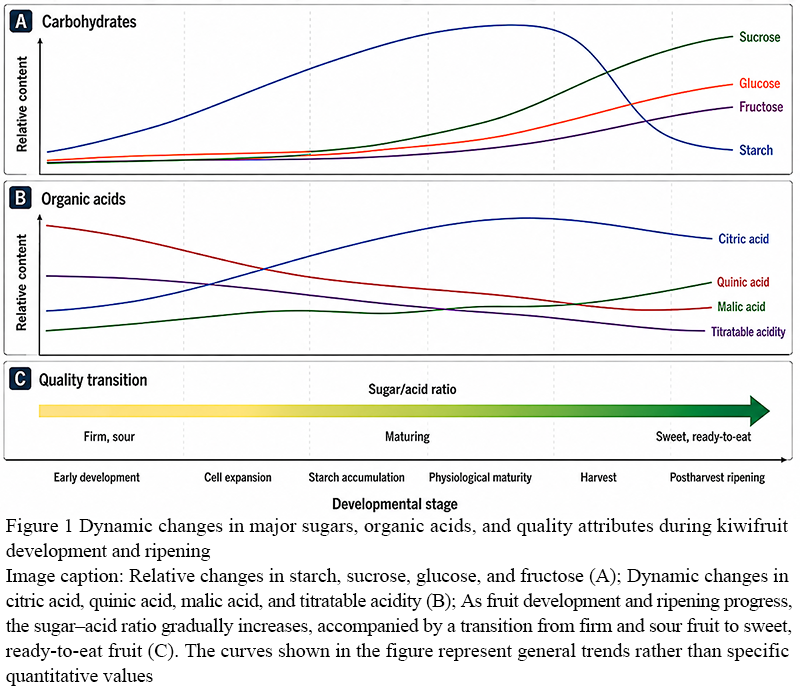 Figure 1 Dynamic changes in major sugars, organic acids, and quality attributes during kiwifruit development and ripening Image caption: Relative changes in starch, sucrose, glucose, and fructose (A); Dynamic changes in citric acid, quinic acid, malic acid, and titratable acidity (B); As fruit development and ripening progress, the sugar–acid ratio gradually increases, accompanied by a transition from firm and sour fruit to sweet, ready-to-eat fruit (C). The curves shown in the figure represent general trends rather than specific quantitative values |
3 Regulation of Sugar Metabolism in Developing and Ripening Kiwifruit
3.1 Starch metabolism and sugar release
During early fruit development, net starch synthesis begins after cell division and becomes a major feature of the slower enlargement phase (Kang et al., 2021). Comparative metabolic analyses identify AGPase as a key control point for starch accumulation, with high-starch genotypes showing 2- to 5-fold higher and more sustained AGPase activity than low-starch genotypes. Additional evidence indicates that SPS also contributes to maximizing starch accumulation, likely through sucrose cycling that supports carbon supply to the starch pathway (Nardozza et al., 2013). In hardy kiwifruit, expression correlations further suggest genotype-specific regulation, with neutral invertase positively associated with starch and fructokinase linked to the conversion of fructose into starch in some cultivars (Lin et al., 2022).
During ripening, starch degradation becomes the main source of soluble sugar accumulation and is closely tied to the onset of softening. In postharvest fruit, starch breakdown precedes or accompanies strong increases in sucrose, glucose, and fructose, indicating that the conversion of reserve carbon into soluble sugars is a central ripening event. Enzyme and omics studies repeatedly implicate α-amylase, β-amylase, starch phosphorylase, and debranching enzymes in this process, with β-amylase emerging as a particularly important regulator (Tian et al., 2021). Regulation is not solely ethylene-dependent: cool temperatures at 5 °C–10 °C accelerate starch degradation and soluble solids accumulation even when ethylene perception is blocked, through an AcPUB11–AcCTS1–AcBAM3 module (Li et al., 2026). Ethylene still contributes, however, because treatment represses the transcriptional repressors AdVAL2 and AdKAN2 and upregulates BAM genes, thereby accelerating early starch degradation (Tong et al., 2024). Conversely, blue light delays ripening by suppressing starch degradation, amylase activity, and total soluble solids accumulation (Xu et al., 2024).
3.2 Sucrose metabolism and sugar interconversion
Sucrose metabolism in kiwifruit depends mainly on the balance between sucrose synthase and sucrose phosphate synthase, which together regulate sucrose cleavage, resynthesis, and cycling. Sucrose synthase shows high activity through much of fruit growth and is consistently higher than invertase during the growing season, supporting a dominant role in cleavage of imported sucrose (Chen et al., 2017). In growing ‘Hayward’ fruit, sucrose synthase activity is tightly associated with relative growth rate and is co-regulated with fructokinase and UDP-glucose pyrophosphorylase, linking sucrose cleavage directly to sink strength and carbon utilization. Nardozza et al. (2017) used Actinidia chinensis var. deliciosa ‘Hayward’ to compare CPPU-induced fruit enlargement under normal and high carbon supply conditions. The study found that CPPU significantly increased fruit fresh weight and elevated glucose and fructose levels. At 49 days after anthesis (49 DAA), the aquaporin gene PIP2.4 was markedly upregulated. By contrast, SPS remains relatively low during earlier developmental stages and rises near maturity and ripening, when sucrose synthesis from starch-derived substrates intensifies (Kang et al., 2021). Feeding studies and enzyme assays indicate that starch-to-sucrose conversion involves active sucrose cycling, rather than simple one-way accumulation (Nardozza et al., 2013). Cultivar comparisons support this developmental shift, with SS highly expressed in immature fruit and SPS increasing in mature stages, while SPS expression is positively associated with sugar accumulation in some genotypes (Lin et al., 2022).
Invertases provide a second route for sucrose cleavage and help shape the balance between sucrose and hexose accumulation. Invertases occur as cell wall, vacuolar, and neutral isoforms, and their functions differ by compartment and developmental stage (Huang et al., 2025). In kiwifruit fruit, neutral invertase is generally more important than acid invertase during development, and early changes in glucose and neutral invertase activity mark the transition into starch accumulation (Kang et al., 2021). During softening, acid and neutral invertase activities increase alongside amylase activities and correlate with sucrose, fructose, starch, and soluble solids, indicating a broader role in remobilizing carbon during ripening. Gene-expression data from ‘Donghong’ further suggest that specific NINV members participate in postharvest sugar accumulation, because several sugar-metabolism genes were upregulated during ripening but inhibited by 1-MCP (Yuan et al., 2023).
3.3 Sugar transport and sink strength
Sugar accumulation also depends on transport capacity and sink strength, because imported assimilates must be unloaded from the phloem and partitioned into storage parenchyma (Falchi et al., 2020). In general, sucrose can be unloaded symplasmically through plasmodesmata or apoplasmically into the cell wall space, after which SUTs, SWEETs, or hexose transporters mediate membrane transfer (Braun, 2022). Work across crops shows that these transporters strongly influence sink development, soluble sugar levels, and carbon allocation (Li et al., 2021). In kiwifruit leaves, Zhang et al. (2026) found that SPS in source tissues is itself a central regulator of sucrose synthesis and export capacity, and distinct SPS isoforms appear to differ in their contributions to whole-plant carbon allocation.
For kiwifruit fruit specifically, the strongest anatomical and tracer evidence supports predominantly apoplastic phloem unloading in the flesh during development. This conclusion contrasts with an earlier metabolite-based inference of symplastic unloading, showing that the unloading route remains somewhat debated (Nardozza et al., 2013). Within this apoplastic framework, low cell wall acid invertase but high sucrose synthase activity suggests that post-unloading sucrose is metabolized mainly through the sucrose synthase pathway rather than extensive extracellular hydrolysis (Chen et al., 2017). More broadly, sugar partitioning in fruit tissues depends on the interaction between unloading route, transporter function, and sucrose-cleaving enzymes that maintain concentration gradients and sustain sink activity.
4 Regulation of Organic Acid Metabolism in Kiwifruit
4.1 Biosynthesis and accumulation of major organic acids
Citrate in kiwifruit is formed through the tricarboxylic acid cycle in mitochondria, and its accumulation depends on both strong synthesis and restricted degradation (Baiquan et al., 2018). In developing kiwifruit, citrate often accumulates continuously and becomes the predominant contributor to total acidity by harvest, as shown in both ‘Hongyang’ and ‘Hayward’ backgrounds (Fu et al., 2023). Jia et al. (2023) conducted enzyme activity analyses in Actinidia eriantha and found that high citrate accumulation was associated with increased citrate synthase activity, accompanied by decreased activities of mitochondrial aconitase and NAD-dependent isocitrate dehydrogenase. These findings suggest that substantial citrate accumulation may result from the combined effects of enhanced biosynthetic flux and reduced citrate utilization. This interpretation is consistent with broader fruit studies showing that citrate synthesis is controlled by the pyruvate-to-acetyl-CoA-to-citrate pathway and that TCA-cycle protein abundance can shift citrate accumulation capacity (Zheng et al., 2021; Wu et al., 2025).
Malate and quinate show distinct developmental trajectories from citrate. In kiwifruit, malate often peaks earlier or accumulates less strongly than citrate, while quinate is high in young fruit and declines during development (Qi et al., 2025). In A. eriantha, malate accumulation increased during fruit development and was positively associated with titratable acidity, with NAD-MDH and PEPC identified as major synthetic drivers and AeMDH2 implicated as a key regulator (Jia et al., 2023). Qi et al. (2025), based on a study of ‘Hongyang’ kiwifruit, found that malate content declined rapidly between 6 and 12 weeks after full bloom and was significantly negatively correlated with the expression of the plastidial AcPNAD-MDH1. CRISPR mutagenesis of AcSQBP9 reduced both malate and citrate contents while increasing AcPNAD-MDH1 expression, indicating that malate regulation also involves transcriptional control. Quinate metabolism is less resolved mechanistically, but kiwifruit studies have linked its accumulation to DAHPS, DHQS, and QDH expression, and consistently show high early abundance followed by decline as citrate becomes dominant (Fu et al., 2023).
4.2 Organic acid degradation during ripening
During ripening, organic acid decline in kiwifruit reflects increased respiratory utilization and broader metabolic reprogramming rather than simple dilution. Postharvest analyses show that citric acid declines progressively and tracks titratable acidity closely, identifying citrate degradation as the main cause of acid loss during ripening (Mao et al., 2023). In ‘Xuxiang’ fruit, Chai et al. (2024) found that the outer pericarp shows faster citric acid reduction than the core together with higher ATP, ADP, AMP, and energy charge, linking stronger acid decline to higher local respiration and energy metabolism. Across fruits more generally, citrate can be consumed through aconitase- and NAD-IDH-dependent pathways in mitochondria or diverted into the GABA shunt, and low mitochondrial aconitase activity can favor citrate retention whereas higher GABA-pathway activity promotes citrate degradation (Baiquan et al., 2018).
Malate decline during ripening is more variable than citrate decline, but when it decreases it is typically associated with decarboxylation and recycling into other pathways (Shu et al., 2024). Broader fruit metabolism studies indicate that vacuole-released malate and citrate can be redirected through gluconeogenesis, amino acid biosynthesis, and respiratory carbon metabolism during the transition from acid-dominated to sugar-dominated fruit composition (Iglesias-Sanchez et al., 2026).
In apple, malate decomposition is associated with NADP-malic enzyme and PEPCK activity, and suppressing these pathways during storage preserves acidity, supporting the general model that malate decarboxylation contributes to acid decline in fleshy fruit (Shu et al., 2024). Evidence in kiwifruit suggests this process is integrated with ethylene-responsive and TCA-linked ripening programs, although citrate appears to be the main driver of titratable acid loss in postharvest fruit (Fu and Chen, 2026).
4.3 Transport and compartmentation of organic acids
The final acidity of kiwifruit depends not only on metabolism but also on compartmentation, because malate and citrate are largely accumulated in vacuoles and their storage depends on tonoplast transport and vacuolar acidification (Huang et al., 2021). Reviews across fleshy fruits conclude that vacuolar storage is often the dominant determinant of cellular malate and citrate accumulation, even when biosynthetic pathways are active (Fu and Chen, 2026). In kiwifruit specifically, AcALMT1 has been functionally identified as a citrate transporter: its expression correlates with citrate accumulation, overexpression increases citrate content, and CRISPR mutagenesis of the upstream transcription factor AcNAC1 causes a dramatic citrate decrease without substantially affecting malate or quinate (Fu et al., 2023). This finding is notable because ALMT family members in other systems are more often linked to malate or fumarate transport, highlighting diversification of transporter function in fruit acidity control (Doireau et al., 2024).
Acid homeostasis also requires proton pumps and additional tonoplast carriers that establish the electrochemical gradient for organic acid sequestration (Huang et al., 2021; 2023). In other fruit systems, P-type ATPases such as PH5 and Ma10, together with V-ATPase and V-PPase, promote vacuolar acidification and enhance malate or citrate storage, indicating a transport logic likely relevant to kiwifruit as well (Wu et al., 2025). Tonoplast exchangers and channels such as tDT, ALMT9/Ma1, and related carriers further regulate the balance among citrate, malate, and other dicarboxylates by controlling import, export, and exchange across the vacuolar membrane (Doireau et al., 2024).
5 Molecular Regulation of Sugar–Acid Balance in Kiwifruit
5.1 Key structural genes involved in sugar and acid metabolism
Genes controlling starch degradation and sucrose metabolism are major determinants of sugar accumulation during ripening. Multi-omics analyses identify AMY, BAM, SUS, SPS, INV, HK, and FK as core structural genes associated with soluble sugar metabolism in kiwifruit (Wang et al., 2021). Among them, BAM genes are repeatedly highlighted as the main drivers of starch-to-sugar conversion, and AcBAM3.5 shows especially strong ripening-associated expression in ‘Hongyang’ (Gong et al., 2025). Zhang et al. (2018) further demonstrated in an ethylene-response study of ‘Hayward’ kiwifruit that AdBAM3L is a key gene involved in starch degradation, and its overexpression reduces starch content, supporting a direct structural role for AdBAM3L in soluble sugar formation. Recent family-wide analysis also expanded the BAM repertoire to 17 AcBAM genes, with AcBAM5 and AcBAM13 most highly expressed during postharvest storage and strongly induced by ABA; silencing either gene increases starch content. In yellow-fleshed kiwifruit, Lin et al. (2024) pointed out six AcBAM genes are significantly upregulated during ripening, especially AcBAM3.1 and AcBAM3.2, and their expression parallels rising β-amylase activity and sugar accumulation. Starch synthesis capacity also contributes to final sweetness, because AGPS1.1, AGPS1.2, and WAXY1 are upregulated during development in sweeter A. eriantha fruit, while BAM3.2, BAM3.3, PHO1, PHO2.2, SUS2.1, and SUS2.2 support subsequent remobilization (Li et al., 2024).
Genes associated with citrate and malate metabolism regulate the acid side of the balance through both metabolic flux and transport. For citrate, accumulation depends on strong synthesis and weak degradation, with citrate synthase, mitochondrial aconitase, and NAD-dependent isocitrate dehydrogenase identified as key enzymatic control points (Wang et al., 2021). A major kiwifruit-specific advance is the identification of AcALMT1 as a citrate transporter rather than a malate transporter in this context; its expression correlates with citrate levels, and transient overexpression increases citrate accumulation. Malate regulation appears partly distinct: AcPNAD-MDH1 is negatively correlated with malate content during ‘Hongyang’ development, and overexpression lowers both malate and citrate in leaves (Qi et al., 2025). In A. eriantha, malate accumulation is linked mainly to NAD-MDH and PEPC activity, with AeMDH2 implicated as an important regulator, while quinate metabolism has been associated with DAHPS, DHQS, and QDH expression.
Sugar and organic acid metabolism are interconnected through carbon allocation, respiratory metabolism, and intracellular compartmentation. The major structural genes and metabolic pathways involved in starch–sugar interconversion and citrate–malate metabolism collectively constitute the sugar–acid metabolic network in kiwifruit and contribute to the establishment of sugar–acid balance through coordinated carbon flux (Figure 2).
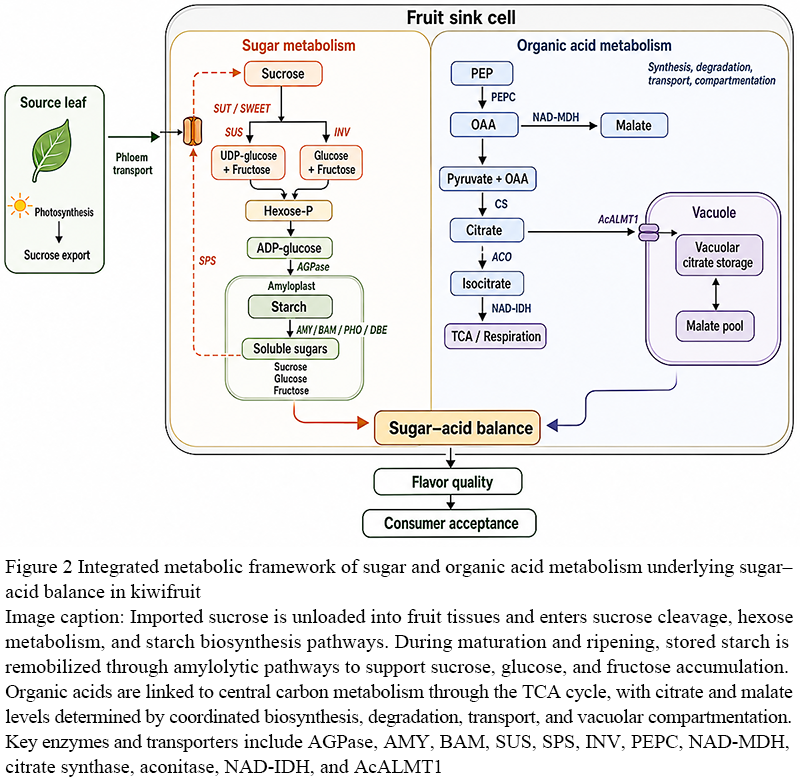 Figure 2 Integrated metabolic framework of sugar and organic acid metabolism underlying sugar–acid balance in kiwifruit Image caption: Imported sucrose is unloaded into fruit tissues and enters sucrose cleavage, hexose metabolism, and starch biosynthesis pathways. During maturation and ripening, stored starch is remobilized through amylolytic pathways to support sucrose, glucose, and fructose accumulation. Organic acids are linked to central carbon metabolism through the TCA cycle, with citrate and malate levels determined by coordinated biosynthesis, degradation, transport, and vacuolar compartmentation. Key enzymes and transporters include AGPase, AMY, BAM, SUS, SPS, INV, PEPC, NAD-MDH, citrate synthase, aconitase, NAD-IDH, and AcALMT1 |
5.2 Transcriptional regulation of sugar–acid metabolism
MYB, bZIP, NAC, ERF, bHLH, C2H2, Dof, and related transcription factor families all contribute to sugar–acid regulation, but they do so through different targets and developmental signals. Network analysis places NAC, C2H2, AP2/ERF, MYB, and bHLH among the dominant candidate families associated with soluble sugar accumulation in kiwifruit (Song et al., 2025). Within sugar metabolism, AcERF182 directly emerges as a central positive regulator because it is tightly correlated with AcBAM3.5 and embedded in the soluble sugar regulatory network (Wang et al., 2021). Additional ripening regulators act upstream of BAM genes through different mechanisms: AdDof3 activates the AdBAM3L promoter in an ethylene-responsive pathway, while under cool temperature AcCTS1 directly activates AcBAM3.3 and AcBAM3.5 and is negatively controlled by the E3 ligase AcPUB11 (Zhang et al., 2018). Co-regulation can also be negative: spatiotemporal multiomics identified an A. chinensis ERF1 that negatively controls sugar accumulation and ethylene production, indicating that not all ERFs promote ripening sugar gain (Zeng et al., 2025).
On the acid side, NAC regulation is the clearest experimentally validated mechanism. AcNAC1 directly binds the AcALMT1 promoter and activates its expression, and CRISPR mutagenesis of AcNAC1 causes a dramatic citrate decline without major effects on malate or quinate (Fu et al., 2023). Malate control involves a different transcriptional module, because AcSQBP9 represses AcPNAD-MDH1 and its mutagenesis decreases both malate and citrate while increasing AcPNAD-MDH1 expression (Qi et al., 2025). Broader kiwifruit studies on MYB and bZIP factors, although centered on ascorbate metabolism, show that these families form cooperative transcriptional complexes and are hormone responsive, making them plausible components of wider flavor-regulatory networks (Liu et al., 2022).
5.3 Hormonal regulation during kiwifruit ripening
Ethylene is the dominant hormonal regulator of sugar–acid conversion during postharvest ripening, but its effects are selective across traits and can interact with temperature. In climacteric kiwifruit, ethylene strongly accelerates ripening-associated transcriptional programs and starch degradation (Tipu and Sherif, 2024; Yang et al., 2025). Ethylene promotes sugar accumulation partly by inducing BAM-centered pathways: AdDof3–AdBAM3L, AcERF182–AcBAM3.5, and ethylene-upregulated AdBAM3-family genes all support faster starch loss and higher soluble solids (Zhang et al., 2018). Ethylene treatment also accelerates starch degradation and TSS accumulation, whereas 1-MCP suppresses these responses (Yang et al., 2025). However, Li et al. (2026) found that cool temperature can activate a partly ethylene-independent route, because AcCTS1 drives AcBAM3.3/3.5 expression and starch degradation under 5 °C–10 °C even when ethylene perception is blocked.
ABA and auxin appear to modulate maturation timing and flavor formation mainly through crosstalk with sugar and ethylene pathways rather than by replacing them. Across fruit systems, ABA usually rises during ripening and promotes flavor development, softening, and color, often in interaction with ethylene (Wu et al., 2023). In yellow-fleshed kiwifruit, ABA peaks early in postharvest ripening and participates with cytokinins and ethylene in a coordinated ripening model (Lin et al., 2024). Gong et al. (2025) reported that ABA also connects directly to sugar metabolism because AcBAM5 and AcBAM13 are strongly ABA induced, and their promoters contain ABRE elements. By contrast, auxin appears more associated with developmental timing: early-maturing A. eriantha germplasm has lower IAA, ABA, and ZR contents together with faster starch conversion and higher sucrose, glucose, and fructose at harvest (Liao et al., 2021). More generally, sugar signaling, ABA, and auxin are increasingly viewed as interdependent ripening regulators, but the kiwifruit-specific auxin network remains less resolved than the ethylene and ABA pathways (Durán-Soria et al., 2020; Bai et al., 2021).
6 Environmental and Cultivation Factors Affecting Sugar–Acid Balance
6.1 Light and temperature effects
Canopy light conditions influence carbohydrate accumulation mainly by regulating photosynthesis, leaf sugar metabolism, and carbon export to the fruit. In kiwifruit, carbohydrate supply varies with leaf area, leaf position, light exposure, and leaf age, so canopy structure directly affects the amount of photosynthate reaching fruit sinks (Patiyal et al., 2024). Light quality also changes sugar metabolism at the source level: red or red–blue light increased leaf sucrose, glucose, and fructose compared with blue-dominant treatments, and the red–blue 3:1 treatment gave the highest sucrose content and SPS activity (Zhang et al., 2026). Promoter analysis of the AdSPS family further showed that light-responsive elements are abundant, supporting direct light regulation of sucrose metabolism genes in kiwifruit. Field management that improves light interception can therefore strengthen sugar accumulation indirectly through enhanced source activity, although excessive solar irradiance can become harmful rather than beneficial (Patiyal et al., 2024).
Temperature has equally strong effects on respiration and organic acid metabolism. High summer temperatures and heat load reduce dry matter, soluble solids, and starch-to-sugar conversion, while increasing acidity and delaying commercial ripening (Denaxa et al., 2023). Elevated temperature during starch accumulation also diverts carbohydrates toward vegetative growth and away from fruit sinks, weakening final sugar accumulation. By contrast, Mitalo et al. (2019) found that low-temperature storage can accelerate sugar accumulation and softening even without detectable ethylene production, and these changes occur faster at 5 °C than at 22 °C. Postharvest blue light has the opposite effect, reducing respiration, ethylene production, total soluble solids accumulation, and starch degradation, thereby delaying ripening (Xu et al., 2024). Organic acid behavior during ripening is closely tied to respiratory metabolism, with citrate decline being the main cause of titratable acidity (Mao et al., 2023).
6.2 Water and nutrient regulation
Water management affects both yield and flavor-related composition, but the response depends on irrigation intensity and growth stage. A recent meta-analysis by Ding et al (2025) showed that optimized water and fertilizer management increased soluble sugar by 6.35% and reduced titratable acidity by 4.35%, improving overall fruit quality. The same analysis found that excessive irrigation had a greater negative effect on yield and water-use efficiency, whereas reducing super-optimal water input increased yield by 16.24% and water-use efficiency by 20.06%. Stage-specific fertigation studies in ‘Jinyan’ further showed that moderate water deficit combined with potassium regulation can maintain yield while improving TSS and sugar/acid ratio, with late-stage HWHK treatment raising TSS by 30.58% and sugar/acid ratio by 24.91% (Cui et al., 2023).
Among nutrients, potassium has the clearest effect on flavor development because it regulates osmotic balance, carbon transport, and sugar–acid composition. Excess potassium can raise soluble solids and pH enough to disrupt acid balance and impair flavor, while overapplication also competes with Ca, Mg, and NH4+ uptake (Ding et al., 2025). In ‘Hayward’, increasing potassium generally reduced SSC and titratable acidity, and intermediate rates were more appropriate overall than the highest doses (Tarakçıoğlu and Öztürk, 2022). Potassium source also matters: basal K2SO4 followed by KCl topdressing improved fruit weight and vitamin C relative to single-source treatments (Ma et al., 2025). Nitrogen effects appear more conditional. Moderate nitrogen can increase fruit weight without large changes in sugars or acids, but excess N can disrupt nutrient balance and reduce fruit K and Ca status. Calcium mainly improves firmness and storability rather than sugar–acid composition: foliar Ca sprays increased fruit Ca and firmness, but did not significantly alter soluble solids or acidity (Sotiropoulos et al., 2021). In calcareous soils, Baldi et al. (2025) pointed out that soil-applied Ca was largely ineffective for improving fruit quality, whereas reflective films increased soluble solids at harvest and during storage.
6.3 Crop load and canopy management
Crop load and canopy management regulate sugar–acid balance by changing source–sink balance within the vine. General source–sink theory predicts that excessive fruit number increases demand for limited carbohydrates, while thinning and pruning improve carbon partitioning to the remaining fruit (Pawar and Rana, 2019). In ‘Zesy002’, experimentally increasing carbohydrate supply through girdling and thinning increased starch and soluble sugar concentrations and advanced maturation, whereas low carbohydrate supply delayed maturity and produced fruit perceived as more acidic and under-ripe (Lievre et al., 2021). Similar source–sink effects are reported more broadly in fruit crops, where thinning alters sugar and organic acid profiles early in development and predicts final quality (Paz Covarrubias et al., 2021).
Pruning and canopy regulation can improve the sugar–acid ratio when they optimize leaf area relative to fruit load. In ‘Hayward’, pruning up to 12 nodes per cane produced the highest TSS:acid ratio and total sugar content, and the combination of 12 nodes per cane with thinning to 6 fruits per shoot gave the highest ratio and sugars overall (Patiyal et al., 2024). Angami et al. (2022) showed that stronger thinning with regular pruning increased TSS and sugars and reduced titratable acidity, while moderate thinning maximized grade-A yield and profit.
7 Postharvest Regulation of Sugar–Acid Balance During Kiwifruit Ripening
7.1 Changes in sugar–acid metabolism during postharvest ripening
After harvest, kiwifruit enters a ripening program in which starch degradation precedes or accompanies rapid softening and the rise in soluble solids (Li et al., 2024). In ‘Jinyan’, starch fell rapidly from harvest onward, while SSC rose sharply during phase II softening and reached 14.4% by day 12 (Mao et al., 2023). The same general pattern appears across cultivars, including hardy kiwifruit, where high harvest starch gradually degrades into soluble sugars during storage and ripening (Lee et al., 2025). Proteomic and transcriptomic studies identify β-amylase-centered pathways as major drivers of this conversion, with BAM genes repeatedly induced during postharvest ripening (Tian et al., 2021; Lin et al., 2024).
Organic acid decline is slower and less uniform than sugar increase, but titratable acidity generally falls as fruit soften. In ‘Jinyan’, citrate, quinate, and malate remain the main organic acids during postharvest ripening, yet only citrate shows a steady decline that closely tracks the fall in titratable acidity (Mao et al., 2023). Quinate tends to rise first and then fall, whereas malate remains relatively stable in some cultivars, indicating that citrate degradation is the main source of acid loss during softening rather than a uniform depletion of all acids. Fruit ripened at room temperature also show a rising sugar–acid ratio as starch fragments, cells collapse, and texture softens, linking metabolic change directly to eating quality (Li et al., 2024).
7.2 Effects of ripening treatments
Ethylene or ethylene analog treatment accelerates sugar accumulation mainly by hastening starch degradation, ethylene biosynthesis, and softening. In ‘Kosui’, Mitalo et al. (2019) found that propylene rapidly increased sucrose, glucose, and fructose together with Acβ-AMY1, Acβ-AMY2, and AcINV3-1 expression, while 1-MCP strongly delayed these changes. Ethrel treatment similarly accelerated senescence in ‘Hayward’, and ready-to-eat studies show that direct ethylene treatment shortens shelf life by increasing respiration, ethylene bursts, and starch loss (Salazar et al., 2021). Exogenous sucrose can also promote this process by increasing endogenous ethylene production and accelerating softening, indicating that sugar signaling feeds into ethylene-mediated ripening (Fei et al., 2020).
Controlled ripening aims to gain sweetness without excessive softening or flavor imbalance. 1-MCP consistently suppresses softening, ethylene production, starch degradation, and sugar accumulation during shelf ripening (Liu et al., 2021). After cold storage, combining postharvest ripening with 1-MCP can retain soluble sugars while limiting rapid decay and over-ripening (Hongli et al., 2024). Alternative delaying treatments show similar preservation logic: blue light suppresses ethylene biosynthesis, starch degradation, and TSS accumulation (Xu et al., 2024); GA3 delays ripening by suppressing ACO and BAM expression (Yang et al., 2023); tenuazonic acid inhibits BAM activity and maintains higher starch (Yan et al., 2025); and GABA or melatonin restrain sugar increase while slowing organic acid loss (Niu et al., 2025). Ethylene-induced and naturally ripened fruit can still be sensorially similar, although exogenous ethylene tends to shift the profile toward higher glucose, fructose, and quinate and lower sucrose, citrate, and malate.
7.3 Storage conditions and flavor stability
Low-temperature storage modifies sugar and acid metabolism in ways that are partly independent of ethylene. Mitalo et al. (2019) pointed out that kiwifruit can soften and accumulate sugars at 5 °C without detectable ethylene, and these changes occur faster at 5 °C than at 22 °C in ethylene-free air. Mechanistically, cool temperatures between 5 °C and 10 °C accelerate starch degradation and SSC increase even when ethylene perception is blocked by 1-MCP, through the AcCTS1–AcBAM3 pathway (Li et al., 2026). However, low-temperature-ripened fruit remain deficient in ethylene-dependent aroma volatiles, so faster sugar gain does not necessarily preserve the full flavor profile (Mitalo et al., 2019). In hardy kiwifruit, 1 °C delays ripening relative to 5°C, slows starch degradation, but can favor later soluble sugar accumulation while increasing chilling injury risk (Lee et al., 2025).
Controlled-atmosphere storage helps preserve sugar–acid balance chiefly by slowing softening, decay, and acid loss, but the gas composition must stay within a safe range. In ‘Jinyan’, storage at 1 °C under 5% O2 + 4% CO2 delayed losses of firmness, acidity, and vitamin C and reduced decay by 43.7% at 200 days, whereas 2% CO2 caused abnormal softening (Zhang et al., 2026). In ‘Hayward’, later harvest maturity improved long-term RA and CA outcomes and slowed acidity decline during storage, showing that storage stability depends partly on preharvest maturity at harvest (Goldberg et al., 2021). For cold-sensitive ‘Xuxiang’, 1-MCP followed by ethylene alleviated chilling injury better than ethylene alone and maintained fruit quality during 0 °C storage (Liu et al., 2021). In addition to genetic and developmental regulation, sugar–acid balance can be substantially modified by preharvest source–sink management and postharvest ripening conditions (Figure 3).
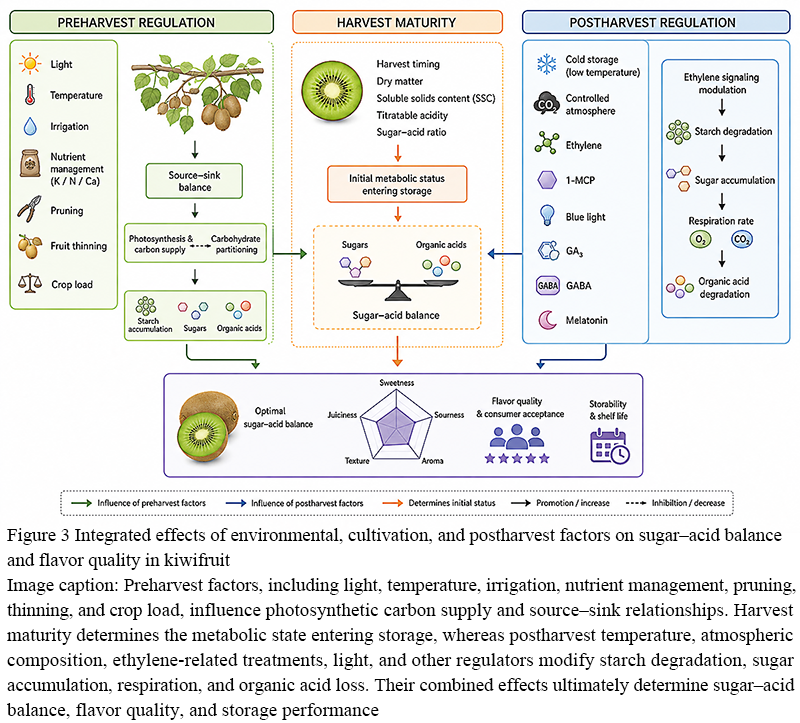 Figure 3 Integrated effects of environmental, cultivation, and postharvest factors on sugar–acid balance and flavor quality in kiwifruit Image caption: Preharvest factors, including light, temperature, irrigation, nutrient management, pruning, thinning, and crop load, influence photosynthetic carbon supply and source-sink relationships. Harvest maturity determines the metabolic state entering storage, whereas postharvest temperature, atmospheric composition, ethylene-related treatments, light, and other regulators modify starch degradation, sugar accumulation, respiration, and organic acid loss. Their combined effects ultimately determine sugar–acid balance, flavor quality, and storage performance |
8 Concluding Remarks
Sugar–acid balance in kiwifruit is regulated by a coordinated developmental program in which sugar accumulationand acid remodeling proceed together rather than independently. Across development and ripening, metabolome–transcriptome studies show that flavor formation reflects linked changes in soluble sugars, organic acids, and their regulatory genes, with network organization becoming clearer when fruit are sampled across many developmental stages. During postharvest ripening, starch reserves are converted into sucrose, glucose, and fructose while titratable acidity declines mainly through citrate degradation, producing the sensory shift from sour, firm fruit to sweet, edible fruit. This coordination is stage specific: early fruit development emphasizes starch and acid accumulation, whereas ripening activates starch breakdown, sugar release, respiratory carbon reallocation, and acid decline. Recent work also shows that this transition is not governed by ethylene alone, because cool temperature can directly activate AcBAM-centered starch degradation through the AcPUB11–AcCTS1–AcBAM3 module, linking environmental sensing to flavor formation.
Substantial progress has been made in identifying the structural genes, transcription factors, and hormonal cues involved in this process, but the regulatory architecture remains incomplete. Network studies in ‘Hongyang’ and red-fleshed kiwifruit have uncovered modules linking sugar metabolism, organic acid metabolism, and ripening-related transcription factors, yet these studies also emphasize that earlier work relied heavily on single-omics designs or limited metabolite coverage. Cultivar and species differences remain a major gap. ‘Hongyang’ and ‘Jinyan’ differ in their dominant sugar composition, A. eriantha shows distinctive high-acid behavior, early-maturing germplasm exhibits faster starch conversion under lower endogenous hormone levels, and species-level comparisons reveal divergent carbon allocation strategies between sweetness and other quality traits. Even postharvest flavor regulation can be strongly genotype dependent, as shown by varietal specificity in ‘Cuixiang’, A. melanandra, and CPPU-treated red-fleshed fruit.
Another unresolved issue is the still limited integration of metabolism, transport, and signaling across tissues and scales. Existing studies have largely succeeded in mapping changes in metabolites and candidate transcripts, but fewer have connected these data to tissue-specific transport, chromatin state, alternative splicing, long noncoding RNAs, or epigenetic regulation. This matters because flavor balance likely emerges from cross-compartment and cross-pathway coordination, not from enzyme abundance alone. Spatiotemporal networks already show that regulatory relationships differ among fruit skin, outer pericarp, inner pericarp, and core, while m6A studies show that epigenetic modifiers such as AcALKBH10 can simultaneously increase glucose, fructose, and sucrose and decrease citrate. More broadly, studies in other fruit systems indicate that integrated transcriptomic, chromatin, hormonal, and metabolomic analyses are effective for uncovering regulators of sugar and acid accumulation, suggesting a clear path forward for kiwifruit.
Future research should therefore move toward multi-omics dissection of sugar–acid regulatory networks across diverse Actinidia germplasm, tissues, environments, and postharvest conditions. Dense time-series sampling remains essential because regulatory peaks for transcripts, enzymes, and metabolites are stage dependent and may be missed by single-time-point studies. At the applied level, the field is now positioned to translate candidate genes, metabolite markers, and trait-linked SNPs into molecular breeding for flavor-balanced cultivars and into precision cultivation strategies that better align orchard climate, ripening management, and harvest timing with desired sugar–acid outcomes. Because consumers perceive flavor through the combined balance of sugars, acids, and other metabolites, breeding targets should shift from single traits such as SSC toward integrated flavor phenotypes supported by metabolomic and genetic markers.
Acknowledgments
The authors would like to express their sincere gratitude to Ms. Wang for her assistance in organizing the literature materials. The authors also extend special thanks to the two anonymous peer reviewers for their comprehensive evaluation of the manuscript.
Conflict of Interest Disclosure
The authors affirm that this research was conducted without any commercial or financial relationships that could be construed as a potential conflict of interest.
Angami T., Kalita H., Chandra A., Kumar J., Makdoh B., Singh K.S., and Touthang L., 2022, Augmenting the production and quality of kiwifruit var. Allison through manual thinning and pruning, Emergent Life Sciences Research, 8: 150-155.
https://doi.org/10.31783/elsr.2022.82150155
Bai Q., Huang Y., and Shen Y., 2021, The physiological and molecular mechanism of abscisic acid in regulation of fleshy fruit ripening, Frontiers in Plant Science, 11: 619953.
https://doi.org/10.3389/fpls.2020.619953
Baldi E., Toselli M., Bonora A., Boini A., Quartieri M., Germani M., Polidori G., and Grappadelli C.L., 2025, Agronomic strategies to manipulate kiwifruit calcium content to understand its role in fruit physiology, Horticulturae, 11(3): 237.
https://doi.org/10.3390/horticulturae11030237
Bao S., Li X., Zhang G., Han R., Li Y., Sun X., and Ma T., 2026, Integrated intelligent sensory and metabolomics elucidate the changes in sensory quality and metabolic profile during post-ripening of ‘Cuixiang’ kiwifruit, Food Chemistry: X: 103497.
https://doi.org/10.1016/j.fochx.2026.103497
Braun D.M., 2022, Phloem loading and unloading of sucrose: What a long, strange trip from source to sink, Annual Review of Plant Biology, 73(1): 553-584.
https://doi.org/10.1146/annurev-arplant-070721-083240
Braun D.M., Wang L., and Ruan Y.L., 2014, Understanding and manipulating sucrose phloem loading, unloading, metabolism, and signalling to enhance crop yield and food security, Journal of Experimental Botany, 65(7): 1713-1735.
https://doi.org/10.1093/jxb/ert416
Chai J., Li J., Liu Q., Chen Z., and Liu Z., 2024, Differential changes in respiratory metabolism and energy status in the outer pericarp and core tissues affect the ripening of ‘Xuxiang’ kiwifruit, Postharvest Biology and Technology, 212: 112876.
https://doi.org/10.1016/j.postharvbio.2024.112876
Chen C., Yuan Y., Zhang C., Li H., Ma F., and Li M., 2017, Sucrose phloem unloading follows an apoplastic pathway with high sucrose synthase in Actinidia fruit, Plant Science, 255: 40-50.
https://doi.org/10.1016/j.plantsci.2016.11.011
Cui N., Wang M., Zou Q., Wang Z., Jiang S., Chen X., Zha Y., Xiang L., and Zhao L., 2023, Water-potassium coupling at different growth stages improved kiwifruit (Actinidia spp.) quality and water/potassium productivity without yield loss in the humid areas of South China, Agricultural Water Management, 289: 108552.
https://doi.org/10.1016/j.agwat.2023.108552
Denaxa N.K., Tsafouros A., Ntanos E., Kosta A., and Roussos P.A., 2023, Mitigation of high solar irradiance and heat stress in kiwifruit during summer via the use of alleviating products with different modes of action—Part 2 effects on fruit quality, organoleptic, and phytochemical properties at harvest and after storage, Agriculture, 13(3): 701.
https://doi.org/10.3390/agriculture13030701
Ding Y., Shang C., Zhao L., Jin S., Li C., Yin S., and Ahammed G.J., 2025, Effects of irrigation and fertilization management on kiwifruit yield, water use efficiency and quality in China: A meta-analysis, Frontiers in Plant Science, 16: 1534702.
https://doi.org/10.3389/fpls.2025.1534702
Doireau R., Jaślan J., Cubero-Font P., Demes-Causse E., Bertaux K., Cassan C., Pétriarcq P., and De Angeli A., 2024, AtALMT5 mediates vacuolar fumarate import and regulates the malate/fumarate balance in Arabidopsis, New Phytologist, 244(3): 811-824.
https://doi.org/10.1111/nph.20077
Durán-Soria S., Pott D.M., Osorio S., and Vallarino J.G., 2020, Sugar signaling during fruit ripening, Frontiers in Plant Science, 11: 564917.
https://doi.org/10.3389/fpls.2020.564917
Falchi R., Bonghi C., Drincovich M.F., Famiani F., Lara M.V., Walker R.P., and Vizzotto G., 2020, Sugar metabolism in stone fruit: Source-sink relationships and environmental and agronomical effects, Frontiers in Plant Science, 11: 573982.
https://doi.org/10.3389/fpls.2020.573982
Fei L., Yuan X., Chen C., Wan C., Fu Y., Chen J., and Gan Z., 2020, Exogenous application of sucrose promotes postharvest ripening of kiwifruit, Agronomy, 10(2): 245.
https://doi.org/10.3390/agronomy10020245
Fu B.L., and Chen L.Y., 2026, Molecular orchestration of malate and citrate metabolism: Regulatory networks governing organic acid dynamics and fruit quality attributes, Horticulture Research, 13(2): uhaf292.
https://doi.org/10.1093/hr/uhaf292
Fu B.L., Wang W.Q., Li X., Qi T.H., Shen Q., Li K., Liu X.F., Li S., Allan A., and Yin X., 2023, A dramatic decline in fruit citrate induced by mutagenesis of a NAC transcription factor, AcNAC1, Plant Biotechnology Journal, 21(8): 1695-1706.
https://doi.org/10.1111/pbi.14070
Goldberg T., Agra H., and Ben-Arie R., 2021, Quality of ‘Hayward’ kiwifruit in prolonged cold storage as affected by the stage of maturity at harvest, Horticulturae, 7(10): 358.
https://doi.org/10.3390/horticulturae7100358
Gong X., Lin M., Song J., Mao J., Yao D., Gao Z., and Wang X., 2025, Genome-wide identification of the AcBAM family in kiwifruit (Actinidia chinensis cv. Hongyang) and the expression profiling analysis of AcBAMs reveal their role in starch metabolism, BMC Plant Biology, 25(1): 415.
https://doi.org/10.1186/s12870-025-06425-w
Huang X.Y., Wang C.K., Zhao Y.W., Sun C.H., and Hu D.G., 2021, Mechanisms and regulation of organic acid accumulation in plant vacuoles, Horticulture Research, 8.
https://doi.org/10.1038/s41438-021-00702-z
Huang X.Y., Xiang Y., Zhao Y.W., Wang C.K., Wang J.H., Wang W.Y., Liu X.L., Sun Q., and Hu D.G., 2023, Regulation of a vacuolar proton-pumping P-ATPase MdPH5 by MdMYB73 and its role in malate accumulation and vacuolar acidification, Abiotech, 4(4): 303-314.
https://doi.org/10.1007/s42994-023-00115-7
Huang Y., Jiang K., Liu H., Song S., Zhao Y., He B., Lan J., and Liu L., 2025, Transcriptome and selected metabolite analyses reveal points of sugar metabolism in the developing leaves of kiwifruit, Frontiers in Plant Science, 16: 1618801.
https://doi.org/10.3389/fpls.2025.1618801
Iglesias-Sanchez A., García-Carbonell S., Fernie A.R., Pujol M., and Florez-Sarasa I., 2026, Fruit respiration: Putting alternative pathways into perspective, New Phytologist, 250(1): 54-73.
https://doi.org/10.1111/nph.70882
Jia D., Xu Z., Chen L., Huang Q., Huang C., Tao J., Qu X., and Xu X., 2023, Analysis of organic acid metabolism reveals citric acid and malic acid play major roles in determining acid quality during the development of kiwifruit (Actinidia eriantha), Journal of the Science of Food and Agriculture, 103(12): 6055-6069.
https://doi.org/10.1002/jsfa.12678
Jiang Y., Qi Y., Chen X., Yan Q., Chen J., Liu H., Shi F., Wen Y., Cai C., and Ou L., 2023, Combined metabolome and transcriptome analyses unveil the molecular mechanisms of fruit acidity variation in litchi (Litchi chinensis Sonn.), International Journal of Molecular Sciences, 24(3): 1871.
https://doi.org/10.3390/ijms24031871
Kang H.H., Oh E.U., Lee K.U., Kwack Y.B., Lee M.H., and Song K.J., 2021, Comparison of fruit development characteristics and sucrose metabolizing enzyme activity in different kiwifruit cultivars, Horticultural Science and Technology, 39(2): 213-223.
https://doi.org/10.7235/hort.20210019
Lee U., Eo H.J., Jung C.R., and Kim Y., 2025, Cold storage characteristics of hardy kiwifruit, Actinidia arguta ‘Autumn Sense’: Comparison between two cold storage temperatures, Frontiers in Plant Science, 16: 1692735.
https://doi.org/10.3389/fpls.2025.1692735
Li A., Meng Y., Chen X., Zeng Z., Zhao Z., Li T., Ding G., Atkinson R., Huang Y., Cheng Y., Deng X., and Zeng Y., 2026, A cool temperature-induced ubiquitination-controlled transcription factor promotes starch degradation and ripening in kiwifruit, Plant Communications, 7(7).
https://doi.org/10.1016/j.xplc.2026.101736
Li X., Peng W., Zhang M., Zhao Q., Fang Y., Sun X., and Ma T., 2024, Mechanisms of texture and cell microstructure changes during post-ripening of ‘Cuixiang’ kiwifruit, Postharvest Biology and Technology, 207: 112596.
https://doi.org/10.1016/j.postharvbio.2023.112596
Li Y., Liu H., Yao X., Wang J., Feng S., Sun L., S., Xu K., Chen L., and Sui X., 2021, Hexose transporter CsSWEET7a in cucumber mediates phloem unloading in companion cells for fruit development, Plant Physiology, 186(1): 640-654.
https://doi.org/10.1093/plphys/kiab046
Liao G., Liu Q., Xu X., He Y., Li Y., Wang H., Ye B., Huang C., Zhong M., and Jia D., 2021, Metabolome and transcriptome reveal novel formation mechanism of early mature trait in kiwifruit (Actinidia eriantha), Frontiers in Plant Science, 12: 760496.
https://doi.org/10.3389/fpls.2021.760496
Lievre D.L., Anderson R., Boldingh H., Cooney J., Seelye R., Gould N., Hunter D., Jensen D., Pereira T., Wohlers M., Clearwater M., and Richardson A., 2021, Modifying carbohydrate supply to fruit during development changes the composition and flavour of Actinidia chinensis var. chinensis ‘Zesy002’ kiwifruit, Plants, 10(7): 1328.
https://doi.org/10.3390/plants10071328
Lim S., Lee J.G., and Lee E.J., 2017, Comparison of fruit quality and GC-MS-based metabolite profiling of kiwifruit ‘Jecy green’: Natural and exogenous ethylene-induced ripening, Food Chemistry, 234: 81-92.
https://doi.org/10.1016/j.foodchem.2017.04.163
Lin M., Gao Z., Wang X., Mao J., Pan L., Gong X., Yao D., Zhong H., and Huo H., 2024, Identification of two postharvest ripening regulatory models in kiwifruit: Based on plant hormones, physiology, and transcriptome analysis, BMC Plant Biology, 24(1): 1121.
https://doi.org/10.1186/s12870-024-05817-8
Lin Y., Tang H.Q., Zhao B., Lei D., Zhou X., Yao W., Fan J., Zhang Y., Chen Q., Wang Y., Li M., He W., Luo Y., Wang X., Tang H., and Zhang Y., 2022, Comparative changes of health-promoting phytochemicals and sugar metabolism of two hardy kiwifruit (Actinidia arguta) cultivars during fruit development and maturity, Frontiers in Plant Science, 13: 1087452.
https://doi.org/10.3389/fpls.2022.1087452
Liu N., Chen Y., Yang C., Zhang P., and Xie G., 2021, Ripening and ethylene production affected by 1-MCP in different parts of kiwifruit during postharvest storage, International Journal of Food Properties, 24(1): 1011-1021.
https://doi.org/10.1080/10942912.2021.1953071
Liu X., Tang S., Ji N., Lei J., Chen C., Zheng P., Liu B., and Wang R., 2026, Different treatments regulate starch degradation, ethylene biosynthesis, and energy metabolism involved in the preparation and shelf life of ready-to-eat kiwifruit, Food Chemistry: Molecular Sciences: 100431.
https://doi.org/10.1016/j.fochms.2026.100431
Liu X., Wu R., Bulley S., and Zhong C., 2022, Kiwifruit MYBS1-like and GBF3 transcription factors influence L-ascorbic acid biosynthesis by activating transcription of GDP-L-galactose phosphorylase 3, New Phytologist, 234: 1782-1800.
https://doi.org/10.1111/nph.18097
Ma B., Liao L., Fang T., Peng Q., Ogutu C., Zhou H.F., and Han Y., 2019, A Ma10 gene encoding P-type ATPase is involved in fruit organic acid accumulation in apple, Plant Biotechnology Journal, 17(3): 674-686.
Ma L., Chi C., Lv S., Tong Y.A., and Yang L., 2025, Effects of different sources of potassium fertiliser on yield, fruit quality and nutrient absorption in “Harward” kiwifruit (Actinidia deliciosa), Open Life Sciences, 20(1): 20251114.
https://doi.org/10.1515/biol-2025-1114
Mao J., Gao Z., Lin M., Zhang X., Ning X., Gong X., Lu Y., Chen L., and Wang X., 2023, Targeted multi-platform metabolome analysis and enzyme activity analysis of kiwifruit during postharvest ripening, Frontiers in Plant Science, 14: 1120166.
https://doi.org/10.3389/fpls.2023.1120166
Mitalo O.W., Tokiwa S., Kondo Y., Otsuki T., Galis I., Suezawa K., Kataoka I., Doan A.T., Nakano R., Ushijima K., and Kubo Y., 2019, Low temperature storage stimulates fruit softening and sugar accumulation without ethylene and aroma volatile production in kiwifruit, Frontiers in Plant Science, 10: 888.
https://doi.org/10.3389/fpls.2019.00888
Nardozza S., Boldingh H., Osorio S., Höhne M., Wohlers M., Gleave A., Macrae E., Richardson A., Atkinson R., Sulpice R., Fernie A., and Clearwater M., 2013, Metabolic analysis of kiwifruit (Actinidia deliciosa) berries from extreme genotypes reveals hallmarks for fruit starch metabolism, Journal of Experimental Botany, 64(16): 5049-5063.
https://doi.org/10.1093/jxb/ert293
Nardozza S., Boldingh H.L., Wohlers M.W., Gleave A.P., Luo Z., Costa G., Macrae E., Clearwater M., and Richardson A.C., 2017, Exogenous cytokinin application to Actinidia chinensis var. deliciosa ‘Hayward’ fruit promotes fruit expansion through water uptake, Horticulture Research, 4.
https://doi.org/10.1038/hortres.2017.43
Niu J., Bao H., Jiao S., Duan B., Chen Y., Hu Z., Zhang L., Zhao C., Xie J., Hui W., and Wang G., 2025, Effects of γ-aminobutyric acid and melatonin on quality, physiological-biochemical characteristics, cell ultrastructure and sugar metabolism of kiwifruit during postharvest shelf life, Food Chemistry: 146923.
https://doi.org/10.1016/j.foodchem.2025.146923
Patiyal V., Rana V.S., Rana N., Hashem A., Abd_Allah E.F., and Sharma S., 2024, Appraisal of extended cane length and fruit thinning strategies on the performance of growth yield and quality of kiwifruit, Heliyon, 10(8).
https://doi.org/10.1016/j.heliyon.2024.e29546
Pawar R., and Rana V.S., 2019, Manipulation of source-sink relationship in pertinence to better fruit quality and yield in fruit crops: A review, Agricultural Reviews, 40(3): 200-207.
https://doi.org/10.18805/ag.r-1934
Paz Covarrubias M., Lillo-Carmona V., Melet L., Benedetto G., Andrade D., Maucourt M., Deborde C., Fuentealba C., Moing A., Valenzuela M., Pedreschi R., and Almeida A.M., 2021, Metabolite fruit profile is altered in response to source-sink imbalance and can be used as an early predictor of fruit quality in nectarine, Frontiers in Plant Science, 11: 604133.
https://doi.org/10.3389/fpls.2020.604133
Qi T.-H., Huang Y., Deng J.-H., Fu B.-L., Li X., Li S., Allan A.C., and Yin X.-R., 2025, Mutagenesis of AcSQBP9 in kiwifruit results in reduction of malate via alteration of the expression of a plastidial malate dehydrogenase, The Plant Journal, 121(5): e70082.
https://doi.org/10.1111/tpj.70082
Salazar J., Zapata P., Silva C., González M., Pacheco I., Bastías M., Meneses C., Jorquera C., Moreno I., Shinya P., and Infante R., 2021, Transcriptome analysis and postharvest behavior of the kiwifruit ‘Actinidia deliciosa’ reveal the role of ethylene-related phytohormones during fruit ripening, Tree Genetics and Genomes, 17(1): 8.
https://doi.org/10.1007/s11295-021-01493-z
Shu C., Liu B., Zhao H., Cui K., and Jiang W., 2024, Effect of near-freezing temperature storage on the quality and organic acid metabolism of apple fruit, Agriculture, 14(7): 1057.
https://doi.org/10.3390/agriculture14071057
Shu P., Zhang Z., Wu Y., Chen Y., Li K., Deng H., Zhang J., Zhang X., Wang J., Liu Z., Xie Y., Du K., Li M., Bouzayen M., Hong Y., Zhang Y., and Liu M., 2023, A comprehensive metabolic map reveals major quality regulations in red-flesh kiwifruit (Actinidia chinensis), New Phytologist, 238(5): 2064-2079.
https://doi.org/10.1111/nph.18840
Song X., Wang T.-T., Zhao P., Fan Y., He L.-G., Zhang Y., Wang Z.X., Xiao C., Jiang Y.-C., Song F., and Wu L., 2025, Metabolomic and transcriptomic analyses provide insights into metabolic networks during Kiyomi tangors development and ripening, Plants, 14(17): 2751.
https://doi.org/10.3390/plants14172751
Sotiropoulos T., Voulgarakis A., Karaiskos D., Chatzistathis T., Manthos I., Dichala O., and Mpountla A., 2021, Foliar calcium fertilizers impact on several fruit quality characteristics and leaf and fruit nutritional status of the ‘Hayward’ kiwifruit cultivar, Agronomy, 11(2): 235.
https://doi.org/10.3390/agronomy11020235
Tarakçioğlu C., and Öztürk Y., 2022, Effect of nitrogen and potassium fertilization on fruit yield and quality in kiwifruit, Anadolu Journal of Agricultural Sciences: 525-540.
https://doi.org/10.7161/omuanajas.1053643
Tian X., Zhu L., Yang N., Song J., Zhao H., Zhang J.F., and Li M., 2021, Proteomics and metabolomics reveal the regulatory pathways of ripening and quality in post-harvest kiwifruits, Journal of Agricultural and Food Chemistry, 69(2): 824-835.
https://doi.org/10.1021/acs.jafc.0c05492
Tipu M.M., and Sherif S.M., 2024, Ethylene and its crosstalk with hormonal pathways in fruit ripening: Mechanisms, modulation, and commercial exploitation, Frontiers in Plant Science, 15: 1475496.
https://doi.org/10.3389/fpls.2024.1475496
Titeli V.S., Michailidis M., Tanou G., and Molassiotis A., 2023, Physiological and metabolic traits linked to kiwifruit quality, Horticulturae, 9(8): 915.
https://doi.org/10.3390/horticulturae9080915
Tong Y., Su W.-Y., Chen Y., Liu X.-F., Zhang Q.-Y., Qi T.-H., Allan A.C., Li X., and Yin X.-R., 2024, Two ethylene-responsive transcription factors, AdVAL2 and AdKAN2, regulate early steps in kiwifruit starch degradation, Postharvest Biology and Technology, 216: 113058.
https://doi.org/10.1016/j.postharvbio.2024.113058
Wang R., Shu P., Zhang C., Zhang J., Chen Y., Zhang Y., Du K., Xie Y., Li M.T., Zhang Y., Li Z.-G., Grierson D., Pirrello J., Chen K.-S., Bouzayen M., and Liu M., 2021, Integrative analyses of metabolome and genome-wide transcriptome reveal the regulatory network governing flavor formation in kiwifruit (Actinidia chinensis), New Phytologist, 233(1): 373-389.
Wang Y., Dong J., Yuan X., Zheng H., Zhong C., and Zhang Q., 2025, Cracking the kiwifruit code: How cultivar and origin co-create premium quality and consumer appeal, Future Foods, 11: 100651.
https://doi.org/10.1016/j.fufo.2025.100651
Wu K., Hu C., Duan Y., Moussa M.G., Li J., Lou W., Sun X., Yan X., Tan Q., and Wu S., 2025, Potassium promotes citric acid accumulation by regulating its synthesis and vacuole storage in Newhall navel orange (Citrus sinensis), Journal of Agricultural and Food Chemistry, 73(19): 12072-12082.
https://doi.org/10.1021/acs.jafc.4c11984
Wu W., Cao S.F., Shi L.Y., Chen W., Yin X.R., and Yang Z.F., 2023, Abscisic acid biosynthesis, metabolism and signaling in ripening fruit, Frontiers in Plant Science, 14: 1279031.
Xu Y., Yang C., Zhang Y., Cao Q., Wan C., Chen C., Chen J., Huang Z., and Gan Z., 2024, Blue light treatment delays postharvest ripening of kiwifruit by suppressing ethylene biosynthesis, starch degradation, and cell wall metabolism, LWT, 199: 116105.
https://doi.org/10.1016/j.lwt.2024.116105
Yan H., Huang L., Liao Q., Xia M., Yao T., Liu H., Chen H., and Li W., 2025, Tenuazonic acid delays postharvest kiwifruit softening by inhibiting starch and cell wall degradation, and maintaining ROS homeostasis during ambient storage, International Journal of Biological Macromolecules, 318: 144780.
https://doi.org/10.1016/j.ijbiomac.2025.144780
Yang H., Li J., Li X., Wu R., Zhang X., Fan X., Li G., Gong H., Yin X.-F., and Zhang A.-D., 2023, The mechanism of gibberellins treatment suppressing kiwifruit postharvest ripening processes by transcriptome analysis, Postharvest Biology and Technology, 198: 112223.
https://doi.org/10.1016/j.postharvbio.2022.112223
Yang Y., Chen M., Zhu Q., Lv Y., Liu C., Wei Y., Cha G., Shi X., Ren X., and Ding Y., 2025, The transcription factors AdNAC3 and AdMYB19 regulate kiwifruit ripening through brassinosteroid and ethylene signaling networks, Plant Physiology, 197(3): kiaf084.
Yuan X., Fei L., Shan N., Xu Y., Xu Q., Chen C., Wan C., Gan Z., and Chen J., 2023, Expression profile of genes involved in sugar metabolism during ‘Donghong’ kiwifruit postharvest ripening, European Journal of Horticultural Science, 88(3).
https://doi.org/10.17660/ejhs.2023/016
Zeng Z., Li Y., Zhu M., Wang X., Wang Y., Li A., Chen X., Han Q., Nieuwenhuizen N.J., Ampomah-Dwamena C., Deng X., Cheng Y., Xu Q., Xiao C., Zhang F., Atkinson R., and Zeng Y., 2025, Kiwifruit spatiotemporal multiomics networks uncover key tissue-specific regulatory processes throughout the life cycle, Plant Physiology, 197(1): kiae567.
https://doi.org/10.1093/plphys/kiae567
Zhang A.D., Wang W.Q., Tong Y., Li M., Grierson D., Ferguson I., Chen K.S., and Yin X., 2018, Transcriptome analysis identifies a zinc finger protein regulating starch degradation in kiwifruit, Plant Physiology, 178(2): 850-863.
https://doi.org/10.1104/pp.18.00427
Zhang S., Niu J., Cui W., Zhang K., and Lu Y., 2026, Effects of CO2 concentration on postharvest quality of ‘Jinyan’ kiwifruit under controlled atmosphere storage: Evidence of low CO2 sensitivity, Horticulturae, 12(6): 725.
https://doi.org/10.3390/horticulturae12060725
Zheng B., Zhao L., Jiang X., Cherono S., Liu J., Ogutu C., Ntini C., Zhang X., and Han Y., 2021, Assessment of organic acid accumulation and its related genes in peach, Food Chemistry, 334: 127567.
https://doi.org/10.1016/j.foodchem.2020.127567



. PDF(735KB)
. FPDF(win)
. FPDF(mac)
. HTML
. Online fPDF
Associated material
. Readers' comments
Other articles by authors
. Kaiwen Liang

. Chunyang Zhang
Related articles
. Kiwifruit
. Sugar–acid balance
. Sugar metabolism
. Organic acid metabolism
. Quality regulation
Tools
. Email to a friend
. Post a comment