Feature Review
Effects of Calcium and Boron Nutrition on Fruit Firmness and Storage Quality of Blueberry 

2 Zhejiang Agronomist College, Hangzhou, 310021, Zhejiang, China
 Author Correspondence author
International Journal of Horticulture, 2026, Vol. 16, No. 5 doi: 10.5376/ijh.2026.16.0024
Received: 17 Jul., 2026 Accepted: 22 Aug., 2026 Published: 12 Sep., 2026
Pan J.P., 2026, Effects of calcium and boron nutrition on fruit firmness and storage quality of blueberry, International Journal of Horticulture, 16(5): 282-297 (doi: 10.5376/ijh.2026.16.0024)
Blueberry fruits are prone to softening, water loss, and decay after harvest, and fruit firmness and storage quality have become important factors affecting their commercial value. This study reviews the effects of calcium and boron nutrition on blueberry fruit firmness, storage performance, and quality formation, and analyzes the underlying mechanisms, synergistic effects, and production application strategies of these two nutrients. The results indicate that calcium improves fruit firmness and delays postharvest quality deterioration by promoting pectin cross-linking, enhancing cell wall stability, and reducing the activities of softening-related enzymes. Boron mainly influences fruit development and structural stability through its involvement in RG-II cross-linking, pollen germination, and cell expansion. Combined calcium and boron supply has the potential to synergistically improve fruit quality; however, its effectiveness is influenced by cultivar characteristics, application timing, nutrient transport efficiency, and environmental conditions. Future blueberry nutrient management should integrate nutrient diagnosis, phenological stages, and rhizosphere environment regulation to establish a precision calcium-boron management system, providing a theoretical basis for improving blueberry fruit quality and extending storage life.
1 Introduction
Blueberry is an economically and nutritionally important fruit crop worldwide, and its production has expanded rapidly in recent years. Doyle et al. (2021) reported that global blueberry production has increased approximately fourfold over the past two decades. With the growing demand for fresh blueberries, increasing attention has been directed toward postharvest quality maintenance and storage performance (Vance et al., 2017; Lopes et al., 2026). As fresh fruit supply chains continue to extend, blueberries must maintain desirable appearance, texture, and biochemical quality during postharvest transportation and storage (Vance et al., 2017; Manzi and Lado, 2019). Among these quality traits, fruit firmness is a critical indicator of blueberry market value, as it directly affects resistance to mechanical damage, transportation adaptability, and storage life (Olmedo et al., 2021; Hirzel, 2023). However, blueberry fruit is highly susceptible to softening, water loss, and decay after harvest, resulting in quality deterioration and economic losses.
The development of blueberry fruit firmness is closely associated with cell wall structure and mineral composition; therefore, calcium nutrition has become an important target for preharvest quality regulation. Calcium maintains the stability of cell walls and cell membranes, participates in pectin structural maintenance and cellular signaling regulation, and plays a crucial role in preserving fruit texture (Wang et al., 2024; Lopes et al., 2026). Previous studies have shown that higher concentrations of cell wall-bound calcium, together with specific structural characteristics of cell wall polysaccharides, including calcium-associated homogalacturonan domains and xyloglucans, are closely correlated with greater firmness during storage (Olmedo et al., 2021; Lopes et al., 2026). Calcium can also enhance pectin stability, restrict pectin degradation, and reduce the activities of softening-related enzymes, such as polygalacturonase and pectin methylesterase, thereby delaying fruit softening (Jaime-Guerrero et al., 2024; Wang et al., 2024).
Calcium nutritional regulation in blueberry is highly complex. Doyle et al. (2021) systematically summarized the physiological processes involved in calcium nutrition in blueberry and indicated that calcium uptake into fruit mainly depends on xylem transport. However, as fruit development progresses toward maturity, reduced fruit transpiration limits calcium accumulation. Previous studies have shown that calcium concentration in blueberry fruit generally declines from approximately 0.2% during early development to below 0.05% at maturity. Consequently, preharvest calcium application has received considerable attention, although its effectiveness varies substantially depending on cultivar, application timing, and treatment method. Some studies have demonstrated that calcium treatments can increase fruit firmness and reduce weight loss and decay incidence, whereas others have reported limited effects on fruit calcium concentration, firmness, and shelf-life improvement (Lobos et al., 2021b; Hirzel, 2023; Lopes et al., 2026).
Boron is another essential nutrient involved in blueberry growth and quality formation. It contributes to the maintenance of cell wall and membrane functions and plays important roles in pollen germination, pollen tube elongation, cell expansion, and fruit development (Álvarez-Herrera et al., 2025). Blueberry has a relatively short flowering and fertilization period and is therefore highly sensitive to boron availability. Boron deficiency is more likely to occur under conditions of low organic matter content, coarse-textured soils, or drought stress. Studies have shown that foliar or fertigation-based boron applications can increase boron concentrations in blueberry leaves, roots, and fruits; however, improved boron status does not necessarily translate into increased yield, fruit weight, or firmness (Arrington and DeVetter, 2017; Leon-Chang and Bryla, 2024). In addition, because the optimal range of boron availability is relatively narrow, excessive application may cause toxicity, highlighting the need for precise boron management.
Both calcium and boron participate in cell wall stabilization, membrane maintenance, and fruit quality development. In several fruit crops, combined calcium and boron applications have been shown to further improve fruit firmness and storage performance. However, blueberry responses to calcium and boron nutrition remain highly variable, which may be associated with differences in nutrient uptake capacity, transport efficiency, cultivar characteristics, developmental stage, and environmental conditions. This study analyzes the effects of calcium and boron nutrition on blueberry fruit firmness and storage quality, with particular emphasis on firmness maintenance, weight loss regulation, and postharvest quality stability. The aim is to provide a theoretical basis for precision nutrient management and quality improvement in blueberry production.
2 Physiological Basis of Blueberry Fruit Firmness Formation
2.1 Cell wall structure and firmness development
Pectin is one of the major components determining fruit firmness and is primarily distributed in the middle lamella and primary cell wall. In the middle lamella, pectin regulates adhesion between adjacent cells, whereas in the primary cell wall, pectin forms a hydrated matrix structure that influences cell wall strength and porosity characteristics (Posé et al., 2019; Huang et al., 2023). Blueberry fruit texture is closely associated with pectin composition. Pectin maintains intercellular connections, while changes in pectin solubility and side-chain structure are highly consistent with the decline in fruit firmness during ripening. Hemicellulose and cellulose also contribute to fruit firmness by strengthening the structural framework of the cell wall. Chea et al. (2019) found that blueberry fruits with higher firmness or stronger crispness generally contained higher levels of hemicellulose polysaccharides and cellulose. In particular, hemicellulose content showed a positive correlation with fruit firmness during fruit development. Although cellulose content typically changes less markedly than matrix polysaccharides during ripening, its interactions with pectin and hemicellulose remain an important basis for maintaining cell wall mechanical properties (Wang et al., 2018).
Fruit softening is mainly driven by cell wall degradation processes, including pectin solubilization and depolymerization, matrix polysaccharide remodeling, and the loss of neutral sugars from pectin side chains (Wang et al., 2018; Huang et al., 2023). In blueberry, fruit firmness decreases progressively during ripening, with the most pronounced decline occurring between the light-green and red-purple stages. This reduction is generally accompanied by disruption of parenchyma tissue microstructure, degradation of cell wall materials, increased levels of water-soluble pectin, and decreased contents of hydrochloric acid-soluble pectin and hemicellulose (Chea et al., 2019). During ripening, the activities of enzymes associated with cell wall loosening gradually increase. Changes in the activities of polygalacturonase, α-arabinofuranosidase, β-galactosidase, and xylanase-related enzymes during late ripening collectively contribute to the degradation of pectin and hemicellulose, thereby accelerating fruit softening (Hocking et al., 2016; Chea et al., 2019).
2.2 Calcium-mediated regulation of cell wall stability
Calcium primarily enhances cell wall stability by binding to de-esterified homogalacturonan (HG) regions, forming cross-linked calcium pectate networks that strengthen pectin gel structure and improve intercellular adhesion, thereby increasing fruit tissue stability. This process depends on pectin methylesterase-mediated de-esterification of pectin, as block-wise de-esterified homogalacturonan provides binding sites for Ca2+ cross-linking (Huang et al., 2023). Calcium-pectin interactions are particularly important in the middle lamella and tricellular junction regions, which serve as key sites for cell adhesion. Calcium stabilizes these cell connection areas and enhances tissue resistance to cell separation caused by internal turgor pressure (Wang et al., 2018). In blueberry, Doyle et al. (2021) found that higher fruit calcium concentrations were generally associated with increased tightly bound pectin, reduced loosely bound pectin, lower pectin solubilization, and decreased postharvest softening and water loss, indicating the important role of calcium in maintaining cell wall stability.
Studies have further demonstrated that calcium improves fruit firmness retention by maintaining cell membrane integrity and structural stability (Doyle et al., 2021; Lopes et al., 2026). Calcium deficiency often results in increased membrane leakage, abnormal cell wall degradation, and impaired fruit tissue development (Hocking et al., 2016). Although calcium plays important physiological roles in blueberry production, its accumulation in fruit is relatively limited. This is mainly because calcium is transported predominantly through the xylem and has restricted mobility via the phloem, while fruit calcium concentration generally declines during fruit development. These physiological constraints contribute to the variable quality responses observed following calcium fertilization in blueberry production (Manzi and Lado, 2019; Doyle et al., 2021).
2.3 Boron functions in cell wall formation and fruit development
Boron contributes to cell wall stability by promoting covalent cross-linking between two rhamnogalacturonan-II (RG-II) domains, forming borate diester bridges within pectic polysaccharides of the primary cell wall (Sechet et al., 2018). Under sufficient boron supply, most RG-II molecules can form dimer structures. Although RG-II represents only a minor fraction of total pectin, its cross-linking status has a substantial influence on cell wall mechanical properties and porosity. The absence of boron-mediated RG-II cross-links results in abnormal cell wall properties, reduced structural stability, and impaired plant growth. In contrast, the combined action of calcium and boron can partially alleviate defects in cell wall integrity caused by impaired pectin cross-linking (Feng et al., 2018; Sechet et al., 2018). Begum and Fry (2023) further demonstrated that boron-mediated RG-II cross-linking affects not only local cell wall architecture but also broader pectin organization by enhancing homogalacturonan-calcium interactions and reducing cell wall porosity.
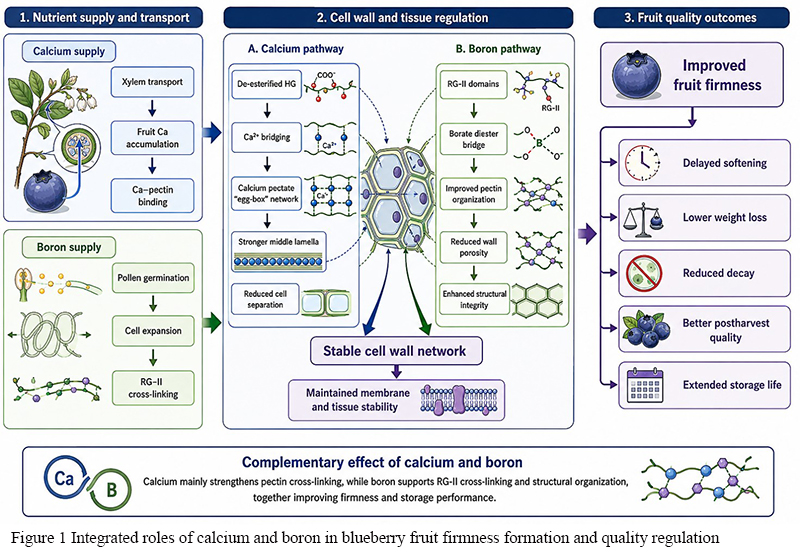
The effects of boron on fruit development extend beyond pectin cross-linking and also involve the regulation of cell expansion and normal tissue growth (Funakawa and Miwa, 2015; Begum and Fry, 2023). When RG-II dimerization is disrupted, plants commonly exhibit reduced growth, restricted cell expansion, and abnormal cell wall permeability, indicating that boron-dependent cell wall organization is essential for maintaining normal cellular expansion and development. Begum and Fry (2022) reported that borate cross-linking primarily occurs within the endomembrane system during pectin biosynthesis, while some dimerization processes may continue after pectin secretion into the cell wall. This suggests that boron availability during active growth stages may influence cell wall assembly both before and after pectin deposition. In blueberry production, boron has also received considerable attention due to its close association with reproductive growth and young fruit development (Figure 1). However, under field conditions, the effects of boron fertilization on fruit firmness and yield remain highly variable.
|
Figure 1 Integrated roles of calcium and boron in blueberry fruit firmness formation and quality regulation |
3 Effects of Calcium Nutrition on Blueberry Fruit Firmness and Storage Quality
3.1 Calcium uptake, transport, and distribution in blueberry plants
Calcium uptake begins in the root system, and its continuous absorption depends on maintaining concentration gradients across root cell membranes and a low cytosolic Ca2+ level. Calcium is subsequently transported mainly through the xylem into different plant tissues (Hocking et al., 2016; Jaime-Guerrero et al., 2024). In fruit trees and berry crops, the amount of calcium delivered to fruits is jointly determined by xylem water flow, fruit transpiration, and vascular structural characteristics, while membrane-associated transport systems regulate Ca2+ allocation among different tissues (Hocking et al., 2016). Although calcium transport mechanisms in blueberry remain insufficiently characterized, existing studies suggest that fruit transpiration intensity, xylem functionality, and calcium transporter activity are key factors influencing Ca2+ uptake and distribution in blueberry fruits, which require further investigation (Doyle et al., 2021).
Calcium accumulation in fruits mainly occurs during the early developmental stage, when cell division, rapid fruit expansion, and xylem transport activity are relatively high. During later developmental stages, the contribution of phloem transport to calcium supply remains limited because calcium has relatively low mobility within the phloem, resulting in reduced additional calcium input into fruits (Larocca et al., 2025; Rojas-Barros et al., 2025). In blueberry, fruit calcium concentration generally decreases progressively during fruit development and ripening (Figure 2). For example, Doyle et al. (2021) reported that calcium concentration in blueberry fruits declined from approximately 0.2% at early developmental stages to below 0.05% at maturity. Manzi and Lado (2019) also observed that calcium concentration in the cultivar ‘O’Neal’ decreased from 0.32% at 25 days after full bloom (25 DAFB) to 0.11% at harvest.
|
Figure 2 Developmental changes in calcium transport capacity and optimal timing of calcium application in blueberry |
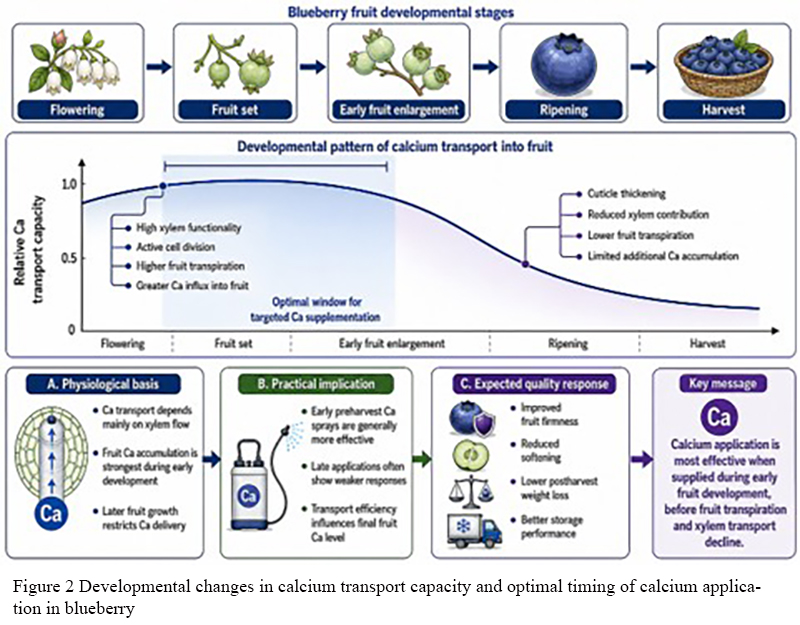
Recent hydroponic studies further indicated that calcium uptake in blueberry reaches its peak during periods of rapid vegetative growth, whereas calcium absorption becomes stable or even declines during later fruiting stages. This trend is particularly evident under high-temperature conditions and high vapor pressure deficit environments, which is consistent with the limitation of xylem-mediated calcium transport during late fruit development (Peñuelas-Montoya et al., 2026). Because fruit calcium accumulation is closely associated with transpiration and vascular continuity, calcium transport into fruits is further restricted in related berry crops as fruit development progresses, accompanied by cuticle thickening and reduced xylem functionality. These limitations ultimately affect the maintenance of postharvest quality (Rojas-Barros et al., 2025).
3.2 Effects of calcium application on fruit firmness
The primary mechanism by which calcium enhances fruit firmness is through its binding with de-esterified homogalacturonan in the cell wall, forming calcium pectate cross-linked structures that strengthen middle lamella stability and restrict cell wall degradation processes (Martins et al., 2020; Jaime-Guerrero et al., 2024). In blueberry, higher levels of cell wall-bound calcium are generally associated with greater fruit firmness. For example, Olmedo et al. (2021) compared the cell wall composition of the firm-fleshed cultivar ‘Emerald’ and the soft-fleshed cultivar ‘Jewel’ at harvest and after 30 days of storage at 0 °C. The results showed that ‘Emerald’ had higher concentrations of cell wall-bound calcium and stronger signals detected by the 2F4 antibody targeting calcium-binding HG domains. After 30 days of storage, ‘Emerald’ also exhibited increased glucose content and stronger LM15 antibody signals associated with xyloglucan structures. These findings indicate that firmness differences are not determined solely by total pectin content but are closely related to Ca2+-mediated low-methylesterified HG cross-linking and the stability of xyloglucan networks.
Increasing fruit calcium concentration can also reduce pectin solubilization and degradation. Doyle et al. (2021) found that soil calcium application increased cell wall-bound Ca2+ concentration in blueberry fruits by approximately 10% at harvest, while increasing the proportion of tightly bound pectin and decreasing loosely bound pectin fractions. These results suggest that calcium can slow down cell wall disassembly processes. Related studies in blueberry have further shown that lower fruit calcium concentrations are often accompanied by higher polygalacturonase activity during storage (Lobos et al., 2021a). During cold storage, Ca2+ signaling can suppress the activities of pectin methylesterase and polygalacturonase, thereby delaying the conversion of protopectin and chelator-soluble pectin into water-soluble pectin (Wang et al., 2024).
Multiple blueberry studies have demonstrated that preharvest calcium supplementation can reduce the rate of fruit softening and maintain tissue structural stability during storage. For instance, in ‘Liberty’ blueberry, early-season foliar calcium application increased fruit firmness by approximately 10% compared with the control, and the effect was greater than that of later applications, indicating that the early fruit developmental stage may represent a critical period for calcium-mediated firmness regulation (Lobos et al., 2021a). Doyle et al. (2021) reported that soil calcium application during the autumn of the previous year also reduced postharvest softening and improved shelf-life performance in the cultivars ‘O’Neal’ and ‘Bluecrop’. From a physiological perspective, calcium mainly maintains fruit firmness by preserving cell wall adhesion, reducing cell separation, and delaying structural deterioration of fruit tissues.
3.3 Calcium effects on postharvest quality preservation
The role of calcium in maintaining postharvest quality depends on its ability to enhance cell wall structural stability, while also being closely associated with the preservation of cell membrane integrity and regulation of water balance. Lobos et al. (2021a) reported that early preharvest calcium sprays reduced weight loss of blueberry fruits during cold storage. The water loss rate was approximately 1% lower than that of the control, and fruit calcium concentration showed a negative correlation with weight loss during storage. Another study also demonstrated that soil calcium application could reduce fruit weight loss after cold storage (Doyle et al., 2021).
Calcium can also reduce decay risk and maintain overall postharvest fruit condition. In ‘Liberty’ blueberry, early calcium application increased the proportion of healthy fruits after storage while decreasing the proportions of dehydrated and decayed fruits (Lobos et al., 2021a). This protective effect is consistent with the findings of Hocking et al. (2016), who suggested that calcium deficiency increases fruit susceptibility to pathogen infection and promotes abnormal softening, whereas sufficient calcium supply enhances apoplastic barrier function and reduces the risk of quality deterioration.
Calcium nutrition contributes to improvements in blueberry fruit firmness and storage quality; however, its effectiveness depends largely on whether calcium can reach the fruit during early developmental stages and participate in the establishment of stable cell wall and membrane structures. In addition, the response to calcium fertilization is influenced by application timing, transport efficiency, and the intrinsic calcium accumulation capacity of different cultivars (Doyle et al., 2021; Larocca et al., 2025).
4 Effects of Boron Nutrition on Blueberry Fruit Quality
4.1 Boron regulation of fruit development and structural integrity
Boron is an essential nutrient for normal plant growth and development and participates in multiple physiological processes, including cell wall formation, cell membrane maintenance, cell division, cell elongation, and carbohydrate transport. In blueberry, physiological processes such as pollen germination, fertilization, and cell expansion directly influence subsequent fruit set and fruit enlargement, and boron has been shown to be particularly important during flowering and early fruit development stages (De Silva et al., 2022). Studies in other fruit crops also support the promotive role of boron during early fruit development. Michailidis et al. (2023) reported that pre-bloom boron application in sweet cherry increased early fruit set, fruit fresh weight, and mesocarp cell expansion, indicating that adequate boron supply facilitates sink organ establishment and early fruit growth. Similar effects have been observed in pitaya, where boron application improved pollen germination capacity, fruit weight, and pulp proportion. These effects were associated with enhanced cell division, improved cell membrane integrity, and more efficient assimilate transport (Sahu et al., 2022). However, responses to boron application in blueberry production are not always consistent. Although foliar or soil boron application can improve plant boron nutritional status, it does not necessarily increase berry weight, suggesting that fruit enlargement responses to boron depend on whether plants are actually limited by boron availability, as well as on cultivar characteristics and environmental conditions (Leon-Chang and Bryla, 2024).
The effects of boron on fruit tissue strength are mainly associated with its regulation of cell wall structure. Most boron within plants is located in the cell wall, where it contributes to tissue formation by maintaining cell wall integrity and mechanical stability. Zhang et al. (2022) found that boron deficiency increased cell wall porosity, disrupted cellulose arrangement, and reduced cell wall mechanical strength, thereby promoting tissue weakening and fruit softening. In fruit crops, boron supplementation generally delays softening by reducing the activities of cell wall-degrading enzymes, such as polygalacturonase and pectin lyase, while maintaining interactions between boron and structural components including pectin, cellulose, and hemicellulose (Zhang et al., 2024; Álvarez-Herrera et al., 2025). Studies in strawberry have shown that foliar boron application can increase fruit firmness and extend shelf life, while appropriate boron supply similarly improves pulp firmness in pitaya (Sahu et al., 2022; Zhang et al., 2024). However, in blueberry, the direct effects of boron on fruit firmness remain highly variable. Leon-Chang and Bryla (2024) reported that boron treatments increased boron concentrations in leaves and fruits but did not significantly improve berry firmness. Thus, although boron has a clear physiological basis for maintaining fruit firmness, whether this function translates into measurable firmness improvement depends on specific cultivation conditions and plant nutritional status.
4.2 Boron effects on carbohydrate metabolism and quality formation
Boron participates in carbohydrate metabolism and sugar transport in plants, and boron deficiency can affect photosynthetic efficiency as well as the translocation and distribution of photosynthetic products within the plant. Overall, sugar accumulation in fruits is regulated by the coordinated effects of multiple factors, including the activities of related metabolic enzymes, sugar transport processes, mineral nutrition status, and environmental conditions (Du et al., 2024; Wu et al., 2025). In sweet cherry, boron application can induce sugar homeostasis pathways and promote the accumulation of fructose, glucose, and organic acids during early fruit development (Michailidis et al., 2023). In pitaya, boron supply increased soluble solids, sugar content, and total carbohydrate levels, while enhancing the activities of invertase and sucrose synthase, indicating that boron participates in assimilate metabolism regulation during fruit maturation (Sahu et al., 2022). Similar trends have been observed in blueberry, although the positive effects appear to be relatively limited. For example, Leon-Chang and Bryla (2024) found that boron fertigation or foliar application did not significantly increase yield or berry size, but soluble solids content increased in some cultivars, suggesting that boron may promote sugar accumulation without necessarily causing concurrent changes in external fruit characteristics.
Because sugars, organic acids, and their balance are key determinants of fruit flavor, boron nutrition can indirectly regulate flavor development by influencing carbon metabolism and fruit biochemical processes. Reviews of various fruit crops have shown that boron application generally increases soluble solids content, regulates titratable acidity and pH, and contributes to the maintenance of ascorbic acid levels, all of which are closely associated with sensory fruit quality (Thakur et al., 2023; Álvarez-Herrera et al., 2025). In citrus, Luo et al. (2024) reported that excessive boron supply reduced soluble solids, sugar content, vitamin C concentration, and sugar-acid ratio, indicating that both boron deficiency and excessive boron availability may negatively affect flavor-related quality formation. In blueberry, direct evidence regarding the effects of boron on flavor quality remains limited. However, increases in soluble solids content observed in some cultivars following foliar or fertigation-based boron application suggest that, under appropriate conditions, boron may contribute to the development of sweeter fruits (Leon-Chang and Bryla, 2024).
4.3 Boron deficiency and its impact on blueberry production
Boron deficiency commonly occurs in acidic and high-rainfall cultivation environments. This issue is particularly important in blueberry production because low soil pH reduces boron availability, while strong leaching processes can further accelerate boron loss from the root zone (Reyes-Díaz et al., 2024; Vera-Maldonado et al., 2024). Symptoms of boron deficiency in blueberry mainly include shoot tip necrosis, leaf mottling and chlorosis, leaf curling, shortened internodes, reduced leaf area, and restricted new shoot growth (Arrington and DeVetter, 2017; Meriño-Gergichevich et al., 2017). De Silva et al. (2022) found that with increasing boron deficiency severity, flower buds may fail to open normally, pollen tube growth can be inhibited, seed development may be impaired, and fruit deformation may occur, highlighting the essential role of boron in reproductive tissue development. In various fruit crops, boron deficiency has also been associated with physiological disorders and reduced commercial fruit quality (Álvarez-Herrera et al., 2025).
Both male and female reproductive tissues have relatively high boron requirements, and boron deficiency can reduce pollen production, pollen viability, pollen tube elongation, and the functionality of transmitting tissues (De Silva et al., 2022). However, studies in blueberry have shown that even when tissue boron concentrations are increased, correcting low boron status does not necessarily improve fruit set or yield, indicating that boron availability represents only one of multiple factors limiting production performance (Arrington and DeVetter, 2017; Leon-Chang and Bryla, 2024). The optimal range between boron deficiency and toxicity is relatively narrow and is influenced by cultivar differences, making excessive boron application more likely to exceed suitable levels under intensive fertilization conditions.
Excessive boron supply can inhibit plant growth, reduce photosynthetic efficiency, and subsequently affect yield and fruit quality. Such effects have been demonstrated in blueberry and other fruit crops (Luo et al., 2024; Reyes-Díaz et al., 2024). Therefore, the objective of boron management in blueberry production should be to maintain an appropriate nutritional level. Proper control of boron application rates and timing is essential for maximizing its beneficial effects on fruit development and quality formation while avoiding potential toxicity risks.
5 Synergistic Effects of Calcium and Boron Nutrition on Blueberry Quality
5.1 Interaction between calcium and boron in cell wall formation
Calcium and boron act on different components of fruit cell walls, and their synergistic effects are mainly reflected in pectin stabilization and the maintenance of cell wall structural integrity. Lopes et al. (2026) reported that blueberry fruit texture is highly dependent on cell wall composition, cell membrane integrity, and pectin structures responsible for connecting adjacent cells. Cell wall-bound Ca2+ enhances pectin stability and regulates the activities of cell wall degradation-related enzymes. In various fruit systems, both calcium and boron interact with pectin structures and jointly contribute to the stability of cell wall networks. Calcium mainly enhances pectin network stability through the formation of “egg-box” structures between Ca2+ and de-esterified pectin, whereas boron improves cell wall adhesion and rigidity by participating in the formation of borate ester bonds associated with RG-II (Figure 3). Du et al. (2025) reported in citrus that combined Ca+B treatment reduced water-soluble pectin content while increasing the proportions of CDTA-soluble pectin and sodium carbonate-soluble protopectin, indicating that this treatment delayed pectin solubilization and enhanced peel structural stability.
|
Figure 3 Complementary roles of calcium and boron in maintaining blueberry cell wall integrity Image caption: Calcium and boron maintain blueberry fruit cell wall stability through complementary functions. Calcium primarily binds to de-esterified homogalacturonan (HG) to form calcium pectate cross-linked structures, thereby enhancing middle lamella stability. Boron promotes RG-II dimerization and borate ester bridge formation, improving pectin network integrity. The synergistic effects of calcium and boron reduce cell wall degradation and membrane damage, thereby delaying fruit softening and improving fruit firmness and storage stability |
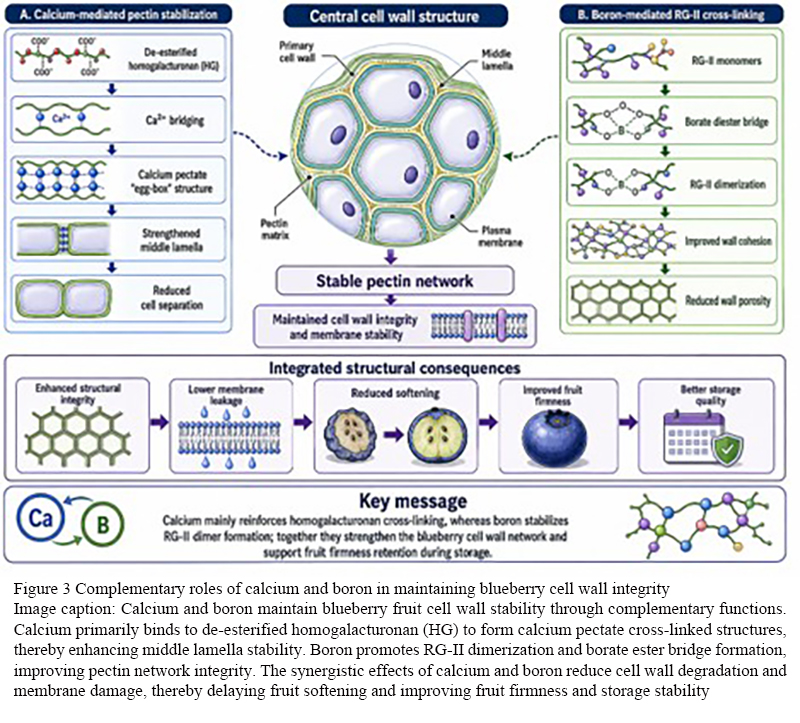
Similar mechanisms have been demonstrated in tomato and strawberry. In tomato, boron was found to promote calcium distribution in the symplast and reduce pectin methylesterase activity (Gholamnejad et al., 2023). In strawberry, boron maintained cell wall-bound boron levels and promoted cross-linking interactions between boron and structural components such as pectin, cellulose, and hemicellulose, thereby improving cell wall stability during storage (Zhang et al., 2024).
Calcium and boron also exhibit complementary effects in maintaining fruit firmness. Calcium mainly increases tissue strength by enhancing middle lamella stability and the structural integrity of cell wall polysaccharide networks, whereas boron contributes to firmness preservation by limiting pectin degradation and softening-related cell wall disassembly processes (Khalaj et al., 2016; Álvarez-Herrera et al., 2025). In apple, postharvest calcium treatment and combined calcium-boron treatment both delayed fruit softening, primarily through reduced pectin solubilization and decreased activities of pectin lyase, β-galactosidase, and α-L-arabinofuranosidase, although calcium treatment showed a stronger effect than boron application alone (Mohebbi et al., 2020). In tomato, Haleema et al. (2024) found that combined Ca+B treatment improved fruit firmness more effectively than either nutrient applied separately, which was attributed to boron-mediated enhancement of calcium metabolism and reinforcement of cell wall cross-linked polymer networks. Liu et al. (2022) reported that calcium treatment increased apricot fruit firmness by 41.53% while reducing the activities of polygalacturonase, β-galactosidase, and pectin methylesterase. Strawberry studies have also shown that foliar boron application can increase fruit firmness and delay firmness loss during storage (Zhang et al., 2024). For blueberry, this synergistic mechanism has strong physiological relevance. During blueberry ripening and storage, continuous pectin solubilization contributes to fruit softening and firmness loss. However, responses under commercial production conditions remain strongly influenced by cultivar characteristics and application timing, and consistent improvements are not observed under all circumstances.
5.2 Combined effects on fruit development and storage performance
Calcium–boron combined nutrition can improve fruit size and quality components in some fruit crops; however, compared with other fruit trees, blueberry exhibits a more complex response to this combined treatment. El-Motaium et al. (2025) found that combined application of nano-calcium and boron resulted in the highest mango yield, while also improving fruit firmness, total soluble solids content, and reducing acidity. In strawberry, Ca+B treatment increased fruit firmness, soluble solids, sugar content, vitamin C, anthocyanin content, and marketable fruit yield (Mohamed et al., 2021). However, research results in blueberry are not entirely consistent. In the southern highbush blueberry cultivar ‘Sharpblue’, preharvest boric acid + CaCl2 foliar application increased yield and extended storage duration, while combined nutrient treatment reduced physiological weight loss and decay rate under cold storage conditions (Negi and Upadhyay, 2024). However, in northern highbush blueberry, repeated foliar applications of calcium and boron did not increase fruit firmness, single fruit weight, fruit set rate, or yield. Although calcium concentrations in plant tissues changed after treatment, fruit calcium concentration did not increase significantly (Arrington and DeVetter, 2017). These differences indicate that the effects of calcium-boron synergism on blueberry fruit size and firmness largely depend on cultivar characteristics, initial nutritional status, and the efficiency of nutrient transport into developing fruits.
Currently, the most convincing evidence for calcium–boron synergistic effects is mainly focused on postharvest quality maintenance. In blueberry, Lobos et al. (2021a) reported that early calcium application increased fruit firmness of ‘Liberty’ blueberry by approximately 10%, reduced water loss, increased the proportion of healthy fruits, and decreased decay and dehydration after storage, indicating that calcium application timing plays an important role in storage performance. Reviews related to blueberry also indicate that storage losses mainly result from water loss, fungal infection, and continuous weakening of cell wall structures. When preharvest nutrient management effectively enhances fruit structural stability, it has the potential to improve storage performance (Lopes et al., 2026). However, not all calcium-based nutritional programs can extend shelf life. Vance et al. (2017) evaluated CaCl2, CaCl2+B, calcium silicate, chelated calcium, and calcium acetate in strawberry, raspberry, blackberry, and four blueberry cultivars, including Spartan, Liberty, Draper, and Legacy, with calcium concentrations ranging from 0.05% to 0.30%. Treatments were applied three to four times continuously from the immature green fruit stage, and fruit quality was evaluated at 5, 10, 15, and 20 days after harvest. The results showed that none of the treatments significantly altered calcium concentrations in leaves or fruits, nor did they improve fruit firmness, skin toughness, weight loss rate, collapse rate, or shelf life. Electrostatic spraying also did not outperform conventional spraying. These findings indicate that simply increasing spray coverage does not necessarily mean that calcium can effectively enter fruit tissues or cell wall structures.
5.3 Nutrient balance and optimization strategies
Improvement of fruit quality depends more on the balance between calcium and boron supply rather than simply increasing the input of a single element. For example, in tomato, higher calcium levels combined with higher boron supply resulted in better quality and yield performance. Meanwhile, boron was able to modify calcium distribution within plants and fruits, increase symplastic Ca content, and slightly enhance the transfer index from apoplast to symplast (Gholamnejad et al., 2023). Haleema et al. (2024) also found in tomato that Ca+B treatment had a significantly greater effect on improving fruit firmness than calcium or boron application alone. Moreover, boron increased fruit calcium content, indicating that boron may promote calcium binding and utilization within cell wall structures. El-Motaium et al. (2025) reported that in mango, the optimal treatment was not the highest nano-calcium application rate, but rather 250 mg/L boron combined with 50% of the recommended nano-calcium level, further demonstrating that appropriate nutrient ratios and balanced supply are more beneficial for quality formation than simply increasing nutrient inputs. This principle is also applicable to blueberry because fruit firmness is closely associated with pectin structure and cell wall-bound calcium, while boron may participate in cell wall maintenance and reproductive development processes. However, direct studies on the optimal Ca:B ratio in blueberry remain limited.
Optimization of calcium and boron nutrition also requires avoiding nutrient imbalance, inappropriate application timing, and low nutrient utilization efficiency. Calcium is mainly transported through the xylem, while fruit transpiration is relatively low; therefore, calcium delivery to fruits is often restricted. Meanwhile, both calcium and boron have certain limitations in their transport and distribution within plants. Compared with non-targeted fertilization, multiple foliar applications during critical developmental stages are often more effective. Arrington and DeVetter (2017) demonstrated in blueberry that conventional foliar calcium and boron applications do not necessarily improve fruit quality when plant nutritional status, cultivar differences, and nutrient transport efficiency are not considered, because treatments may only increase leaf boron concentration without improving fruit calcium levels, firmness, shelf life, fruit set, or yield.
6 Integrated Calcium and Boron Management for Blueberry Production
6.1 Optimization of calcium and boron application strategies
During the period from flowering to fruit maturity, plant nutrient requirements and nutrient transport capacity undergo significant changes. Therefore, integrated calcium and boron management in blueberry should be regulated according to phenological stages. During flowering and early fruit set stages, calcium and boron are closely associated with reproductive success. Insufficient nutrient supply during flowering, ovule fertilization, and young fruit development may reduce fruit set, with boron being particularly important for pollen germination and cell elongation (Álvarez-Herrera et al., 2025). During the early fruit expansion stage, before extensive cuticle formation occurs, calcium absorption and transport into fruits are relatively efficient. Therefore, the first few weeks after flowering are generally considered the optimal period for targeted calcium supplementation to fruits (Lopes et al., 2026). As fruits enter the ripening stage, reduced fruit transpiration and increased wax deposition on the cuticle restrict nutrient entry, resulting in gradually reduced calcium uptake capacity. Meanwhile, under high-temperature and high vapor pressure deficit stress conditions, calcium and boron uptake may also become stabilized or even decline (Arrington and DeVetter, 2017; Lopes et al., 2026). This developmental pattern explains why early calcium spraying in ‘Liberty’ blueberry improved fruit firmness and reduced weight loss, whereas later applications showed relatively weaker effects (Lobos et al., 2021a).
Current studies indicate that the focus of calcium and boron management in blueberry should be maintaining appropriate nutrient supply and optimizing application timing rather than simply increasing fertilizer inputs. In ‘Draper’ and ‘Bluecrop’ blueberry, Arrington and DeVetter (2017) found that continuous calcium and boron spraying from the early pink bud stage to the end of flowering increased leaf boron concentration but did not improve fruit calcium concentration, fruit set, yield, single fruit weight, or firmness, indicating that routine annual applications do not necessarily result in quality improvements. Similarly, foliar calcium application at recommended concentrations during the green fruit stage in multiple blueberry cultivars did not increase fruit calcium levels, firmness, or shelf life, suggesting that nutrient delivery efficiency into fruits remains a limiting factor (Vance et al., 2017). In contrast, preharvest application of 400-800 g Ca/ha improved postharvest quality in ‘Liberty’ blueberry, while high-frequency calcium spraying beginning at mid-full bloom in ‘Draper’ blueberry alleviated green fruit drop. These results indicate that cultivar differences, nutrient deficiency status, and application timing are more decisive factors determining final outcomes than simply supplying nutrients.
For boron management, current recommendations suggest supplementing 0.4-2.5 kg/ha boron when summer leaf boron concentrations in blueberry are ≤30 ppm, while foliar spraying concentrations exceeding approximately 500 ppm may increase the risk of phytotoxicity (Arrington and DeVetter, 2017; Leon-Chang and Bryla, 2024). Controlled environment studies further demonstrated that a foliar boron concentration of approximately 400 mg/L was safer and more effective than 800 mg/L, as excessive boron reduced photosynthetic performance and increased lipid peroxidation levels (Hirzel et al., 2025; Lopes et al., 2026). Currently, direct studies on the optimal Ca:B ratio in blueberry remain insufficient. However, studies in tomato, mango, strawberry, and Asian pear have consistently shown that, under appropriate nutrient ratios, combined Ca+B application generally improves fruit firmness, soluble solids content, and yield more effectively than single nutrient treatments, whereas excessive nutrient supply does not further enhance fruit quality (Mohamed et al., 2021; Gholamnejad et al., 2023; El-Motaium et al., 2025).
6.2 Integration of nutrient management with orchard practices
Irrigation strategy is an important component of the blueberry calcium and boron management system, as the uptake and transport of both elements are highly dependent on xylem transport and water movement in the rhizosphere. Boron mainly enters blueberry roots through mass flow, making boron deficiency more likely in coarse-textured soils with low organic matter content. Under such conditions, drip irrigation combined with fertigation is generally more suitable than large-scale soil fertilization for maintaining a stable boron supply. A field study conducted in Oregon by Leon-Chang and Bryla (2024) showed that weekly boron fertigation from April to July was the only approach that increased soil extractable boron concentrations to recommended levels, whereas foliar boron application was more effective in increasing boron concentrations in leaves, roots, and fruits. Irrigation conditions also influence calcium use efficiency because under low transpiration conditions, calcium accumulation in fruits is usually lower than that in leaves, and high root-zone temperatures during later growth stages can further restrict calcium and boron uptake.
Studies on sweet cherry provide additional mechanistic insights. Under boron-deficient soil conditions, calcium allocation to branches, leaves, and edible tissues was reduced, while more calcium remained in roots and seeds, indicating that boron deficiency may impair effective calcium transport and distribution within plants (Bonomelli et al., 2025). Therefore, in blueberry production, calcium and boron nutritional management should consider the interactions between these two elements to achieve synergistic regulation. Rhizosphere chemical conditions determine whether applied calcium and boron can be effectively absorbed and utilized by plants. Blueberry prefers acidic soil conditions; however, excessively low pH and high rainfall conditions generally reduce boron availability, while excessive concentrations of aluminum, iron, and manganese in acidic substrates may also inhibit calcium uptake (Zydlik et al., 2022; Leon-Chang and Bryla, 2024). In soilless cultivation systems, the proportion of ammonium nitrogen and the type of nitrogen fertilizer can also alter nutrient balance. For example, Anwar et al. (2024) found that an NH4+:NO3- ratio of 50:50 increased leaf calcium content, promoted flowering and fruiting, and enhanced photosynthetic capacity. However, under potted conditions, increasing ammonium sulfate application increased leaf calcium content in some cultivars but reduced leaf boron levels in most cultivars.
The suitable range of soil calcium availability in blueberry is relatively narrow and shows strong site-specific variation. Under commercial production conditions, low-dose soil calcium application increased exchangeable calcium content but did not improve fruit firmness, size, or weight in ‘Duke’ and ‘Legacy’ blueberry (Hirzel, 2023). Optimization of the root-zone environment requires comprehensive consideration of soil pH, nitrogen forms, water supply, soil physical properties, and the nutrient requirements of specific cultivars.
6.3 Application of calcium and boron regulation in quality-oriented production
For blueberry production targeting high quality and high commercial value, the currently more reliable strategy is to implement early precise calcium supplementation combined with boron nutritional management based on boron deficiency risk assessment. Existing studies have shown that calcium has the most significant effects on fruit firmness and storage performance when it can effectively enter fruits and increase fruit calcium levels. For example, in ‘Liberty’ blueberry, early preharvest calcium application increased fruit firmness, reduced polygalacturonase activity, and decreased decay and dehydration, thereby improving postharvest quality (Lobos et al., 2021a). Some foliar fertilizers containing calcium and micronutrients have also been shown to increase blueberry fruit weight, firmness, soluble solids content, and post-storage quality; however, these effects are usually influenced by the combined action of multiple components in the formulations and cannot be fully attributed to calcium alone (Zydlik et al., 2022).
In contrast, boron management plays a more consistent role in maintaining normal reproductive development and can increase soluble solids content in some cultivars through foliar spraying or fertigation (Leon-Chang and Bryla, 2024). Negi and Upadhyay (2024) found in southern highbush blueberry that preharvest CaCl2, boric acid, and their combined treatments all reduced physiological weight loss and decay rate during cold storage, indicating that appropriate calcium–boron combinations have the potential to extend storage life.
Sustainable high-quality blueberry production requires the establishment of an integrated nutrient management system based on cultivar characteristics, tissue nutrient diagnosis, and orchard stress management. Blueberry responses to calcium are highly variable, the optimal range of boron availability is relatively narrow, and the transport of both elements into fruits is subject to certain limitations. Future sustainable management strategies should integrate leaf and soil testing results, implement precise fertigation or foliar fertilization according to phenological stages, and strengthen pH regulation and rhizosphere ecological management. Lopes et al. (2026) demonstrated that rhizosphere microbial inoculation and other preharvest regulation measures can promote nutrient uptake in blueberry and improve fruit size, yield, and firmness. Therefore, calcium and boron nutritional management should shift from a single fertilizer input model toward an integrated regulation system based on plant requirements, environmental conditions, and quality objectives, thereby achieving coordinated improvement of fruit quality and efficient resource utilization.
7 Concluding Remarks
Calcium and boron are important mineral nutrients affecting blueberry fruit firmness formation and postharvest quality maintenance. Their functions are mainly associated with cell wall structural stability, membrane system maintenance, and fruit development regulation. Calcium forms stable pectin cross-linked structures by binding with de-esterified pectin, thereby enhancing middle lamella stability, reducing pectin degradation and cell separation, and delaying fruit softening. Boron contributes to fruit structural formation through RG-II cross-linking, maintenance of cell wall integrity, and promotion of pollen germination and young fruit development. Both nutrients participate in the construction of cell wall networks, providing a physiological basis for maintaining blueberry fruit texture and storage stability.
Current studies indicate that preharvest calcium supplementation has relatively clear effects on improving blueberry fruit firmness and delaying postharvest quality deterioration; however, its effectiveness is highly dependent on application timing, cultivar characteristics, and calcium transport efficiency into fruits. For example, early preharvest calcium spraying in ‘Liberty’ blueberry increased fruit firmness and reduced weight loss and decay risk, whereas later applications showed relatively limited effects. This difference is mainly related to the fact that calcium transport into blueberry fruits relies predominantly on xylem movement, while fruit transpiration decreases and calcium accumulation capacity declines during ripening. In comparison, boron plays a more stable role in maintaining normal reproductive development and the formation of certain quality traits. However, increasing boron levels in plants or fruits does not necessarily directly translate into improvements in firmness and yield, as its effects are constrained by nutritional status and environmental conditions.
Combined calcium and boron regulation provides a new management approach for improving blueberry quality. Theoretically, calcium mainly enhances pectin network stability, whereas boron contributes to RG-II cross-linking and improves cell wall structure, indicating complementary functions between these two nutrients. However, the synergistic effects of calcium and boron in blueberry production remain highly variable. Some studies have demonstrated improvements in firmness, weight loss reduction, and storage performance, whereas others have not observed significant quality enhancement. These differences indicate that simply increasing calcium and boron inputs does not guarantee improved fruit quality. Instead, the efficiency of nutrient transport into fruits, the synchronization between application timing and critical developmental stages, and the intrinsic nutrient uptake and utilization capacity of cultivars may be more important than fertilizer input levels alone.
Calcium and boron management in blueberry production should shift from a traditional nutrient supplementation approach toward a precision regulation model based on cultivar characteristics, nutritional diagnosis, and fruit developmental stages. Currently, a more reasonable production strategy is to conduct targeted calcium supplementation during the early post-flowering period, evaluate boron deficiency risks according to soil and leaf nutrient status, and improve nutrient utilization efficiency through integrated measures such as drip irrigation, fertigation, and rhizosphere environment optimization. Future research should further investigate calcium and boron uptake and transport mechanisms in blueberry, optimal Ca:B ratios, and differences in cultivar responses, thereby establishing a more precise and efficient quality-oriented nutrient management system to achieve coordinated improvements in fruit firmness, storage life, and resource utilization efficiency.
Acknowledgments
The authors would like to express their sincere gratitude to Mr. Li for his assistance in organizing the literature materials. The authors also extend special thanks to the two anonymous peer reviewers for their comprehensive evaluation of the manuscript.
Conflict of Interest Disclosure
The authors affirm that this research was conducted without any commercial or financial relationships that could be construed as a potential conflict of interest.
Anwar A., Zheng J., Chen C., Chen M., Xue Y., Wang J., Su W., Chen R., and Song S., 2024, Effects of NH4+-N: NO3−-N ratio on growth, nutrient uptake and production of blueberry (Vaccinium spp.) under soilless culture, Frontiers in Plant Science, 15: 1438811.
https://doi.org/10.3389/fpls.2024.1438811
Arrington M., and DeVetter L.W., 2017, Foliar applications of calcium and boron do not increase fruit set or yield in northern highbush blueberry (Vaccinium corymbosum), HortScience, 52(9): 1259-1264.
https://doi.org/10.21273/hortsci12207-17
Begum R.A., and Fry S.C., 2022, Boron bridging of rhamnogalacturonan-II in Rosa and Arabidopsis cell cultures occurs mainly in the endo-membrane system and continues at a reduced rate after secretion, Annals of Botany, 130(5): 703-715.
https://doi.org/10.1093/aob/mcac119
Begum R.A., and Fry S.C., 2023, Arabinogalactan-proteins as boron-acting enzymes, cross-linking the rhamnogalacturonan-II domains of pectin, Plants, 12(23): 3921.
https://doi.org/10.3390/plants12233921
Bonomelli C., Arredondo G., Nario A., Artacho P., and Contreras C., 2025, Calcium allocation to the tree canopy and the edible part of sweet cherry fruit is hindered by boron soil deficiency, Agronomy, 15(3): 691.
https://doi.org/10.3390/agronomy15030691
Chea S., Yu D.J., Park J., Oh H.D., Chung S.W., and Lee H.J., 2019, Fruit softening correlates with enzymatic and compositional changes in fruit cell wall during ripening in ‘Bluecrop’ highbush blueberries, Scientia Horticulturae, 245: 163-170.
https://doi.org/10.1016/j.scienta.2018.10.019
De Silva A.L., Kämper W., Wallace H.M., Ogbourne S.M., Bai S.H., Nichols J., and Trueman S.J., 2022, Boron effects on fruit set, yield, quality and paternity of macadamia, Agronomy, 12(3): 684.
https://doi.org/10.3390/agronomy12030684
Doyle J.W., Nambeesan S.U., and Malladi A., 2021, Physiology of nitrogen and calcium nutrition in blueberry (Vaccinium sp.), Agronomy, 11(4): 765.
https://doi.org/10.3390/agronomy11040765
Du K., Lin H., Luo Q., Li T., Wu H., Wang B., Guo Z., Pan T., and She W., 2025, Calcium and boron foliar fertilizer to relieve cracking of ‘Liuyuezao’ pummelos, Foods, 14(4): 595.
https://doi.org/10.3390/foods14040595
Du M., Zhu Y., Nan H., Zhou Y., and Pan X., 2024, Regulation of sugar metabolism in fruits, Scientia Horticulturae, 326: 112712.
https://doi.org/10.1016/j.scienta.2023.112712
El-Motaium R.A.E., Shaban A.E.S., Badawy E.S.H., and Ibrahim A.S., 2025, The potential role of nano-calcium and boron in increasing mango fruits productivity, quality and antioxidant content, Journal of Plant Nutrition, 48(9): 1529-1546.
https://doi.org/10.1080/01904167.2024.2445087
Feng W., Kita D.W., Peaucelle A., Cartwright H.N., Doan V., Duan Q., Liu M., Maman J., Steinhorst L., Schmitz-Thom I., Yvon R., Kudla J., Wu H.-M., Cheung A., and Dinneny J., 2018, The FERONIA receptor kinase maintains cell-wall integrity during salt stress through Ca2+ signaling, Current Biology, 28(5): 666-675.
https://doi.org/10.1016/j.cub.2018.01.023
Funakawa H., and Miwa K., 2015, Synthesis of borate cross-linked rhamnogalacturonan II, Frontiers in Plant Science, 6: 223.
https://doi.org/10.3389/fpls.2015.00223
Gholamnejad S., Haghighi M., Etemadi N., and Pessarakli M., 2023, Effects of boron on nutrient partitioning, Ca movement, and fruit quality of tomatoes, Journal of Plant Nutrition, 46(5): 697-713.
https://doi.org/10.1080/01904167.2022.2071731
Haleema B., Shah S.T., Basit A., Hikal W.M., Arif M., Khan W., Ahl H.S.-A.S., and Fhatuwani M.N., 2024, Comparative effects of calcium, boron, and zinc inhibiting physiological disorders, improving yield and quality of Solanum lycopersicum, Biology, 13(10): 766.
https://doi.org/10.3390/biology13100766
Hirzel J., 2023, Can the firmness, weight, and size of blueberry fruit be enhanced through the application of low amounts of calcium to the soil?, Plants, 13(1): 1.
https://doi.org/10.3390/plants13010001
Hirzel J., Muñoz V., Moya-Elizondo E., Balbontín C., and Uribe H., 2025, Nitrogen rate affects fruit production and leaf nutrient concentration of nine pot-grown blueberry cultivars, Journal of Plant Nutrition, 48(5): 827-838.
https://doi.org/10.1080/01904167.2024.2415469
Hocking B., Tyerman S.D., Burton R.A., and Gilliham M., 2016, Fruit calcium: Transport and physiology, Frontiers in Plant Science, 7: 569.
https://doi.org/10.3389/fpls.2016.00569
Huang W., Shi Y., Yan H., Wang H., Wu D., Grierson D., and Chen K., 2023, The calcium-mediated homogalacturonan pectin complexation in cell walls contributes the firmness increase in loquat fruit during postharvest storage, Journal of Advanced Research, 49: 47-62.
https://doi.org/10.1016/j.jare.2022.09.009
Jaime-Guerrero M., Álvarez-Herrera J.G., and Fischer G., 2024, Effect of calcium on fruit quality: A review, Agronomía Colombiana, 42(1): 1-14.
https://doi.org/10.15446/agron.colomb.v42n1.112026
Khalaj K., Ahmadi N., and Souri M.K., 2016, Improvement of postharvest quality of Asian pear fruits by foliar application of boron and calcium, Horticulturae, 3(1): 15.
https://doi.org/10.3390/horticulturae3010015
Larocca G.N., Baldi E., and Toselli M., 2025, Understanding the role of calcium in kiwifruit: Ion transport, signaling, and fruit quality, Horticulturae, 11(3): 335.
https://doi.org/10.3390/horticulturae11030335
Leon-Chang D.P., and Bryla D.R., 2024, Applying boron by fertigation or as a foliar fertilizer is more effective than soil applications in northern highbush blueberry, HortScience, 59(5): 565-570.
https://doi.org/10.21273/hortsci17461-23
Liu M., Li J., Zong W., Sun W., Mo W., and Li S., 2022, Comparison of calcium and ultrasonic treatment on fruit firmness, pectin composition and cell wall-related enzymes of postharvest apricot during storage, Journal of Food Science and Technology, 59(4): 1588-1597.
https://doi.org/10.1007/s13197-021-05170-w
Lobos T.E., Retamales J.B., and Hanson E.J., 2021a, Early preharvest calcium sprays improve postharvest fruit quality in ‘Liberty’ highbush blueberries, Scientia Horticulturae, 277: 109790.
https://doi.org/10.1016/j.scienta.2020.109790
Lobos T.E., Retamales J.B., Luengo Escobar A., and Hanson E.J., 2021b, Timing of foliar calcium sprays improves fruit firmness and antioxidants in “Liberty” blueberries, Journal of Soil Science and Plant Nutrition, 21(1): 426-436.
https://doi.org/10.1007/s42729-020-00371-2
Lopes T., Silva A.P., Vicente A.A., and Gonçalves B., 2026, A comprehensive overview of strategies to improve blueberry fruit quality, Frontiers in Plant Science, 17: 1833867.
https://doi.org/10.3389/fpls.2026.1833867
Luo Z., Zhang L., Hu W., Wang Y., Tao J., Jia Y., Miao R., Chen L.-S., and Guo J., 2024, Excessive boron fertilization-induced toxicity is related to boron transport in field-grown pomelo trees, Frontiers in Plant Science, 15: 1438664.
https://doi.org/10.3389/fpls.2024.1438664
Manzi M., and Lado J., 2019, Foliar applications of calcium do not impact on fruit and leaf nutrient concentration or quality of ‘O’Neal’ blueberry, The Journal of Horticultural Science and Biotechnology, 94(5): 676-684.
https://doi.org/10.1080/14620316.2019.1577185
Martins V., Garcia A., Alhinho A.T., Costa P., Lanceros-Méndez S., Costa M.M.R., and Gerós H., 2020, Vineyard calcium sprays induce changes in grape berry skin, firmness, cell wall composition and expression of cell wall-related genes, Plant Physiology and Biochemistry, 150: 49-55.
https://doi.org/10.1016/j.plaphy.2020.02.033
Meriño-Gergichevich C., Reyes-Díaz M., Guerrero J., and Ondrasek G., 2017, Physiological and nutritional responses in two highbush blueberry cultivars exposed to deficiency and excess of boron, Journal of Soil Science and Plant Nutrition, 17(2): 307-318.
https://doi.org/10.4067/S0718-95162017005000024
Michailidis M., Bazakos C., Kollaros M., Adamakis I.D.S., Ganopoulos I., Molassiotis A., and Tanou G., 2023, Boron stimulates fruit formation and reprograms developmental metabolism in sweet cherry, Physiologia Plantarum, 175(3): e13946.
https://doi.org/10.1111/ppl.13946
Mohamed M.H., Petropoulos S.A., and Ali M.M.E., 2021, The application of nitrogen fertilization and foliar spraying with calcium and boron affects growth aspects, chemical composition, productivity and fruit quality of strawberry plants, Horticulturae, 7(8): 257.
https://doi.org/10.3390/horticulturae7080257
Mohebbi S., Babalar M., Zamani Z., and Askari M.A., 2020, Influence of early season boron spraying and postharvest calcium dip treatment on cell-wall degrading enzymes and fruit firmness in ‘Starking Delicious’ apple during storage, Scientia Horticulturae, 259: 108822.
https://doi.org/10.1016/j.scienta.2019.108822
Negi N., and Upadhyay S.K., 2024, Foliar nutrition induced changes in quality and storability of southern highbush blueberry cv. Sharpblue, Indian Journal of Horticulture: 167-173.
https://doi.org/10.58993/ijh/2024.81.2.8
Olmedo P., Zepeda B., Rojas B., Silva-Sanzana C., Delgado-Rioseco J., Fernández K., Balic I., Arriagada C., Moreno A., Defilippi B., and Campos-Vargas R., 2021, Cell wall calcium and hemicellulose have a role in the fruit firmness during storage of blueberry (Vaccinium spp.), Plants, 10(3): 553.
Peñuelas-Montoya F., López-Bautista E., Fortunato R.M., Posos-Parra O.A., and Miranda-Valdez J.A., 2026, Precision nutrient management in hydroponic blueberry (Vaccinium corymbosum L.) under climatic stress: Uptake dynamics and accumulation patterns, Notulae Scientia Biologicae, 18(1): 12820.
https://doi.org/10.55779/nsb18112820
Posé S., Paniagua C., Matas A.J., Gunning A.P., Morris V.J., Quesada M.A., and Mercado J.A., 2019, A nanostructural view of the cell wall disassembly process during fruit ripening and postharvest storage by atomic force microscopy, Trends in Food Science & Technology, 87: 47-58.
https://doi.org/10.1016/j.tifs.2018.02.011
Reyes-Díaz M., Cárcamo-Fincheira P., Tighe-Neira R., Nunes-Nesi A., Savouré A., and Inostroza-Blancheteau C., 2024, Effects of foliar boron application on physiological and antioxidants responses in highbush blueberry (Vaccinium corymbosum L.) cultivars, Plants, 13(11): 1553.
https://doi.org/10.3390/plants13111553
Rojas-Barros P., Wernow J., Workmaster B.A., Zalapa J., Devi J.M., and Atucha A., 2025, Fruit cuticle thickness and anatomical changes in pedicel xylem vessels influence fruit transpiration and calcium accumulation in cranberry fruit, Physiologia Plantarum, 177(1): e70036.
https://doi.org/10.1111/ppl.70036
Sahu A., Kishore K., Dash S., Sahoo S.C., Nayak R., Baidya B.K., Shukla K., and Barik S., 2022, Foliar feeding of boron influencing biochemical attributes and enzyme activity in dragon fruit (Selenicereus monacanthus), Notulae Botanicae Horti Agrobotanici Cluj-Napoca, 50(4): 12777.
https://doi.org/10.15835/nbha50312777
Sechet J., Htwe S., Urbanowicz B.R., Agyeman A., Feng W., Ishikawa T., Colomes M., Kumar K., Kawai-Yamada M., Dinneny J., O’Neill M., and Mortimer J., 2018, Suppression of Arabidopsis GGLT1 affects growth by reducing the L-galactose content and borate cross-linking of rhamnogalacturonan-II, The Plant Journal, 96(5): 1036-1050.
https://doi.org/10.1111/tpj.14088
Thakur S., Sinha A., and Ghosh Bag A., 2023, Boron—a critical element for fruit nutrition, Communications in Soil Science and Plant Analysis, 54(21): 2899-2914.
https://doi.org/10.1080/00103624.2023.2252878
Vance A.J., Jones P., and Strik B.C., 2017, Foliar calcium applications do not improve quality or shelf life of strawberry, raspberry, blackberry, or blueberry fruit, HortScience, 52(3): 382-387.
https://doi.org/10.21273/hortsci11612-16
Vera-Maldonado P., Aquea F., Reyes-Díaz M., Cárcamo-Fincheira P., Soto-Cerda B., Nunes-Nesi A., and Inostroza-Blancheteau C., 2024, Role of boron and its interaction with other elements in plants, Frontiers in Plant Science, 15: 1332459.
https://doi.org/10.3389/fpls.2024.1332459
Wang C., Zhang S., Han Y., Li L., Ban Z., and Lu P., 2024, γ irradiation mediated the inhibitory effect of Ca2+ signals on softening of blueberry fruit during cold storage, Food Bioscience, 57: 103513.
https://doi.org/10.1016/j.fbio.2023.103513
Wang D., Yeats T.H., Uluisik S., Rose J.K., and Seymour G.B., 2018, Fruit softening: Revisiting the role of pectin, Trends in Plant Science, 23(4): 302-310.
https://doi.org/10.1016/j.tplants.2018.01.006
Wu J., Lu L., Meng Z., Qin Y., Guo L., Ran M., Peng P., Tang Y., Huang G., Li W., and Li L., 2025, Advancements on the mechanism of soluble sugar metabolism in fruits, Horticulturae, 11(9): 1001.
https://doi.org/10.3390/horticulturae11091001
Zhang C., He M., Jiang Z., Liu L., Pu J., Zhang W., Wang S., and Xu F., 2022, The xyloglucan endotransglucosylase/hydrolase gene XTH22/TCH4 regulates plant growth by disrupting the cell wall homeostasis in Arabidopsis under boron deficiency, International Journal of Molecular Sciences, 23(3): 1250.
https://doi.org/10.3390/ijms23031250
Zhang L., Sun C., Tian H., Xu J., and Wu X., 2024, Foliar spraying of boron prolongs preservation period of strawberry fruits by altering boron form and boron distribution in cell, Frontiers in Plant Science, 15: 1457694.
https://doi.org/10.3389/fpls.2024.1457694
Zydlik Z., Zydlik P., Kafkas N.E., Yesil B., and Cieśliński S., 2022, Foliar application of some macronutrients and micronutrients improves yield and fruit quality of highbush blueberry (Vaccinium corymbosum L.), Horticulturae, 8(7): 664.
https://doi.org/10.3390/horticulturae8070664
Álvarez-Herrera J.G., Marilcen J.G., and Fischer G., 2025, The effect of boron on fruit quality: A review, Horticulturae, 11(8): 992.
https://doi.org/10.3390/horticulturae11080992


. PDF(1170KB)
. HTML
Associated material
. Readers' comments
Other articles by authors
. Jianping Pan

Related articles
. Blueberry
. Calcium nutrition
. Boron nutrition
. Fruit firmness
. Storage quality
. Precision nutrient management
Tools
. Email to a friend
. Post a comment