Research Report
Evaluation of Growth and Yield Parameters of Okra (Abelmoschus esculentus) Varieties at Chakarghatta, Sarlahi 
 ,
Anil Poudyal2
 ,
Dinesh Khanal3
2 Department of Agricultural Economics and Agribusiness Management, Agriculture and Forestry University, Rampur, Chitwan, 44209, Nepal
3 Department of Plant Breeding and Genetics, Agriculture and Forestry University, Rampur, Chitwan, 44209, Nepal
Author Correspondence author
International Journal of Horticulture, 2026, Vol. 16, No. 5 doi: 10.5376/ijh.2026.16.0024
Received: 23 Jul., 2026 Accepted: 25 Aug., 2026 Published: 23 Sep., 2026
Pyakurel A., Poudyal A., and Khanal D., 2026, Evaluation of growth and yield parameters of okra (Abelmoschus esculentus) varieties at Chakarghatta, Sarlahi, International Journal of Horticulture, 16(5): 298-304 (doi: 10.5376/ijh.2026.16.0024)
Farmers continue to struggle with the productivity and production of Okra. One of the main causes of the low productivity of Okra is lack of high yielding varieties. In order to determine the yield of various okra types under open field circumstances, field experiments were conducted from 2025 March 2 to June 14. Seven treatments with three replications in RCBD made up the trial. The treatments included seven different varieties of okra: Arka Anamika, Selection no.07, Bhindi F1, Rohini, Super Anamika, NOL 303 Julie and Swaraj Pan 2155. Among the various variety maximum plant height was obtained in Bhindi F1(9.80 cm) and minimum plant height was obtained in Selection no. 07 (6.93 cm) at 30 DAS. The maximum leaf number was observed in Selection No.07 (47.93) and minimum leaf number was observed in Swaraj Pan 2155 (26.20) at 70 DAS. Moreover, the highest number of primary branches were found in Selection No.07 (3.58). Arka Anamika reached the earliest among the varieties in days to 50% flowering (52.67 DAS). On contrary to this Swaraj Pan (10.46) obtained the maximum number of pods. The pod length was highest in Swaraj Pan 2155 (13.39 cm) and lowest in NOL303 Julie (9.64 cm). Further, the study shows no difference in the girth of pod and individual weight of pod. Maximum yield was obtained by Swaraj Pan 2155 (7.04 t/ha) and minimum in Super Anamika (3.91 t/ha). So, from our study Swaraj Pan 2155 is inferred as high yielding variety and best suited for Chakarghatta, Sarlahi.
1 Introduction
Okra (Abelmoschus esculentus L. Moench) is one of the most widely cultivated and utilized vegetable crops belonging to the family Malvaceae, and it possesses the highest chromosome number (2n=130) among cultivated vegetables. The crop is known by various local names across the world, such as "lady's finger" in England, "gumbo" in the United States, "bhindi" in India, and "bamia" in Ethiopia (Mkhabela et al., 2022). It is an economically important vegetable crop grown widely in the tropical and subtropical regions of the world (Oyelade et al., 2003). India is the world's leading okra-producing country, with Uttar Pradesh, Bihar, and West Bengal as the major producing states (Swamy, 2023).
Despite these shared nutritional and economic benefits, individual okra genotypes differ considerably in their growth habit, flowering behavior, pod characteristics, and yield potential. These differences arise not only from genetic makeup but also from strong genotype-environment interactions, meaning that a variety bred or selected for one agroecological zone does not necessarily perform equally well under different soil, temperature, and photoperiod conditions. Consequently, varietal performance evaluation trials are essential before recommending a cultivar for a new production environment, since a single variety is unlikely to be optimal across all climatic and agroecological conditions.
In Nepal, several studies have evaluated okra varieties across different agroecological regions, and their results consistently demonstrate that varietal performance is location-dependent. In Chitwan, trials on spacing and mulching have shown clear yield and growth responses under local conditions (Jha et al., 2018). More recent Chitwan-based studies on seed priming have similarly reported significant genotype-linked variation in germination and yield traits. In Morang district, cultivation-method trials have documented distinct growth and yield responses of okra to spacing and mulching practices under the local subtropical climate (Shreevastav et al., 2023).
Although these studies confirm that okra varieties respond differently depending on the growing environment, systematic, comparative information on okra varietal performance specific to the Chakarghatta area of Sarlahi district remains lacking. Sarlahi lies in the Terai agroecological belt, which differs in soil type, temperature regime, and rainfall pattern from Chitwan and Morang where the above trials were conducted. Because varietal response to growth and yield traits is strongly influenced by local agroecological conditions, findings from these other regions cannot be reliably extrapolated to predict variety performance in Sarlahi. This creates a clear need for location-specific varietal evaluation before any variety can be confidently recommended to farmers of this region.
Therefore, the present study was undertaken to evaluate the growth, flowering, and yield performance of different okra varieties under the agroclimatic conditions of Chakarghatta, Sarlahi, with the objective of identifying variety best suited for higher productivity in this region. It is expected that the findings will provide farmers and extension agencies in Sarlahi with reliable, location-specific varietal recommendations and contribute to filling the existing information gap on okra variety performance in this agroecological zone.
2 Materials and Methods
2.1 Experimental site
The research was conducted in the farmer’s field in Chakarghatta rural municipality, Khoriya, Sarlahi district, Madhesh province. This region lies in Terai of Nepal covering area of 25.16 Square Kilometer. Sarlahi district is in latitude 26°58’08.04” North and 85°34’ 06.24” East longitudes. The research site was located at Chakarghatta rural municipality, Khoriya, Sarlahi. The average highest and lowest temperature is 37.3 °C and 12.03 °C. The soil type of this area is Sandy loam, moderately acidic in soil reaction.
2.2 Research detail
The experiment was conducted in randomized complete block design (RCBD) with seven treatments and three replications (Table 1). All together there were 21 plots, each plot containing 4 rows and 5 plants per row. Each plot contained 20 Plants where inner 5 plants was selected as sample. Net experiment plot was 3.5 meter square, having spacing of 0.5 m between treatment and 1m between replications. Total area for research was 110.5 meter square. The spacing between row to row is 50 centimeter and plant to plant is 30 centimeter. Recommended dose of fertilizer is applied in the field (118:79:39 NPK kg/ha), 0.43 kg of potassium and 0.86 kg phosphorous and 0.65 kg of nitrogen was applied during sowing time and remaining dose of Nitrogen (0.32 kg) was applied at two split doses. Weeding was carried out and irrigation was done at weekly interval.
|
Table 1 Treatment consists of seven different varieties |

2.3 Data collection
From each experimental plot randomly 5 inner plants were selected for data collection. Tagging of plants were done using colorful plastics. Plant height and number of leaves were recorded from randomly selected 5 plants at every 10 days interval. Similarly, number of branches were recorded at 60 DAS. Days to 50% flowering was recorded. The total number of pods from the selected plants was recorded. And it was converted into number of pods per plant. Weight of pod was measured in gram by using digital weighing machine. And it was converted into ton per hectare based on yield per plant.
2.4 Statistical analysis
The collected data was entered into MS Excel (2019) and analyzed using r- studio (4.5.1 version). The mean comparison was done using DMRT.
3 Results and Analysis
3.1 Plant height
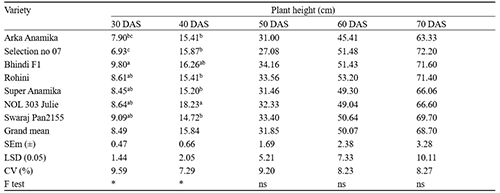
The statistical analysis indicates that there is significant difference at 5% level of significance between the plant height of different varieties at observation of 30 DAS (Table 2). Bhindi F1 produce the maximum plant height (9.80 cm). The minimum plant height was produced by Selection no. 07 (6.93 cm). The study shows a significant difference in plant height at 5% level of significance at 40 DAS. The maximum plant height is attained by NOL 303 Julie (18.23 cm) and minimum by Swaraj Pan (14.72). The study shows that the difference in the plant height among the varieties is insignificant after 40 DAS.
|
Table 2 Plant height of different varieties of okra at Chakarghatta, Sarlahi Note: LSD: Least Significant Difference, SEm: Standard Error of Mean; CV: Coefficient of Variation, letters “a”, “b”, “c” represent the ranking of treatments according to DMRT at 0.05 level of significance, DAS: Days After Sowing, ns: Non-Significant, * significant at 5% level of significance, ** significant at 1% level of significance, *** significant at 0.1% level of significance |
3.2 Number of leaves
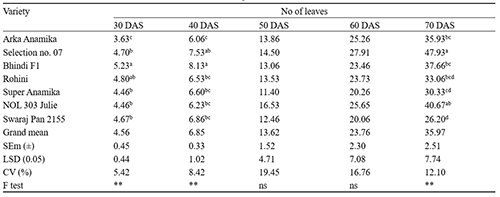
The data recorded at 30 DAS shows significant result in the leaf number at 1% level of significance where maximum leaf number is observed in Bhindi F1(5.23) which is at par with variety Rohini (Table 3). Similarly, minimum number of leaves is observed in Arka Anamika (3.63). Furthermore, at 40 DAS maximum leaf number is observed in Bhindi F1 (8.13) and minimum leaf number is observed in Arka Anamika (6.06). Additionally, Rohini, Super Anamika, NOL 303 Julie and Swaraj Pan 2155 are statistically similar. The observation of leaf number is statistically similar at 50 and 60 DAS. Moreover, Maximum leaf number is observed in Selection no 07 (47.93) at 70 DAS.
|
Table 3 Number of leaves of different varieties of okra at Chakarghatta, Sarlahi Note: LSD: Least Significant Difference, SEm: Standard Error of Mean; CV: Coefficient of Variation, letters “a”, “b”, “c” represent the ranking of treatments according to DMRT at 0.05 level of significance, DAS: Days After Sowing, ns: Non-Significant, * significant at 5% level of significance, ** significant at 1% level of significance, *** significant at 0.1% level of significance |
3.3 Number of lateral branches
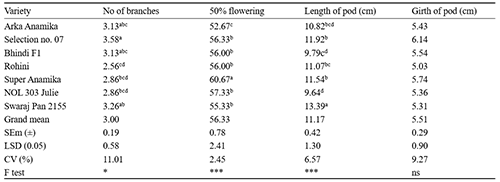
There is a significant difference in the number of lateral branches among the varieties at 5% level of significance. The highest number of lateral branches is observed in Selection no. 07 (3.58). Likewise, Super Anamika (2.86) and NOL 303 Julie are statistically similar and minimum number of lateral branches is observed in Rohini (2.56).
3.4 Days to 50 % flowering
There is a significant result in 50% flowering at 0.1% level of significance where Arka Anamika reached the earliest among the varieties in days to 50% flowering (52.67 DAS). Similarly, Selection no.07 attained 50% flowering at 56.33 DAS which is at par with Bhindi F1, Rohini, NOL 303 Julie and Swaraj Pan 2155 whereas late flowering occurs in Super Anamika (60.67 DAS).
3.5 Length and girth of pod
Length of pod is found statistically significant at 0.1% level of significant (Table 4). The highest fruit length is found in Swaraj Pan 2155 (13.39 cm) followed by Selection no. 07 (11.92 cm) and super Anamika (11.54 cm) which is at par with Rohini (11.07 cm). the lowest pod length is found in NOL 303 Julie (9.64 cm) which is statistically similar with Bhindi F1 (9.79 cm). The average fruit girth is statistically similar ranging from 6.14 cm to 5.03 cm.
|
Table 4 Number of branches, 50% flowering, length of pod and girth of pod of different varieties of okra at Chakarghatta, Sarlahi Note: LSD: Least Significant Difference, SEm: Standard Error of Mean; CV: Coefficient of Variation, letters “a”, “b”, “c” represent the ranking of treatments according to DMRT at 0.05 level of significance, DAS: Days After Sowing, ns: Non-Significant, * significant at 5% level of significance, ** significant at 1% level of significance, *** significant at 0.1% level of significance |
3.6 Number of pod and pod weight
The number of pods per plant is statistically significant at 0.1% level of significance (Table 5). The maximum number of pods is found in Swaraj Pan 2155 (10.46) followed by Rohini (8.50) and NOL 303 Julie (7.50). Similarly, minimum number of pods is found in Super Anamika (5.10) which is at par with Arka Anamika, Selection no.07 and Bhindi F1.
|
Table 5 Number of pods, weight per pod, yield per plant and yield per hectare of pod of different varieties of Okra at Chakarghatta, Sarlahi Note: LSD: Least Significant Difference, SEm: Standard Error of Mean; CV: Coefficient of Variation, letters “a”, “b”, “c” represent the ranking of treatments according to DMRT at 0.05 level of significance, DAS: Days After Sowing, ns: Non-Significant, * significant at 5% level of significance, ** significant at 1% level of significance, *** significant at 0.1% level of significance |
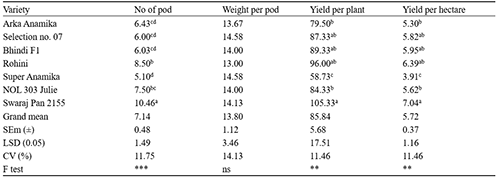
The individual pod weight is statistically similar ranging from 14.58 to 13 gram.
3.7 Yield per plant and yield per hectare
Yield per plant is found to be statistically significant at 1% level of significant (Table 5). The maximum yield per plants obtained in Swaraj Pan 2155 (105.33 gram) where Selection no.07, Bhindi F1 and Rohini are statistically at par and minimum yield per plant is found in Super Anamika (58.73) gram.
Similar result is recorded in yield per hectare where maximum yield per hectare is obtained in Swaraj Pan 2155 (7.04 ton per hectare) which is statistically at par with Selection no.07, Bhindi F1 and Rohini. Similarly, minimum yield is recorded in Super Anamika (3.91 ton per hectare).
4 Discussion
The height variation observed among varieties is more plausibly attributed to inherent genotypic differences than to agronomic factors, a pattern also reported by Magar et al. (2024). Notably, Selection No. 07, despite being the shortest variety, produced the highest number of leaves and primary branches, suggesting a possible compensatory growth pattern in which reduced height was associated with greater lateral branching and foliage production rather than height acting as a limiting factor for leaf development. Magar et al. (2024) similarly proposed that branch number, plant height, and photosynthetic capacity could jointly contribute to differences in leaf number among hybrids. This trend is further supported by Dulal et al. (2024), who reported statistically significant differences in leaf number across most growth stages except at 20 DAS. In the present study, leaf number was statistically similar at 50 and 60 DAS, possibly reflecting reduced nutrient demand for vegetative growth at these later stages.
Delayed flowering, as observed in some varieties, may similarly be linked to prolonged vegetative growth induced by environmental factors such as photoperiod (Aminu et al., 2016). Pod length in the present study was consistent with Khan et al. (2000), though slightly higher value, a difference likely attributable to genotypic variation among varieties. Pod diameter was statistically similar to that reported by Nepali et al. (2025), possibly reflecting the strong adaptability of these cultivars to local environmental conditions (Rahman et al., 2012).
Among the varieties, Swaraj Pan 2155 recorded the highest pod number, longest pods, and highest yield, despite producing fewer leaves and flowering later than Arka Anamika. This combination indicates that, among the traits examined, pod number and pod length contributed more directly to yield than either leaf number or flowering time. The significance of pod number as a yield-determining trait is further supported by Jonah and Kwaga (2019) and Reddy et al. (2012). Pod weight values in the present study, ranging from 13.00 to 14.50 g, fall within the range reported by Nepali et al. (2025) and are broadly consistent with Chaudhary et al. (2023), who observed pod weight ranging from 14.20 to 18.90 g across different mulching treatments. Taken together, the yield differences among varieties appear closely linked to branch number and pod number, both of which showed a direct relationship with final yield in this study.
5 Conclusion
The experimental results show that the different plant parameters help to predict the overall yield and performance of the specific plant. Flowering commences 52 to 60 days after sowing, with early flowering at 52 days for Arka Anamika. Production was varied according to number of pod and weight of pod. Highest yield and maximum number of pods is observed in Swaraj Pan 2155.
Through our experiment, Swaraj Pan 2155 was considered as the high yielding variety among all and best suited to Chakarghatta, Sarlahi. Single field experiment is not suitable for valid result. So similar research trial in the location should be done.
Authors’ contributions
APY carried out the conceptualization of research, designed the experiment, collect the data and drafted the manuscript. AP helped in data analysis and helped to draft the manuscript. DK helped to draft the manuscript and supervision of the research. All authors read and approved the final manuscript.
Acknowledgment
The authors are thankful towards Agriculture and Forestry University, Nepal for academic purpose and Agriculture Knowledge Center, Sarlahi for providing technical support throughout the research period.
Conflict of Interest Disclosure
The authors affirm that this research was conducted without any commercial or financial relationship that could be contruct as a potential conflict of interest.
Aminu D., Bello O.B., Gambo B.A., Azeez A.H., Agbolade O.J., Iliyasu A., and Abdulhamid U.A., 2016, Varietal performance and correlation of okra pod yield and yield components, Acta Universitatis Sapientiae, Agriculture and Environment, 8(1): 112-125.
https://doi.org/10.1515/ausae-2016-0010
Chaudhary B.L., Dholi P.K., Adhikari S., and Khatiwada P., 2023, Efficacy of different mulching materials on performance and yield of okra in Mahottari, Nepal, Journal of Wastes and Biomass Management, 5(1): 41-46.
https://doi.org/10.26480/jwbm.01.2023.41.46
Dulala S., Niraulaa R.K.D., and Neupaneb S., 2024, Effect of spacing on growth and production of okra in Mahottari, Nepal, Agribusiness, 8(2): 72-77.
https://doi.org/10.26480/amdn.02.2024.72.77
Jha R.K., Neupane R.B., Khatiwada A., Pandit S., and Dahal B.R., 2018, Effect of different spacing and mulching on growth and yield of okra (Abelmoschus esculentus L.) in Chitwan, Nepal, Journal of Agriculture and Natural Resources, 1(1): 168-178.
https://doi.org/10.3126/janr.v1i1.22232
Jonah P.M., and Kwaga Y.M., 2019, Genetic interrelationship among quantitative traits and path analysis of some West African okra (Abelmoschus caillei) genotypes, Agricultural Science and Technology, 11(1): 3.
https://doi.org/10.15547/ast.2019.01.001
Khan H., Khan M., Rasul K., and Bhatti A., 2000, Response of different cultivars of okra (Abelmoschus esculentus L.) to three different sowing dates in the mid hill of Swat Valley, Pakistan Journal of Biological Sciences, 3(12): 2010-2012.
https://doi.org/10.3923/pjbs.2000.2010.2012
Magar A.P., Paudel L.K., Ojha A., Thapa S., and Joshi S., 2024, Comparative evaluation of growth and yield parameters of different okra varieties in Lamjung, Nepal, Asian Journal of Agricultural and Horticultural Research, 11(3): 91-100.
https://doi.org/10.9734/ajahr/2024/v11i3332
Mkhabela S.S., Shimelis H., Gerrano A.S., and Mashilo J., 2022, Phenotypic and genotypic divergence in okra [Abelmoschus esculentus (L.) Moench] and implications for drought tolerance breeding: A review, South African Journal of Botany, 145: 56-64.
https://doi.org/10.1016/j.sajb.2020.12.029
Nepali U., Pathak S., Adhikari S., Khatri R., Adhikari S., and Baniya P., 2025, Performance evaluation of different varieties of okra (Abelmoschus esculentus L.) in Pyuthan District, Nepal, International Journal of Horticulture, 15(2): 73-79.
https://doi.org/10.5376/ijh.2025.15.0008
Oyelade O.J., Ade-Omowaye B.I.O., and Adeomi V.F., 2003, Influence of variety on protein, fat contents and some physical characteristics of okra seeds, Journal of Food Engineering, 57(2): 111-114.
https://doi.org/10.1016/S0260-8774(02)00279-0
Rahman K., Waseem K., Kashif M., Jilani M.S., Kiran M., Ghazanfarullah G., and Mamoon-Ur-Rashid M., 2012, Performance of different okra (Abelmoschus esculentus L.) cultivars under the agro-climatic conditions of Dera Ismail Khan, Pakistan Journal of Science, 64: 316-319.
Reddy M.T., Babu K.H., Ganesh M., Reddy K.C., Begum H., Reddy B.P., and Narshimulu G., 2012, Genetic variability analysis for the selection of elite genotypes based on pod yield and quality from the germplasm of okra (Abelmoschus esculentus L. Moench), Journal of Agricultural Technology: 639-655.
Shreevastav C.K., Panthi B., Kattel D., and Dahal J., 2023, Differential response of spacing and mulching materials on growth and yield of okra (Abelmoschus esculentus L.) in Morang, Nepal, Food and Agri Economics Review, 3(2): 67-72.
https://doi.org/10.26480/faer.02.2023.67.72
Swamy K.R.M., 2023, Origin, distribution, taxonomy, botanical description, cytogenetics, genetic diversity and breeding of okra (Abelmoschus esculentus (L.) Moench.), International Journal of Development Research, 13(3): 62026-62046.


. PDF(344KB)
. HTML
Associated material
. Readers' comments
Other articles by authors
. Aakriti Pyakurel

. Anil Poudyal
. Dinesh Khanal
Related articles
. Okra ( Abelmoschus esculentus )
. Growth parameter
. Replication
. Variety
Tools
. Email to a friend
. Post a comment