Review Article
Advances in Production Technology of Marigold and Gomphrena 
 ,
Abhishek Pokhrel2
 ,
Alisha Adhikari2
2 Department of Agronomy, Faculty of Agriculture, Agriculture and Forestry University, Rampur, Chitwan, 44209, Nepal
Author Correspondence author
International Journal of Horticulture, 2026, Vol. 16, No. 5 doi: 10.5376/ijh.2026.16.0023
Received: 30 Jun., 2026 Accepted: 20 Aug., 2026 Published: 10 Sep., 2026
Singh S., Pokhrel A., and Adhikari A., 2026, Advances in production technology of marigold and gomphrena, International Journal of Horticulture, 16(5): 269-281 (doi: 10.5376/ijh.2026.16.0023)
Tagetes erecta and Gomphrena globosa are important commercial ornamental crops with increasing demand in floriculture, pharmaceutical, and industrial sectors. Recent advances in production technology have significantly improved their yield, flower quality, stress tolerance, and post-harvest performance. In marigold, major advancements include hybrid seed production through genic and cytoplasmic male sterility systems, triploid breeding, marker-assisted selection, mutation breeding, and tissue culture techniques for rapid multiplication of elite genotypes. Improved cultivation practices such as pinching, precision irrigation, artificial lighting systems, integrated nutrient management, biofertilizer application, and the use of plant growth regulators have enhanced productivity and flower quality. Modern post-harvest technologies, including cold chain management and pigment extraction, have further increased commercial value. Similarly, advancements in gomphrena production technology include improved pinching methods, biofertilizer use, high-density planting, and optimized growing substrates for better growth and yield. Advanced drying and dehydration techniques have improved post-harvest quality and color retention of dried flowers. Molecular characterization and variability studies have supported genetic improvement, while plant growth regulators such as GA3 and NAA have enhanced flowering, vegetative growth, and flower longevity. Overall, the integration of modern breeding, biotechnology, precision cultivation, and post-harvest management has strengthened sustainable and profitable production of marigold and gomphrena.
1 Introduction
Marigold (Tagetes erecta L.) is an important commercial ornamental flower with increasing demand in Nepal due to its cultural, religious, and economic significance. Flower growers are attracted to its cultivation because of its profuse flowering habit, earliness, wide range of attractive flower colours, forms, sizes, and excellent market demand for loose flowers (Datta and Singh, 2008). Marigold (Tagetes erecta L.), belonging to the family Asteraceae, accounts for more than half of the global loose flower production (Jyothi et al., 2018). In Nepal, marigold, locally known as Sayapatri, remains an integral component of festivals, religious ceremonies, and social events, where flowers are commonly used for garlands and offerings (Gaenszle et al., 2005; Floriculture Association Nepal (FAN), 2023). Beyond its ornamental importance, marigold has gained considerable industrial value owing to its applications in landscaping, pharmaceutical products, cosmetics, poultry feed as a natural source of lutein and xanthophyll pigments, and extraction of bioactive compounds, thereby increasing its commercial significance worldwide.
Globe amaranth (Gomphrena globosa L.) is an ornamental species belonging to the family Amaranthaceae, valued for its attractive papery flower heads, long vase life, and excellent suitability as a dried flower crop. The flowers occur in purple, pink, yellow, and white colours and are widely used in landscape gardening, floral arrangements, and ornamental containers. The species thrives under full sunlight and moderately dry soil conditions, making it suitable for cultivation in diverse agroecological environments (Gilman and Howe, 2007). Besides its ornamental value, G. globosa has attracted increasing attention as a source of natural pigments and bioactive compounds, including vitamin C, β-carotene, flavonoids, and phenolic compounds with antioxidant, antimicrobial, and pharmaceutical properties (Dwiyani et al., 2023). The papery colourful bracts surrounding the true flowers enable excellent colour retention after drying, making globe amaranth one of the most important commercial dried flower species.
Despite their considerable commercial importance, the production of both marigold and globe amaranth continues to face several challenges. The availability of superior cultivars with stable flowering behaviour, improved flower quality, and enhanced resistance to biotic and abiotic stresses remains limited. Environmental stresses such as drought, salinity, and temperature fluctuations adversely affect plant growth, flower yield, and pigment accumulation, while post-harvest deterioration during harvesting, transportation, and storage reduces market value (Ma et al., 2020; Babaei et al., 2021; Dalavi et al., 2025). Furthermore, increasing consumer demand for high-quality flowers, natural pigments, and environmentally sustainable production systems necessitates continuous improvement in breeding strategies, biotechnology, precision cultivation, nutrient management, and post-harvest technologies (Saputra et al., 2025; Venkatesan and Ramesh Kumar, 2025).
Marigold and globe amaranth are reviewed together because both are commercially important ornamental crops with expanding applications in floriculture, natural pigment extraction, pharmaceutical products, and landscape horticulture (Udchachon et al., 2021; Dwiyani et al., 2023). Although both crops share common production objectives, including enhanced flower quality, increased productivity, improved stress tolerance, and greater post-harvest longevity, their technological advancement has followed different pathways. Marigold has experienced substantial progress in hybrid breeding, male sterility systems, molecular breeding, mutation breeding, and tissue culture (Sindhuja et al., 2018; Venkatesan and Ramesh Kumar, 2025), whereas production improvement in globe amaranth has relied more heavily on cultivation optimization, plant growth regulation, germplasm evaluation, and post-harvest technologies (Kumar et al., 2023; Akbar and Sahare, 2024; Saputra et al., 2025). Therefore, a comparative review of these two crops provides a comprehensive understanding of their complementary technological developments and identifies future opportunities for sustainable ornamental crop production.
This review summarizes recent advances in the production technologies of marigold and globe amaranth, with emphasis on genetic improvement, breeding strategies, biotechnology, tissue culture, cultivation practices, nutrient management, pest and disease management, and post-harvest technologies. It further discusses the major production constraints, technological limitations, and future research directions for improving productivity, flower quality, resource-use efficiency, and the sustainable commercialization of these economically important ornamental crops.
2 Origin of Marigold and Gomphrena
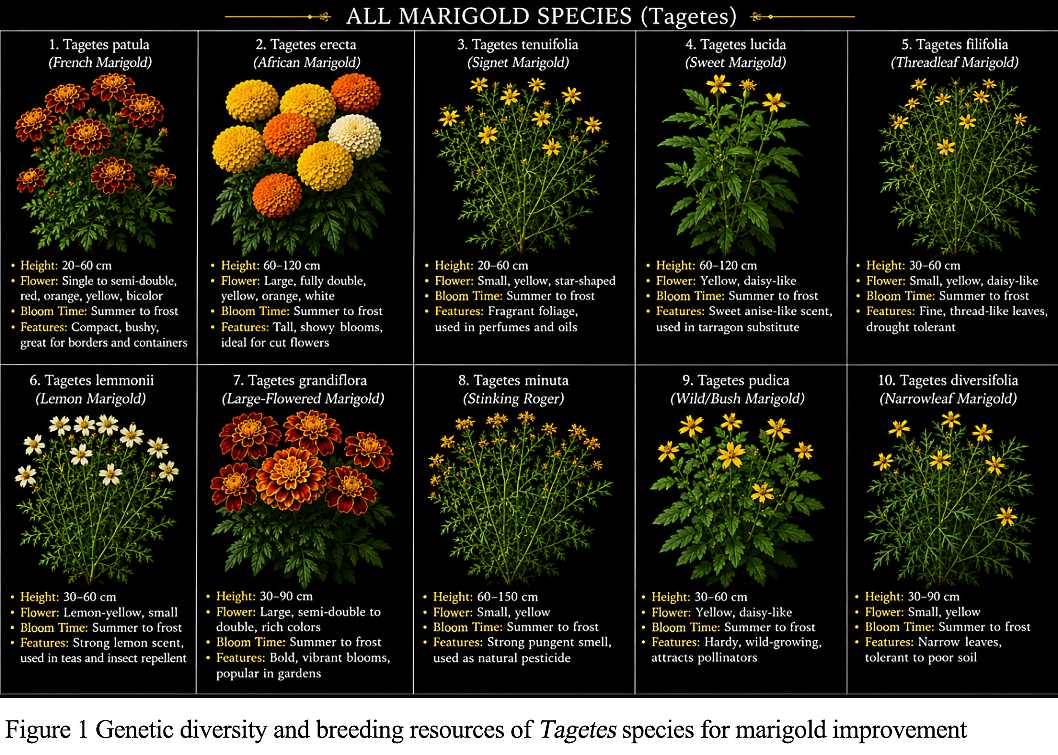
Marigold (Tagetes spp.) is native to South and Central America, particularly Mexico, and belongs to the family Asteraceae (Compositae) (Shafiee et al., 2023). From Mexico, it spread to different parts of the world during the early sixteenth century. The genus Tagetes was named after Tages, an Etruscan demigod associated with wisdom and beauty. The genus comprises approximately 33 species, of which Tagetes erecta (African marigold), Tagetes patula (French marigold), and Tagetes minuta are the most widely cultivated (Figure 1). Marigold plants are generally erect, vigorous, and fast-growing, with heights ranging from 30 to 90 cm. Their flowers vary in colour from deep orange and golden yellow to bright yellow and lemon yellow, with flower diameters typically ranging from 4 to 6 cm (Udchachon et al., 2021).
|
Figure 1 Genetic diversity and breeding resources of Tagetes species for marigold improvement |
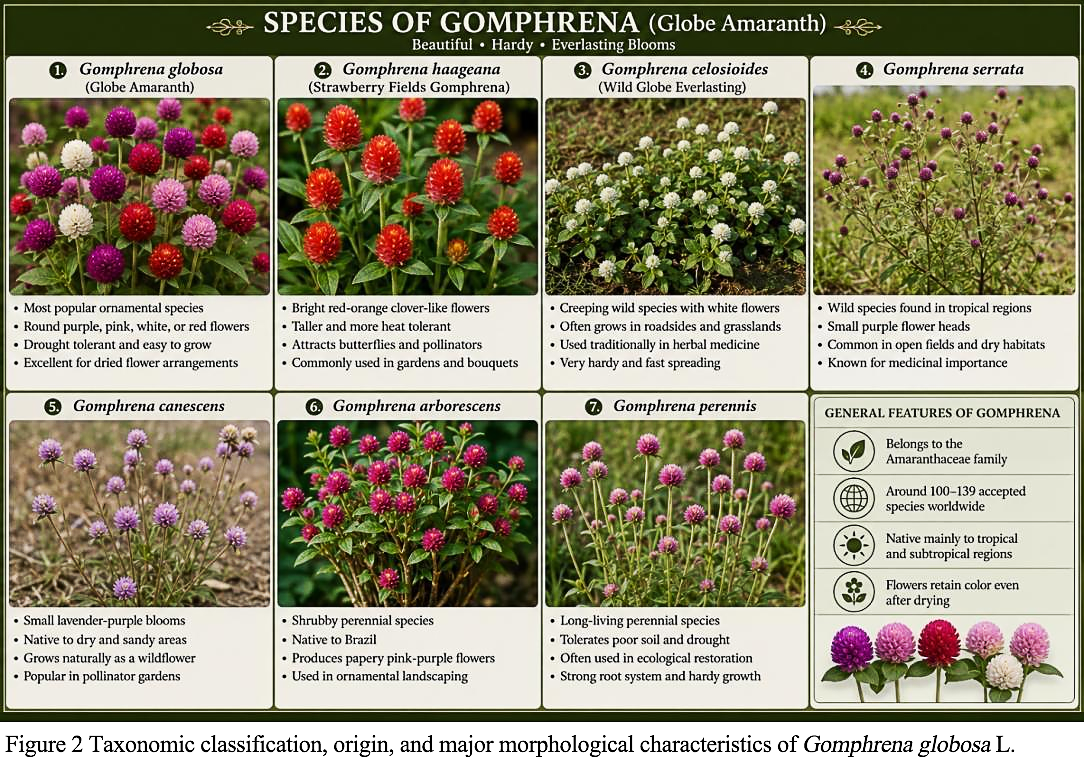
Gomphrena (Gomphrena globosa L.) is native to Central America, particularly Guatemala and Panama, and belongs to the family Amaranthaceae (Akbar and Sahare, 2024). The genus Gomphrena comprises approximately 120–140 species of annual and perennial herbs distributed across the Americas, Australia, and the Indo-Malayan region, with G. globosa being the most widely cultivated ornamental species (Figure 2). In Brazil alone, about 46 species have been documented across diverse ecosystems, including cerrado savannas, open grasslands (campo limpo), rocky highland grasslands (campo rupestre), and caatinga vegetation, whereas relatively few species occur in forest habitats (Vieira et al., 1994). Most species are herbaceous or shrubby and possess specialized underground structures, such as woody xylopodia or fleshy tuber-like roots, which facilitate survival under adverse environmental conditions. Owing to its attractive spherical inflorescences, excellent colour retention after drying, and wide environmental adaptability, G. globosa has become an important ornamental crop cultivated worldwide.
|
Figure 2 Taxonomic classification, origin, and major morphological characteristics of Gomphrena globosa L. |
3 Advances in Marigold (Tagetes spp.) Production Technology
The increasing commercial demand for marigold flowers in ornamental horticulture, the pharmaceutical industry, poultry feed, and natural pigment extraction has accelerated research on improving production technologies. Advances in breeding, biotechnology, cultivation practices, nutrient management, and post-harvest handling have substantially enhanced flower yield, quality, stress tolerance, and production efficiency. Modern production systems increasingly integrate conventional breeding with molecular approaches, tissue culture, precision cultivation, and sustainable crop management to develop high-performing cultivars capable of meeting industrial demands while improving resource-use efficiency (Hussein et al., 2011; Kumar et al., 2016).
3.1 Advancement in hybrid seed production
The discovery of male sterility has greatly expanded opportunities for efficient hybrid seed production in marigold by eliminating the need for labour-intensive manual emasculation. Both genic male sterility (GMS) and cytoplasmic male sterility (CMS) systems have been successfully utilized in breeding programmes. Apetaloid female lines are controlled primarily by GMS and are widely used in commercial hybrid seed production because they are easily distinguishable during flowering. In contrast, petaloid female lines are governed by CMS, although partial fertility may occasionally occur, resulting in gynodioecious or gynomonoecious reproductive systems (Sindhuja et al., 2018; Sukwiwat et al., 2023). These male sterile systems facilitate efficient cross-pollination, increase hybrid seed purity, and reduce production costs, thereby significantly improving commercial hybrid seed production (Dedhia et al., 2022).
3.2 Conventional breeding advances
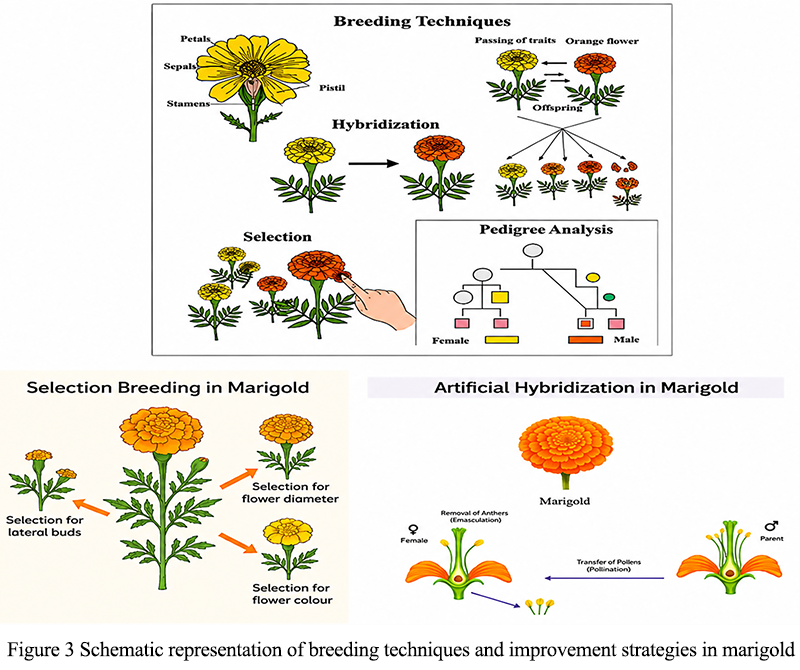
Conventional breeding has played a central role in improving marigold cultivars through mass selection, pedigree selection, pure-line selection, hybridization, and mutation breeding. Mass selection has been successfully employed to develop open-pollinated cultivars such as 'Calcutta Orange' and 'Arka Pari', whereas pedigree and pure-line selection have improved flower yield, colour intensity, carotenoid content, plant architecture, and resistance to diseases such as Fusarium wilt (Ayiecho and Nyabundi, 2025; Venkatesan and Ramesh Kumar, 2025). Hybridization has resulted in superior F1 hybrids, including 'Arka Abhi', 'Arka Shubha', and 'Arka Agni', characterized by larger flowers, improved shelf life, and enhanced transportability. Mutation breeding using gamma rays and ethyl methanesulfonate (EMS) has generated valuable genetic variability, including novel flower colours and improved ornamental traits, thereby providing useful breeding materials for future cultivar development.
Biotechnological approaches, particularly tissue culture, provide opportunities for rapid multiplication and conservation of superior gomphrena germplasm (Figure 3). Successful callus induction has been achieved using hypocotyl explants cultured on Murashige and Skoog (MS) medium supplemented with appropriate concentrations of sucrose, NAA, and BA. These protocols facilitate efficient shoot regeneration and root development, thereby supporting large-scale propagation and conservation of elite genotypes (Ruiz and Valadez, 1985). Nevertheless, commercial application remains constrained by relatively high production costs, specialized laboratory requirements and the need for efficient acclimatization protocols.
|
Figure 3 Schematic representation of breeding techniques and improvement strategies in marigold |
3.3 Modern biotechnology
Modern biotechnology has substantially accelerated marigold improvement by complementing conventional breeding approaches. Marker-assisted selection enables the identification of quantitative trait loci associated with economically important traits such as flower size, yield, and male sterility, thereby increasing breeding efficiency. The development of SCAR markers has facilitated the rapid identification of desirable male sterile lines for hybrid seed production (Joshi et al., 2024). Genome editing using CRISPR-Cas9 also offers considerable potential for improving flower colour, pest resistance, and abiotic stress tolerance. Although its application in marigold remains limited, successful modification of ornamental traits in related species demonstrates promising opportunities for future genetic improvement (Verma et al., 2023; Nishihara et al., 2024). Furthermore, Agrobacterium-mediated transformation has been explored to enhance pyrethrin production, highlighting the potential of genetic engineering for value addition.
3.4 Tissue culture and micropropagation in marigold breeding
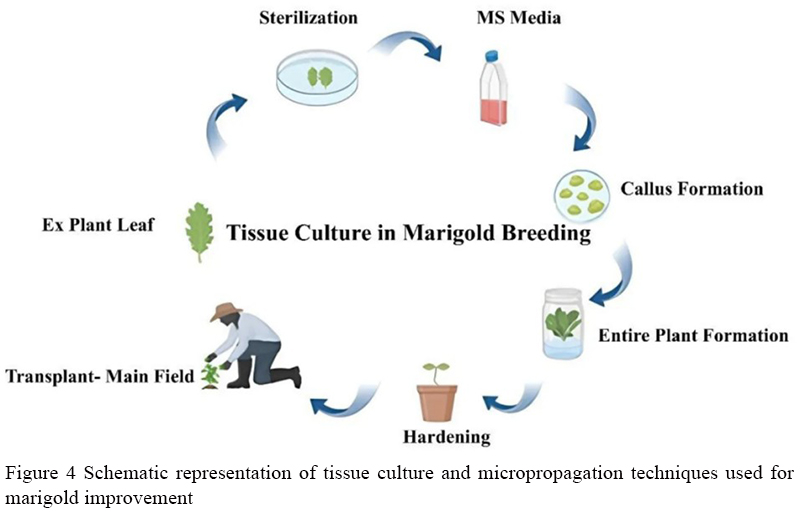
Tissue culture, particularly in vitro propagation, provides a rapid and efficient method for large-scale multiplication of marigold while ensuring uniform expression of desirable traits (Figure 4). Advanced protocols enable regeneration from various explants such as shoot tips, leaves, and floral tissues. These micropropagation techniques have become valuable tools in modern breeding programs for quick multiplication of elite genotypes, conservation of genetic resources, and improvement of breeding efficiency.
|
Figure 4 Schematic representation of tissue culture and micropropagation techniques used for marigold improvement |
Natural pigments such as carotenoids have important antioxidant, functional, medicinal, and nutraceutical properties, making them more valuable than synthetic colorants. Marigold (Tagetes erecta) is an important ornamental plant and a rich source of carotenoids. In vitro callus cultures of marigold can be induced from leaf explants using MS medium supplemented with 2,4-D and BA hormones. Marigold callus cultures can continuously accumulate pigments even after repeated subculturing, indicating stable pigment production potential (Benítez-García et al., 2014). Somaclonal variation has been effectively utilized to develop drought-tolerant marigold lines.exposing marigold tissue cultures to osmotic stress using mannitol led to the selection of drought-tolerant genotypes. These selected clones exhibited higher proline and soluble sugar content, contributing to enhanced drought tolerance. Such drought-resistant lines are particularly valuable in regions facing water scarcity, ensuring sustainable marigold cultivation (Ferreira et al., 2023).
Despite its considerable advantages, commercial application of tissue culture in marigold remains constrained by several factors. Large-scale micropropagation requires specialized laboratory facilities, skilled personnel, and relatively high production costs, limiting its adoption by commercial nurseries. In addition, successful acclimatization of regenerated plantlets under field conditions remains a major challenge, and prolonged in vitro culture may occasionally induce somaclonal variation that affects genetic uniformity. Consequently, further optimization of propagation protocols and cost-effective production systems is required before tissue culture can be widely adopted for commercial-scale marigold production.
3.5 Achievements in marigold breeding
The growing needs of the ornamental, industrial, and religious sectors necessitate the development of highly productive cultivars. To address this, modern research has produced superior hybrids specifically 'Arka Abhi', 'Arka Bhanu', and 'Arka Vibha' which demonstrate remarkably higher flower production. Beyond simple yield increases, these new varieties offer practical advantages like increased durability during transport and a longer shelf life, which ranges from 8 to 9 days. These hybrids have shown potential for commercial cultivation in various agro-climatic zones, enhancing farmer incomes and market availability (Venkatesan and Ramesh Kumar, 2025).
Commercial marigold varieties now have better tolerance to these risks due to breeding operations that have successfully included resistance genes from wild cultivars (Babaei et al., 2021). Abiotic stresses, such as drought, salinity, and heavy metal contamination, also adversely affect marigold growth and essential oil quality. Elevated levels of these stresses can result in the production of reactive oxygen species (ROS), which are harmful to plant cells. Research has shown that drought-responsive genes play a crucial role in regulating important physiological and biochemical processes, supporting the development of drought-tolerant hybrids (Kumar et al., 2023). In a similar way, salinity-tolerant cultivars are being improved by focusing on traits such as osmotic regulation and ion balance, which help maintain productivity under saline conditions (Ma et al., 2020). Advanced biotechnological approaches, including CRISPR-Cas9 and transcriptomic analysis, are increasingly being used to enhance stress tolerance in plants through precise genome editing and in-depth study of stress-response mechanisms. These technologies have enabled the discovery of key genes involved in abiotic stress resistance, accelerating the development of improved resilient varieties (Xu et al., 2020).
Quality traits such as vibrant color, longer vase life, and higher carotenoid content have been prioritized in recent breeding efforts. Varieties like ‘Arka Shubha’, known for its high carotenoid content, have been developed with industrial applications in mind. These varieties offer high yields of carotenoids, which are important for use in the pharmaceutical, food, and cosmetic industries. It is found that ‘Arka Shubha’ produced significantly higher levels of lutein and zeaxanthin, which are valuable carotenoids known for their antioxidant properties. These carotenoids have widespread applications in supplements, skincare products, and natural food colorants (Udchachon et al., 2021).
3.6 Breeding techniques and marigold released
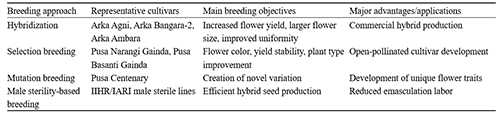
Breeding programs in marigold have resulted in the development of diverse cultivars with improved flower yield, color intensity, plant architecture, and commercial adaptability. Different breeding approaches, including hybridization, selection, mutation breeding, and male-sterility-based breeding have contributed to the release of improved cultivars in India and other regions (Table 1). Hybrid cultivars generally provide advantages in yield and flower quality, whereas selection and mutation breeding have expanded genetic diversity for specific ornamental traits.
|
Table 1 Representative marigold cultivars developed through different breeding approaches and their major applications |
3.7 Integrated post-harvest technology
Post-harvest management is a critical component of marigold production because flowers are highly perishable and rapidly lose their commercial value after harvest. Recent advances in cold chain management, value addition, and processing technologies have significantly improved flower quality, shelf life, and industrial utilization. Low-temperature storage combined with high relative humidity effectively reduces respiration rate, ethylene production, moisture loss, and microbial deterioration, thereby maintaining flower freshness and extending marketability. Studies have demonstrated that storing marigold flowers at 4 °C with approximately 95% relative humidity can extend shelf life to about 8 days, compared with only 3 days under ambient conditions, while preserving flower colour, firmness, and overall quality (Dalavi et al., 2025). Such cold-chain technologies are particularly beneficial for long-distance transportation and export marketing.
In addition to fresh flower marketing, recent technological advances have enhanced the industrial utilization of marigold through value-added processing. Advanced chromatographic techniques enable the extraction of high-purity lutein (up to 97.1%), which is widely used in pharmaceutical products, nutraceuticals, poultry feed, cosmetics, and natural food colourants. Likewise, solid-state fermentation of fresh flowers with calcium lactate prior to drying has been reported to improve β-carotene retention and increase the recovery of high-quality value-added powders suitable for commercial processing (Hayat, 2024). These post-harvest innovations not only minimize economic losses but also diversify the industrial applications of marigold, thereby increasing its commercial profitability.
3.8 Advancement in cultivation practices
Modern cultivation practices have considerably improved marigold productivity through the optimization of plant architecture, resource utilization, irrigation management, and environmental control. Among these practices, pinching remains one of the most effective cultural operations for regulating plant growth and flowering. Pinching suppresses apical dominance by reducing auxin accumulation at the shoot apex, thereby stimulating lateral bud development, increasing branch formation, and improving assimilate distribution towards reproductive organs. Early pinching at 14 days after transplanting promotes earlier flowering, whereas delayed pinching at approximately 28 days after transplanting generally produces greater plant height, more branches, and a higher number of flowers, ultimately resulting in superior flower yield.
Plant growth regulators (PGRs) further complement cultivation management by regulating physiological and biochemical processes associated with vegetative growth and flowering. Gibberellic acid (GA3) enhances stem elongation, cell division, and flower initiation, while improving branching and flower size. Research has shown that the application of GA3 at 200 ppm combined with pinching at 14 days after transplanting provides the most favourable combination for promoting early flowering and improving flower production (Isnawati et al., 2023).
Efficient irrigation scheduling has also become an important component of precision marigold production. Irrigation based on Class A pan evaporation (0.75 Epan) improves water-use efficiency by supplying water according to crop demand while minimizing unnecessary water losses. Such precision irrigation systems enhance nutrient uptake, maintain favourable soil moisture, and improve flower yield and economic returns compared with conventional flood irrigation (Chitra et al., 2025).
Recent advances in artificial lighting have further expanded opportunities for controlled-environment production. Light quality regulates photosynthesis, chlorophyll synthesis, photomorphogenesis, and carotenoid biosynthesis through phytochrome- and cryptochrome-mediated signalling pathways. The combined use of red and blue LED lights has been reported to promote balanced vegetative growth, improve pigment accumulation, and enhance flower quality, whereas red light alone significantly increases lutein concentration. These findings demonstrate that manipulating light spectra offers an effective strategy for improving production efficiency, shortening crop duration, and increasing both ornamental and industrial value under protected cultivation systems.
3.9 Advances in nutrient management
Integrated nutrient management has become an essential component of sustainable marigold production. The combined application of biofertilizers such as Azotobacter, phosphate-solubilizing bacteria (PSB), Azospirillum, and arbuscular mycorrhizal fungi with reduced rates of chemical fertilizers improves nutrient availability, root growth, flower yield, and nutrient-use efficiency (Abdulsada et al., 2013). Seedling root dipping in biofertilizer slurry before transplanting enhances early root colonization and nutrient uptake, while integration with farmyard manure or vermicompost further improves soil microbial activity, nutrient cycling, and long-term soil fertility.
3.10 Integrated pest and disease management
Integrated Pest and Disease Management (IPDM) has evolved from reliance on frequent chemical pesticide applications to environmentally sustainable management strategies that combine cultural, biological, mechanical, and chemical approaches. Modern IPDM programmes emphasize preventive management, conservation of beneficial organisms, and judicious pesticide use to minimize environmental impacts while maintaining effective pest suppression.
Recent studies comparing different pest management modules have demonstrated that adaptable IPDM systems integrating neem cake, vermicompost, biological control agents, and selective pesticides effectively reduce populations of thrips, mites, and bud borers (Helicoverpa armigera) while lowering pesticide dependence (Nikita et al., 2026). Such integrated approaches improve crop health by maintaining ecological balance and reducing the likelihood of pesticide resistance development.
Advances in molecular breeding have further strengthened pest and disease management through the identification of quantitative trait loci (QTLs) and marker-assisted selection (MAS) for resistance against important diseases such as powdery mildew and nematodes. The integration of resistant cultivars with biological control and precision crop management provides a more sustainable approach than reliance on chemical control alone.
In addition to its ornamental value, marigold also functions as an effective trap crop in vegetable production systems. According to Parihar et al. (2025), marigold attracts several insect pests and suppresses nematode populations when intercropped with solanaceous crops such as tomato and potato, thereby reducing pest pressure on the main crop. This multifunctional role enhances biodiversity, supports integrated crop protection strategies, and contributes to environmentally sustainable agricultural production.
4 Advancement in Gomphrena Production technology
Recent advances in the production technology of Gomphrena globosa have focused on improving flower yield, quality, post-harvest longevity, and commercial value through the integration of improved cultivation practices, biotechnology, genetic characterization, and value-added processing. Compared with marigold, where breeding technologies are relatively well developed, technological improvements in gomphrena have relied primarily on optimizing agronomic practices, plant growth regulation, substrate management, germplasm evaluation, and post-harvest technologies. These integrated approaches have enhanced production efficiency while supporting the increasing demand for fresh and dried flowers, natural pigments, and pharmaceutical raw materials.
4.1 Cultivation and growth optimization
Cultivation management plays a fundamental role in determining the growth, flowering behaviour, and market quality of Gomphrena globosa. Among various cultural practices, pinching is one of the most effective techniques for regulating plant architecture and increasing flower production. Pinching suppresses apical dominance by reducing auxin concentration in the terminal shoot, thereby promoting lateral bud development, increasing branching, and improving assimilate partitioning toward reproductive organs. Consequently, plants produce more flowering shoots and a greater number of marketable flowers. However, the response to pinching varies among cultivars, production objectives, and environmental conditions. For example, cut flower production generally favours longer stems with limited pinching, whereas potted plant production benefits from increased branching and compact growth. Recent studies have shown that double pinching performed at 20 and 35 days after planting significantly increases productive branches, flower number, and overall yield, although some cultivars may exhibit greater plant height and primary branching without pinching (Saputra et al., 2025).
The comparative effects of pinching on branching, flower production, flower diameter, and stalk length are summarized in Table 2, which demonstrates that appropriate pinching improves overall flower productivity while modifying plant architecture according to production requirements.
|
Table 2 Effects of different pinching treatments on growth and flowering characteristics of Gomphrena globosa Note: Adopted from Rajasekaran et al. (1983) |

Biofertilizer application has also become an important component of sustainable gomphrena cultivation. The combined use of Azotobacter, phosphate-solubilizing bacteria (PSB), and potash-solubilizing bacteria (KSB) enhances nutrient availability through biological nitrogen fixation, phosphorus solubilization, and potassium mobilization. These beneficial microorganisms also improve root development, stimulate phytohormone production, and enhance soil microbial activity, resulting in increased vegetative growth, flower yield, and nutrient-use efficiency (Yaseen et al., 2022). Although biofertilizers reduce dependence on chemical fertilizers and improve soil health, their field performance may vary depending on soil type, environmental conditions, and microbial survival.
Selection of suitable growing substrates further influences flower quality and productivity by improving root aeration, water retention, and nutrient availability. A substrate mixture consisting of garden soil, Baltic peat, and Klasmann-Deilmann TS3 medium has been reported to produce larger flowers, greater fresh and dry flower weight, and higher overall yield than conventional substrates (Zeljković et al., 2021). Nevertheless, the commercial adoption of specialized substrates should also consider production costs, availability of raw materials, environmental sustainability, and feasibility for large-scale cultivation.
4.2 Post-harvest and dehydration techniques
Post-harvest quality is particularly important in gomphrena because the crop is extensively marketed as a dried ornamental flower. Modern dehydration technologies aim to preserve flower colour, shape, texture, and structural integrity while minimizing shrinkage during drying. Among available techniques, hot-air oven drying at 50 °C-55 °C consistently produces superior colour retention and flower quality compared with traditional air drying (Akbar and Sahare, 2024). Embedding flowers in silica gel during drying further improves dehydration efficiency by minimizing moisture loss-induced deformation and preserving flower diameter, colour intensity, and fresh appearance. Although these techniques substantially improve product quality, commercial adoption depends on drying costs, energy requirements, and processing capacity.
4.3 Genetic and morphological improvements
Genetic improvement of gomphrena has increasingly relied on morphological evaluation and molecular characterization to identify superior breeding materials. Variability studies involving diverse genotypes have revealed substantial differences in vegetative growth, flowering behaviour, flower weight, branch number, and flower stalk length. High heritability estimates for these traits indicate that they can be effectively improved through selection, thereby providing opportunities for developing superior cultivars adapted to different production environments.
Molecular marker technologies have further strengthened breeding programmes by enabling accurate characterization of germplasm diversity. Inter-simple sequence repeat (ISSR) markers have detected approximately 67.76% polymorphism among gomphrena genotypes, demonstrating considerable genetic diversity for breeding improved cultivars with enhanced productivity, flower quality, and stress tolerance (Kumar et al., 2023).
4.4 Value addition and extraction
The commercial value of gomphrena extends beyond ornamental use because its flowers contain biologically active compounds with applications in food, pharmaceutical, and cosmetic industries. Recent advances in extraction technologies have focused on improving the recovery of natural pigments, particularly betacyanins, while maintaining their antioxidant activity. Ultrasonic-assisted extraction has proven more efficient than conventional extraction methods by improving pigment recovery, extraction efficiency, and product quality, making the extracts suitable for natural food colourants and functional food products such as cookies (Roriz et al., 2020).
Chemical profiling studies have also demonstrated that gomphrena flowers are rich sources of flavonoids, phenolic compounds, and other antioxidants possessing antimicrobial, anti-inflammatory, and enzyme inhibitory properties (Tang et al., 2022). These findings further expand the industrial potential of gomphrena beyond ornamental horticulture.
4.5 PGR innovation
Plant growth regulators have become valuable tools for improving vegetative growth, flowering, and post-harvest quality in gomphrena. Gibberellic acid (GA3) promotes cell elongation, stem growth, and flower initiation by stimulating cell division and internode elongation, thereby increasing plant height, flower size, and marketable yield. Application of GA3 at 150 ppm has been reported to provide optimum improvement in growth, flower yield, and post-harvest longevity (Sahoo, 2021). Likewise, NAA at 200 ppm accelerates flowering and prolongs the flowering period, whereas higher concentrations of maleic hydrazide reduce plant height by suppressing vegetative growth. Appropriate selection of plant growth regulators should therefore consider cultivar characteristics, production objectives, and environmental conditions to maximize productivity and flower quality.
4.6 High density planting
High-density planting (HDP) of Gomphrena globosa (globe amaranth) in greenhouses is an intensive production technique used to maximize the yield of cut flowers or potted plants per unit area. It focuses on utilizing vertical space, optimizing light, and maintaining high plant populations (in some systems) for uniform, high-quality production.
4.7 Biotechnology
4.7.1 Micropropagation
The application of biotechnology in Gomphrena production, specifically regarding micropropagation, has historically seen limited documentation; however, established protocols now utilize specific tissue culture techniques to enhance multiplication rates. Research indicates that callus induction is most successful when utilizing hypocotyl tissues as explants (Ruiz and Valadez, 1985). These are typically cultured on a basal Murashige and Skoog (MS) medium enriched with sucrose at concentrations of 3%, 5%, or 7%. To achieve successful morphogenesis, a precise hormonal balance is required: a combination of 10-5 M NAA (Naphthaleneacetic acid) and 10-8 M BA (Benzyladenine) effectively induces shoot growth, although higher sucrose levels (5% to 7%) are generally necessary to stimulate concurrent root development. Furthermore, aseptic seedlings provide viable leaf and stem segments which, when placed on gelled MS medium supplemented with BA alone or in combination with auxins, serve as efficient starting points for mass propagation.
4.7.2 Molecular markers
Molecular marker technology has become an important tool for characterizing genetic diversity and supporting breeding programmes in gomphrena. Random Amplified Polymorphic DNA (RAPD) markers have revealed approximately 94.38% polymorphism, confirming the existence of substantial genetic variation among cultivated genotypes (Fatinah et al., 2012). Such information facilitates parent selection, germplasm conservation, and the development of improved cultivars with superior ornamental and agronomic characteristics.
5 Conclusion
Recent technological advancements have transformed the cultivation and commercial production of Tagetes erecta and Gomphrena globosa by improving productivity, quality, and adaptability under diverse growing conditions.In marigold, progress in hybrid seed production, male sterility systems, molecular breeding, tissue culture, and stress-resilient breeding has accelerated the development of superior cultivars suitable for commercial production. Likewise, innovations in gomphrena production, including improved cultivation practices, biofertilizer application, plant growth regulators, high-density planting, and advanced drying technologies, have enhanced flower productivity and value addition.
The integration of biotechnology, precision cultivation, integrated nutrient management, and modern post-harvest handling techniques has contributed to sustainable and profitable flower production systems. Furthermore, the use of environmentally friendly approaches such as biofertilizers, integrated pest management, and efficient irrigation practices supports sustainable floriculture development under changing climatic conditions. Continued research and adoption of these advanced technologies will play a vital role in improving productivity, maintaining flower quality, and strengthening the commercial potential of marigold and gomphrena in both domestic and international markets.
Authors’ contributions
SS, AP and AA were involved in conceptualization, methodology, editing, writing the original draft, manuscript revision and providing the final structure to the manuscript. All authors read and approved the final manuscript.
Akbar S.H., and Sahare H., 2024, Advanced dehydration techniques standardized for flowers of Gomphrena globosa L., Asian Journal of Soil Science and Plant Nutrition, 10(3): 533-539.
https://doi.org/10.9734/ajsspn/2024/v10i3365
Ayiecho P.O., and Nyabundi J.O., 2025, Development of pure line varieties, In: Conventional and Contemporary Practices of Plant Breeding, Cham: Springer Nature Switzerland, pp. 157-173.
https://doi.org/10.1007/978-3-031-74998-8
Babaei K., Moghaddam M., Farhadi N., and Pirbalouti A.G., 2021, Morphological, physiological and phytochemical responses of Mexican marigold (Tagetes minuta L.) to drought stress, Scientia Horticulturae, 284: 110116.
https://doi.org/10.1016/j.scienta.2021.110116
Benítez-García I., Vanegas-Espinoza P.E., Meléndez-Martínez A.J., Heredia F.J., Paredes-López O., and Del Villar-Martínez A.A., 2014, Callus culture development of two varieties of Tagetes erecta and carotenoid production, Electronic Journal of Biotechnology, 17(3): 107-113.
https://doi.org/10.1016/j.ejbt.2014.01.004
Chitra S., Tamilselvi R., and Rajamani K., 2025, Standardization of irrigation and fertigation schedules for optimizing flower yield, water use efficiency and economic returns in chrysanthemum cultivars under semi-arid conditions, Frontiers in Agronomy, 7: 1605713.
https://doi.org/10.3389/fagro.2025.1605713
Dalavi P., Shinde R., and Thakare H., 2025, Enhancement of storage life and visual quality of marigold (Tagetes erecta L.) flowers through cold room storage, Archives of Current Research International, 25(11): 60-68.
https://doi.org/10.9734/acri/2025/v25i111601
Datta S.K., and Singh S., 2008, Marigold and its commercial potential, Applied Botany Abstract, 28(1): 73-93.
Dedhia L., Prakash T., and Rangarajan V., 2022, Diversification of marigold male sterile lines for hybrid seed production, In: Tending Mendel’s Garden for a Perpetual and Bountiful Harvest, Conference proceedings, Indian Institute of Horticultural Research.
Dwiyani R., Sanjaya P.W., Darmawati I.A.P., Laksmiani N.P.L., Redana I.M.B., Yuswanti H., Susrusa K.B., Gunadi I.G.A., Astiningsih A.A.M., Suada I.K., and Wirawan I.G.P., 2023, The evaluation of vitamin C and β carotene of globe amaranth (Gomphrena globosa), a local germplasm of Bali (Indonesia) from two different altitudes, Bali Medical Journal, 12(3): 3448-3452.
https://doi.org/10.15562/bmj.v12i3.5040
Fatinah A.A., Arumingtyas E.L., and Mastuti R., 2012, Genetic diversity study among six genera of Amaranth Family found in Malang based on RAPD marker, Journal of Tropical Life Science, 2(3): 81-86.
https://doi.org/10.11594/jtls.02.03.05
Ferreira M.d.S., Rocha A.d.J., Nascimento F.d.S., Oliveira W.D.d.S., Soares J.M.d.S., Rebouças T.A., et al., 2023, The role of somaclonal variation in plant genetic improvement: A systematic review, Agronomy, 13(3): 730.
https://doi.org/10.3390/agronomy13030730
Floriculture Association Nepal, 2023, The versatile marigold: A symbol of tradition and utility in Nepali culture, Nepalese Floriculture, 27.
Gaenszle M., Bickel B., Banjade G., Lieven E., Paudyal N.P., Rai I.P., Rai M., Rai N.K., Stoll S., and Yadava Y.P., 2005, Worshipping the king god: A preliminary analysis of Chintang ritual language in the invocation of Rajdeu, In: Contemporary Issues in Nepalese Linguistics, Kathmandu, pp. 33-47.
Hayat A., 2024, Studies on value addition of marigold flowers, Doctoral dissertation, Bidhan Chandra Krishi Viswavidyalaya, Mohanpur, Nadia, Krishikosh.
https://krishikosh.egranth.ac.in/handle/1/5810219263
Hussein M.M., Sakr R.A., Badr L.A., and Mashat K.M.A.L., 2011, Effect of some fertilizers on botanical and chemical characteristics of pot marigold plant (Calendula officinalis L.), Journal of Horticultural Science and Ornamental Plants, 3(3): 220-231.
Isnawati L., Setyaningrum T., Herastuti H., and Hasanov S., 2023, The growth and yield of marigold flowers (Tagetes erecta L.) on gibberellins concentration and pinching time, BIO Web of Conferences, 69: 01020.
https://doi.org/10.1051/bioconf/20236901020
Joshi A., Kumar A., Adhikari S., and Saroj R., 2024, Marker-assisted selection: Strategy for biotic and abiotic stress tolerance in plants, In: Climate-Resilient Agriculture, Apple Academic Press, pp. 137-191.
https://doi.org/10.1201/9781003455271-7
Jyothi K., Goud C.R., Girwani A., and Kumar T.S., 2018, Studies on the effect of planting dates and levels of pinching on growth, flowering and yield in marigold (Tagetes erecta) cv. Arka Agni, International Journal of Current Microbiology and Applied Sciences, 7(11): 2705-2713.
https://doi.org/10.20546/ijcmas.2018.711.309
Kumar D.L., Kulkarni B.S., Kumar P., and Chittapur R.B., 2023, Morphological and molecular characterization of Gomphrena genotypes, Indian Journal of Horticulture, 80(4): 326-332.
https://doi.org/10.58993/ijh/2023.80.4.4
Kumar K.R., 2017, Studies on plant regeneration in marigold (Tagetes spp.) through in vitro culture of male and female gametophytes, Plant Cell, Tissue and Organ Culture, 143(3): 549-564.
https://doi.org/10.1007/s11240-020-01940-0
Kumar N., Kumar J., Singh J.P., Kaushik H., and Singh R.K., 2016, Effect of GA3 and Azotobacter on growth and flowering in African marigold (Tagetes erecta L.) cv. Pusa Narangi Gainda, The Asian Journal of Horticulture, 11(2): 382-386.
https://doi.org/10.15740/HAS/TAJH/11.2/382-386
Kumar R.V., Bharathi T.U., Bindu K.H., Laxman R.H., Venugopalan R., Reddy P.V.R., and Prakash T., 2025, Impact of staggered transplanting of pollen parents and repeated pollination methods in hybrid seed production of marigold (Tagetes erecta L.), Journal of Horticultural Sciences, 20(1).
https://doi.org/10.24154/jhs.v20i1.3619
Ma Y., Dias M.C., and Freitas H., 2020, Drought and salinity stress responses and microbe-induced tolerance in plants, Frontiers in Plant Science, 11: 591911.
https://doi.org/10.3389/fpls.2020.591911
Nikita L.T., et al., 2026, Evaluation of integrated pest management (IPM) modules for the management of important insect and mite pests in marigold, Journal of Advances in Biology and Biotechnology, 29(1): 850-860.
https://doi.org/10.9734/jabb/2026/v29i13586
Nishihara M., Hirabuchi A., Teshima T., Uesugi S., and Takahashi H., 2024, Flower color modification in Torenia fournieri by genetic engineering of betacyanin pigments, BMC Plant Biology, 24(1): 614.
https://doi.org/10.1186/s12870-024-05284-1
Parihar M., Dhar S., and Sahu P., 2025, Marigold as a trap crop: Efficacy and mechanism for sustainable pest and nematode management in solanaceous vegetable crops: A review, Journal of Ornamental Horticulture, 28(1): 20-28.
https://doi.org/10.5958/2249-880X.2025.00005.3
Quintero-Ruiz A., and Valadez J.M., 1985, Effects of different growth factors on Gomphrena globosa callus tissue, Journal of Natural Products, 48(6): 976-980.
https://doi.org/10.1021/np50042a018
Rajasekaran K., Shanmugavelu K.G., and Muthuswamy S., 1983, Effect of pinching on growth and yield of Gomphrena globosa L., South Indian Horticulture, 31(1): 304-306.
Roriz C.L., Heleno S.A., Carocho M., Rodrigues P., Pinela J., Dias M.I., Fernandes I.P., Barreiro M.F., Morales P., Barros L., and Ferreira I.C.F.R., 2020, Betacyanins from Gomphrena globosa L. flowers: Incorporation in cookies as natural colouring agents, Food Chemistry, 329: 127178.
https://doi.org/10.1016/j.foodchem.2020.127178
Sahoo D., 2021, Effect of plant growth regulators on growth and flowering of gomphrena (Gomphrena globosa L.), Master’s thesis, Odisha University of Agriculture and Technology, Krishikosh.
https://krishikosh.egranth.ac.in/items/506ed976-a314-4635-bb6a-9b9b583f489f
Saputra G.M., Kalsum U., and Kurniasih R., 2025, The effect of pinching on the growth and yield of purple globe amaranth (Gomphrena globosa), JERAMI Indonesian Journal of Crop Science, 8(2): 72-79.
https://doi.org/10.25077/jijcs.v8i2.201
Shafiee R., Abdollahi M.R., Mirzaie-Asl A., Moosavi S.S., and Sarikhani H., 2023, Effect of different factors on androgenesis induction in anther culture of African marigold (Tagetes erecta) and French marigold (Tagetes patula), Journal of Horticultural Science.
Sindhuja S., Amarapalli G., and Saidaiah P., 2018, Recent advances in male sterility and its exploitation in marigold, In: Research Trends in Horticulture Sciences, Akinik Publishing, pp. 91-106.
Sukwiwat K., Kumchai J., Bundithya W., and Potapohn N., 2023, Apetaloid and petaloid female performance on horticultural characteristics of F1 American marigold (Tagetes erecta L.) hybrids, SABRAO Journal of Breeding and Genetics, 55(5): 1754-1767.
https://doi.org/10.54910/sabrao2023.55.5.27
Tang S.R., Sun Y.X., Gu T.T., Cao F.F., Shen Y.B., He J.P., Xie Z.X., and Li C., 2022, Phenolic compounds from Gomphrena globosa L.: Phytochemical analysis, antioxidant, antimicrobial, and enzyme inhibitory activities in vitro, CyTA - Journal of Food, 20(1): 218-227.
https://doi.org/10.1080/19476337.2022.2125584
Udchachon S., Pongmanee K., Boonruangrod R., Attamangkune S., and Ruangpanit Y., 2021, Effect of marigold-derived products as pigment source on growth performance, antioxidant activity and liver enzymes of broiler chickens, Agriculture and Natural Resources, 55(6): 925-934.
https://doi.org/10.34044/j.anres.2021.55.6.03
Venkatesan D., and Ramesh Kumar S., 2025, Marigold breeding in India: A comprehensive review of genetic advances, techniques and future prospects, Frontiers in Plant Science, 16: 1619375.
https://doi.org/10.3389/fpls.2025.1619375
Verma V., Kumar A., Partap M., Thakur M., and Bhargava B., 2023, CRISPR-Cas: A robust technology for enhancing consumer-preferred commercial traits in crops, Frontiers in Plant Science, 14: 1122940.
https://doi.org/10.3389/fpls.2023.1122940
Vieira C.C.J., Mercier H., Chu E.P., and Figueiredo-Ribeiro R.C.L., 1994, Gomphrena species (globe amaranth): In vitro culture and production of secondary metabolites, In: Bajaj Y.P.S. ed., Medicinal and Aromatic Plants VII, Springer, pp. 257-270.
https://doi.org/10.1007/978-3-662-30369-6_17
Xu J., Kang B.C., Naing A.H., Bae S.J., Kim J.S., Kim H., et al., 2020, CRISPR/Cas9-mediated editing of 1-aminocyclopropane-1-carboxylate oxidase1 enhances Petunia flower longevity, Plant Biotechnology Journal, 18: 287-297.
https://doi.org/10.1111/pbi.13197
Yaseen T., Slathia D., and Farooq I., 2022, Improving floral characteristics and yield of globe amaranth (Gomphrena globosa L.) through pinching and application of bio fertilizers and its impact on soil fertility, Journal of Pharmaceutical Innovation, 11: 425-430.
https://doi.org/10.13140/RG.2.2.19073.74087
Zeljković S., Ećim T., Davidović Gidas J., and Mladenovic E., 2021, Effects of different substrates on growth and development of globe amaranth (Gomphrena globosa L.), Agroznanje, 22(4): 107-116.
https://doi.org/10.7251/AGREN2104107Z
Zhang H., Song L., Li L., Xin H., Cui R., Li Z., Zhao S., and Wei Z., 2022, Interspecific hybridization with African marigold (Tagetes erecta) can improve flower-related performance in French marigold (T. patula), Notulae Botanicae Horti Agrobotanici Cluj-Napoca, 50(4): 12808.
https://doi.org/10.15835/nbha50312808


. PDF(858KB)
. HTML
Associated material
. Readers' comments
Other articles by authors
. Sonali Singh

. Abhishek Pokhrel
. Alisha Adhikari
Related articles
. Genetic improvement
. Hybrid breeding
. Micropropagation
. Postharvest management
. Ornamental horticulture
. Sustainable floriculture
Tools
. Email to a friend
. Post a comment